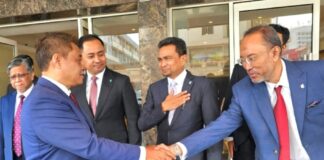
KOTA KINABALU: Sabah’s economy grew by 5.1 per cent last year, its strongest performance in six years, with gross domestic product (GDP) reaching RM88.8 billion, said Chief Minister Datuk Seri Panglima Haji Hajiji Haji Noor.
He said the growth was supported by the services sector, which expanded by 4.5 per cent, manufacturing (five per cent) and construction (28.3 per cent).
“Sabah has momentum. Our task now is to turn it into stronger local businesses, highervalue industries, better jobs and opportunities for communities across the state,” he said.
Hajiji said this was also the focus of the Sabah Maju Jaya (SMJ) 2.0 development roadmap for 2026 to 2030, which emphasised improving competitiveness, raising productivity and creating greater value.
He said this at the Kembara Borneo 2026, Sabah Edition, organised by the Securities Commission Malaysia (SC) at the Magellan Sutera Harbour Resort here today.
Deputy Chief Minister II/Finance Minister Datuk Seri Panglima Masidi Manjun delivered his speech.
Hajiji said the State’s record development ceiling of RM12.02 billion under the 13th Malaysia Plan, covering 933 new projects and 240 extension projects, would further strengthen Sabah’s competitiveness and attractiveness to investors.
The Chief Minister said that while SMJ 1.0 focused on recovery, stabilisation, and restructuring after the pandemic, SMJ 2.0 would build on that foundation to ensure development brought tangible benefits to the people through better opportunities, stronger livelihoods, and improved public services.
“Our aspiration is not only to attract businesses to Sabah. We also want to help Sabahbased companies grow into national, regional and global champions.
“That means nurturing creativity, resilience and entrepreneurship, especially among our young people,” he said.Hajiji reiterated that Sabah has significant economic potential in agriculture, the Blue Economy and downstream industries, supported by its natural resources, biodiversity and strategic location.
The Blue Economy also offered considerable opportunities in modern fisheries, marine biotechnology and nature-based tourism, he said, adding that under SMJ 2.0, the sector had the potential to generate up to RM3.25 billion in additional income annually.
He said agriculture must move beyond primary production toward modern, high-quality practices supported by wider adoption of agri-technology to raise productivity and strengthen food security.
However, Hajiji stressed that increasing production alone was insufficient, as Sabah must also create and retain more value locally through technology transfer, innovation, skills development and greater participation by local businesses in downstream industries.
He said Sabah’s strategic location at the heart of Borneo, close to Brunei Darussalam, Indonesia and the Philippines, also positioned it as a natural gateway for trade, investment and tourism across BIMP-EAGA and the wider ASEAN region.
To realise these opportunities, Hajiji said Sabah businesses must have greater access to capital, expertise and investment networks to enable them to expand into national, regional and global markets.
He said the State Government welcomed the SC’s efforts to broaden financing options for Sabah businesses through equity crowdfunding, peer-to-peer financing, coinvestment, private capital and the stock market.
“We are particularly encouraged by initiatives connecting agribusinesses with financing platforms, venture capital and private equity investors.
“We also value the Food Security Scheme under the Malaysia Co-Investment Fund, or MyCIF. By co-investing RM1 for every RM2 raised from private investors, it supports businesses in agriculture, agri-technology and the bioeconomy,” he said.
He said entrepreneurs and companies need suitable financing at different stages of development, whether for downstream processing, agri-technology, aquaculture, or maritime logistics.
Hajiji also urged local entrepreneurs to strengthen their financial management, corporate governance and business planning to improve their readiness to attract investment.
“Start preparing now for the capital you hope to raise. Keep proper financial records and strengthen your governance and management.
“Be ready to explain how your business earns revenue, how you will use the funds and how you will manage risks. Investors need to understand your business before they can support it,” he said.
He also invited investors, financiers and capital market intermediaries to explore opportunities in Sabah’s farms, processing plants, aquaculture sites, factories and tourism businesses.