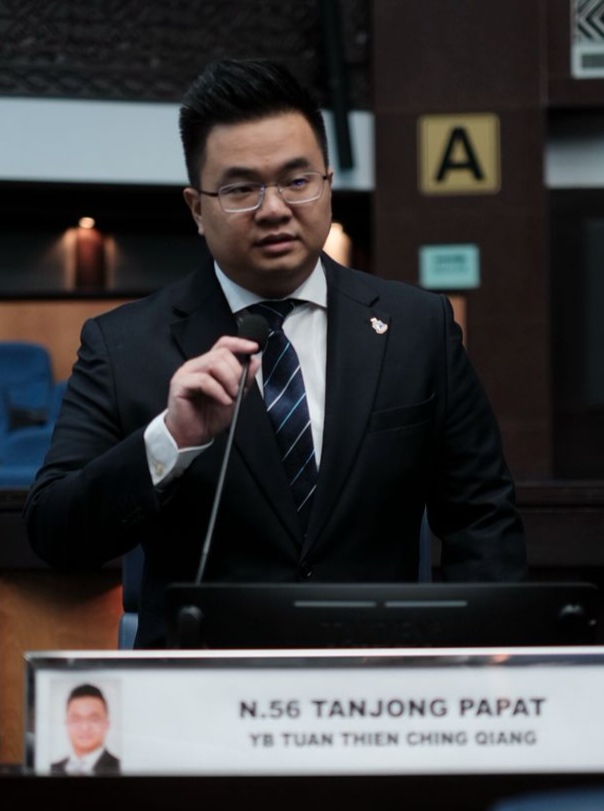
Media Statement by Alex Thien, Tanjong Papat Assemblyman
Sabah’s Water Future Must Be Built on Facts, Transparency and Sound Engineering
SANDAKAN: This clarification is made in response to recent media reporting suggesting that Sabah’s water crisis has reached a critical level, with references to unusually high NRW losses and large-scale river discharge estimates associated with the Ulu Padas Water Supply Scheme. While the urgency of addressing water security is acknowledged, it is precisely because of the scale of such claims that technical accuracy and transparency become even more important.
Alex Thien, Tanjong Papat Assemblyman and Parti Warisan representative, today called for greater transparency and technical accountability regarding Sabah’s water infrastructure planning, particularly in relation to claims surrounding Non-Revenue Water (NRW) losses and the proposed Ulu Padas Water Supply Scheme.
The recent article published in The Star concerning Sabah’s water crisis and the proposed Ulu Padas Water Supply Scheme has brought renewed attention to the critical issue of Sabah’s long-term water security. While the discussion is timely and necessary, several claims reported in the article warrant closer technical scrutiny and greater public clarification.
One particular claim concerns the reported level of Non-Revenue Water (NRW) losses in Sabah. The article stated that Sabah is losing approximately 7,195 million litres per day (MLD) through NRW. This figure requires immediate clarification, as Sabah’s current total treated water production capacity from all operational water treatment plants statewide is estimated to be approximately 1,500 MLD.
From a technical and engineering standpoint, it is impossible for NRW losses to exceed the total volume of treated water being produced and distributed. NRW refers specifically to treated water losses occurring within the distribution system due to leakage, pipe bursts, illegal connections, meter inaccuracies, operational inefficiencies, and storage losses. As such, NRW figures must logically and mathematically fall within the actual treated water production volume.
If the reported figure was intended to represent cumulative annual losses, financial valuation, or future projections, this should have been clearly explained. Public statements involving critical infrastructure must be based on verified engineering data, correct units of measurement, and transparent methodologies to avoid public misunderstanding and maintain confidence in policymaking.
Beyond the NRW issue, there is an equally important need for transparency regarding the technical basis of the proposed Ulu Padas Water Supply Scheme.
Public discussions have repeatedly referred to an estimated 6,000 MLD discharge potential from the Padas River system. However, important questions remain unanswered regarding how this figure was derived and whether it is supported by comprehensive hydrological and engineering assessments.
It remains unclear whether the figure represents average river flow, dependable yield during dry seasons, flood-season discharge, or the long-term sustainable extraction capacity of the river basin. There has also been little public explanation as to whether the underlying hydrological modelling incorporates climate change projections, prolonged drought scenarios, El Niño impacts, river sedimentation risks, or environmental flow requirements necessary to protect downstream ecosystems and communities.
Furthermore, it is not publicly known whether independent engineering peer reviews have been conducted, or whether the feasibility studies, hydraulic analyses, environmental impact assessments, and economic evaluations have been fully disclosed.
Projects of this scale involve billions of ringgit in public expenditure and create long-term operational and financial liabilities. Such investments must be subjected to the highest standards of technical transparency and public accountability.
Decisions of this magnitude should not be confined solely to Cabinet deliberations, particularly when specialised expertise in water engineering, hydrology, hydraulic modelling, climate resilience planning, and integrated river basin management may not necessarily be represented. Sound engineering governance requires independent technical review, stakeholder consultation, public disclosure, and professional scrutiny before implementation.
If comprehensive studies have already been completed, these documents should be made publicly accessible. Sabahans have a legitimate right to understand the scientific, technical, environmental, and financial justifications behind what may become one of the largest water infrastructure investments in the state’s history.
The proposal to construct a major water treatment plant in Beaufort and transport treated water approximately 200 kilometres to Kota Kinabalu through long-distance transmission pipelines also deserves deeper technical and economic evaluation.
Long-distance bulk water transfer systems involve substantial capital expenditure, high pumping energy requirements, pressure management complexities, elevated NRW risks, operational vulnerabilities, maintenance challenges, and significant future replacement liabilities.
For this reason, alternative water resource strategies should be assessed with equal seriousness.
One option that deserves detailed consideration is the development of coastal reservoirs along Sabah’s west coast corridor near Kota Kinabalu. Coastal reservoir technology has been successfully implemented in several water-stressed coastal regions internationally. These systems capture and store freshwater near river mouths before it is discharged into the sea, thereby reducing dependence on long-distance inland transfer infrastructure.
A west coast coastal reservoir approach may offer several potential advantages, including shorter transmission distances, lower pumping costs, direct integration with existing Kota Kinabalu distribution networks, reduced operational energy requirements, and lower exposure to inland pipeline failures.
From a risk management and infrastructure resilience perspective, all proposed solutions should be evaluated against multiple future scenarios, including prolonged drought conditions, climate variability, population growth, industrial expansion, flood impacts on intake structures, and system redundancy during infrastructure failures.
Engineering decisions should never rely solely on maximum theoretical discharge values. Sustainable water planning depends on dependable yield analysis under worst-case hydrological conditions. A river may exhibit very high discharge during monsoon periods but experience significantly reduced flows during prolonged dry seasons. Designing critical urban water infrastructure based on optimistic flow assumptions without adequate resilience margins may expose future generations to serious supply risks.
Sabah urgently needs sustainable, reliable, and technically sound water solutions. However, every proposed solution must be supported by transparent scientific evidence, independent engineering assessment, and meaningful public engagement.
Water security is not merely a political issue. It is fundamentally a matter of public safety, economic sustainability, environmental stewardship, and intergenerational responsibility.
Alex Thien stressed that the people of Sabah deserve full disclosure, professional accountability, and evidence-based planning before billions of ringgit of public funds are committed to long-term infrastructure projects whose technical assumptions and economic justifications have yet to be openly scrutinised by the broader engineering and scientific community.
“Sabahans are not asking for less development. We are asking for better development—development that is backed by sound science, rigorous engineering, transparency, and accountability. Before committing billions of ringgit WARISAN REP CALLS FOR FULL DISCLOSURE ON ULU PADAS WATER PROJECT AND NRW CLAIMS
Sabah’s Water Future Must Be Built on Facts, Transparency and Sound Engineering
This clarification is made in response to recent media reporting suggesting that Sabah’s water crisis has reached a critical level, with references to unusually high NRW losses and large-scale river discharge estimates associated with the Ulu Padas Water Supply Scheme. While the urgency of addressing water security is acknowledged, it is precisely because of the scale of such claims that technical accuracy and transparency become even more important.
Alex Thien, Tanjong Papat Assemblyman and Parti Warisan representative, today called for greater transparency and technical accountability regarding Sabah’s water infrastructure planning, particularly in relation to claims surrounding Non-Revenue Water (NRW) losses and the proposed Ulu Padas Water Supply Scheme.
The recent article published in The Star concerning Sabah’s water crisis and the proposed Ulu Padas Water Supply Scheme has brought renewed attention to the critical issue of Sabah’s long-term water security. While the discussion is timely and necessary, several claims reported in the article warrant closer technical scrutiny and greater public clarification.
One particular claim concerns the reported level of Non-Revenue Water (NRW) losses in Sabah. The article stated that Sabah is losing approximately 7,195 million litres per day (MLD) through NRW. This figure requires immediate clarification, as Sabah’s current total treated water production capacity from all operational water treatment plants statewide is estimated to be approximately 1,500 MLD.
From a technical and engineering standpoint, it is impossible for NRW losses to exceed the total volume of treated water being produced and distributed. NRW refers specifically to treated water losses occurring within the distribution system due to leakage, pipe bursts, illegal connections, meter inaccuracies, operational inefficiencies, and storage losses. As such, NRW figures must logically and mathematically fall within the actual treated water production volume.
If the reported figure was intended to represent cumulative annual losses, financial valuation, or future projections, this should have been clearly explained. Public statements involving critical infrastructure must be based on verified engineering data, correct units of measurement, and transparent methodologies to avoid public misunderstanding and maintain confidence in policymaking.
Beyond the NRW issue, there is an equally important need for transparency regarding the technical basis of the proposed Ulu Padas Water Supply Scheme.
Public discussions have repeatedly referred to an estimated 6,000 MLD discharge potential from the Padas River system. However, important questions remain unanswered regarding how this figure was derived and whether it is supported by comprehensive hydrological and engineering assessments.
It remains unclear whether the figure represents average river flow, dependable yield during dry seasons, flood-season discharge, or the long-term sustainable extraction capacity of the river basin. There has also been little public explanation as to whether the underlying hydrological modelling incorporates climate change projections, prolonged drought scenarios, El Niño impacts, river sedimentation risks, or environmental flow requirements necessary to protect downstream ecosystems and communities.
Furthermore, it is not publicly known whether independent engineering peer reviews have been conducted, or whether the feasibility studies, hydraulic analyses, environmental impact assessments, and economic evaluations have been fully disclosed.
Projects of this scale involve billions of ringgit in public expenditure and create long-term operational and financial liabilities. Such investments must be subjected to the highest standards of technical transparency and public accountability.
Decisions of this magnitude should not be confined solely to Cabinet deliberations, particularly when specialised expertise in water engineering, hydrology, hydraulic modelling, climate resilience planning, and integrated river basin management may not necessarily be represented. Sound engineering governance requires independent technical review, stakeholder consultation, public disclosure, and professional scrutiny before implementation.
If comprehensive studies have already been completed, these documents should be made publicly accessible. Sabahans have a legitimate right to understand the scientific, technical, environmental, and financial justifications behind what may become one of the largest water infrastructure investments in the state’s history.
The proposal to construct a major water treatment plant in Beaufort and transport treated water approximately 200 kilometres to Kota Kinabalu through long-distance transmission pipelines also deserves deeper technical and economic evaluation.
Long-distance bulk water transfer systems involve substantial capital expenditure, high pumping energy requirements, pressure management complexities, elevated NRW risks, operational vulnerabilities, maintenance challenges, and significant future replacement liabilities.
For this reason, alternative water resource strategies should be assessed with equal seriousness.
One option that deserves detailed consideration is the development of coastal reservoirs along Sabah’s west coast corridor near Kota Kinabalu. Coastal reservoir technology has been successfully implemented in several water-stressed coastal regions internationally. These systems capture and store freshwater near river mouths before it is discharged into the sea, thereby reducing dependence on long-distance inland transfer infrastructure.
A west coast coastal reservoir approach may offer several potential advantages, including shorter transmission distances, lower pumping costs, direct integration with existing Kota Kinabalu distribution networks, reduced operational energy requirements, and lower exposure to inland pipeline failures.
From a risk management and infrastructure resilience perspective, all proposed solutions should be evaluated against multiple future scenarios, including prolonged drought conditions, climate variability, population growth, industrial expansion, flood impacts on intake structures, and system redundancy during infrastructure failures.
Engineering decisions should never rely solely on maximum theoretical discharge values. Sustainable water planning depends on dependable yield analysis under worst-case hydrological conditions. A river may exhibit very high discharge during monsoon periods but experience significantly reduced flows during prolonged dry seasons. Designing critical urban water infrastructure based on optimistic flow assumptions without adequate resilience margins may expose future generations to serious supply risks.
Sabah urgently needs sustainable, reliable, and technically sound water solutions. However, every proposed solution must be supported by transparent scientific evidence, independent engineering assessment, and meaningful public engagement.
Water security is not merely a political issue. It is fundamentally a matter of public safety, economic sustainability, environmental stewardship, and intergenerational responsibility.
Alex Thien stressed that the people of Sabah deserve full disclosure, professional accountability, and evidence-based planning before billions of ringgit of public funds are committed to long-term infrastructure projects whose technical assumptions and economic justifications have yet to be openly scrutinised by the broader engineering and scientific community.
“Sabahans are not asking for less development. We are asking for better development—development that is backed by sound science, rigorous engineering, transparency, and accountability. Before committing billions of ringgit to any water project, the public deserves to see the evidence,” said Alex Thien, Tanjong Papat Assemblyman and Parti Warisan representative. any water project, the public deserves to see the evidence,” said Alex Thien, Tanjong Papat Assemblyman and Parti Warisan representative.