By Datuk Ts Dr. Hj Ramli Amir
KOTA KINABALU: The announcement that nearly RM1 billion in financing has been channelled to entrepreneurs and cooperatives in Sabah is encouraging.
It reflects a strong commitment to strengthening entrepreneurship, supporting micro, small and medium enterprises, and widening economic participation across the State.
However, one important dimension deserves greater attention in distributing such funds: logistics.
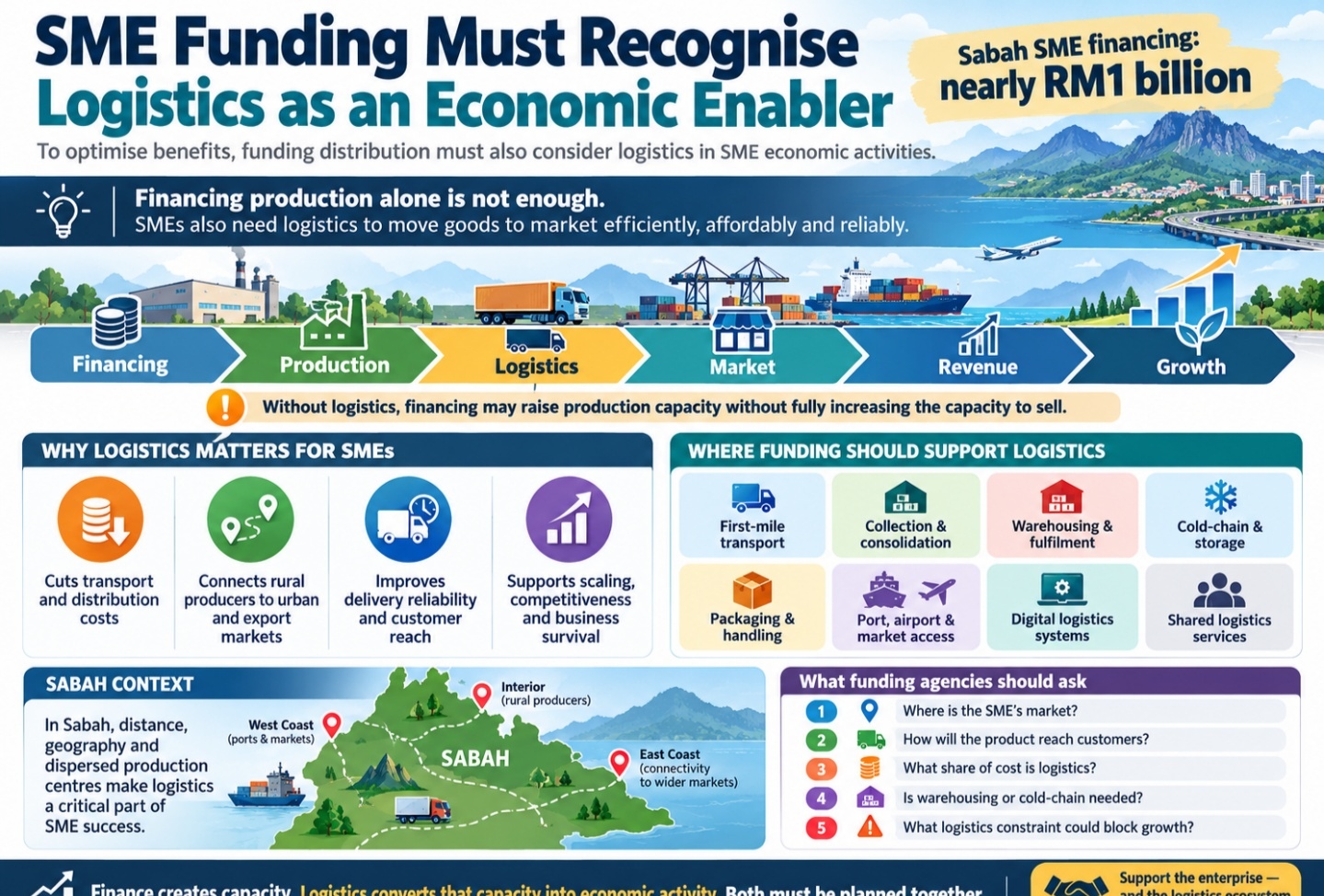
For many SMEs, especially in Sabah, the challenge is not simply producing more. It is moving products efficiently, reliably, and affordably from production to market.
An entrepreneur may receive financing to purchase machinery, increase production, improve packaging or expand premises.
But if the goods cannot be transported economically to Kota Kinabalu, Sandakan, Tawau, Sapangar, airports, ports or export markets, then part of the intended benefit of that financing may be lost.
In other words, financing production without considering logistics may increase production capacity without necessarily increasing sales capacity.
This is why SME financing should account for logistics’ role in the recipient’s economic activities.
Logistics is part of the business model
For an SME, logistics is not simply moving goods after production. It is part of the business model itself.
Logistics determines how raw materials are obtained, how inventories are managed, how products are stored, how quickly orders can be fulfilled, how much delivery contributes to selling prices and how easily customers can be reached.
For agricultural producers, logistics may involve collection, cold storage and refrigerated transport.
For fisheries businesses, it may involve ice, cold-chain facilities and rapid delivery to urban or export markets.
For manufacturers, logistics includes moving raw materials into the factory and distributing finished goods.
For e-commerce businesses, logistics determines whether they can fulfil orders competitively and reliably.
For rural SMEs, the problem may begin even earlier with first-mile transport from villages or production areas to consolidation points.
These are not secondary issues. They directly affect a business’s ability to generate revenue.
Financing should consider the whole economic chain
The traditional approach to SME assistance often focuses heavily on the enterprise itself: working capital, machinery, premises, training, digitalisation and marketing.
All of these remain important. But financing programmes should increasingly view the SME as part of a wider economic chain. That chain can be illustrated simply:
Financing → Production → Logistics → Market → Revenue → Growth
If the logistics component is weak, the chain is incomplete.
In Sabah, this matters because of distance, geography, dispersed settlements, and uneven economic concentration.
A producer in the interior faces a very different logistics environment from an SME located in Kota Kinabalu.
Businesses on the East Coast may also depend on different transport, port, shipping and distribution networks from those on the West Coast.
Financing therefore cannot assume every SME operates under the same market conditions. A more targeted approach should consider where the business is located, where its customers are located and how goods move between those two points.
Introduce a logistics readiness assessment
One practical approach would be to incorporate a simple logistics readiness assessment into SME financing programmes.
Before approving financing, agencies could ask several basic questions.
Where is the SME’s market?
How will the products reach customers?
What proportion of the selling price is represented by transport and distribution cost?
Does the business require warehousing, cold storage or consolidation?
Does it depend on ports, airports or inter-district transport?
What logistics constraint could prevent the business from expanding even after financing is provided?
These questions help financing agencies determine whether the SME needs more than conventional working capital or equipment support.
In some cases, the most important support may not be another machine. It may be better access to transport, storage, fulfilment or cold-chain services.
Finance access, not necessarily ownership
We also need to distinguish between financing logistics and financing logistics assets.
Not every SME should be encouraged to purchase its own truck, warehouse or cold room. This can create under-utilised assets and higher operating costs. In many cases, a better approach would be to finance access to shared logistics services.
For example, a group of agricultural producers may benefit more from a common collection centre, scheduled transport and shared cold storage than from each producer owning separate vehicles.
Cooperatives can also play an important role in organising such shared facilities.
This is especially relevant to programmes such as Tamu Desa.
A rural market should not only be viewed as a place where entrepreneurs sell products. It can also become a small logistics node where products are collected, weighed, packaged, temporarily stored, consolidated and transported to larger markets.
With proper planning, Tamu Desa can evolve from simply improving trading space into strengthening rural market connectivity.
That would significantly increase the economic impact of public expenditure.
Logistics SMEs also deserve support
There is another important dimension.
Logistics businesses are themselves SMEs.
Small hauliers, freight forwarders, warehouse operators, courier companies, cold-chain operators, customs agents, packaging providers, rural transporters and digital logistics companies all contribute to the SME ecosystem.
Financing these businesses can create benefits far beyond the individual company receiving support.
For example, a refrigerated transport operator may serve dozens of farmers.
A rural consolidation company may connect hundreds of small producers to urban markets.
A fulfilment provider may enable many online businesses to grow without building their own warehouses.
The economic multiplier can therefore be substantial. This suggests that SME financing policy should have two complementary objectives.
The first is to finance productive enterprises.
The second is to strengthen the logistics ecosystem that enables those enterprises to reach markets.
From enterprise support to ecosystem development
The broader lesson is that entrepreneurship policy should not be separated from logistics policy. A successful SME ecosystem requires three connected layers.
The first is enterprise capacity: finance, machinery, skills, technology and working capital.
The second is logistics capacity: transportation, warehousing, consolidation, cold-chain and distribution.
The third is market connectivity: access to domestic markets, BIMP-EAGA, ports, airports, e-commerce platforms and export opportunities.
When these three layers function together, public financing can create a much stronger economic impact. The objective should therefore not simply be to distribute funds successfully. The real objective should be to ensure that financing leads to sustainable business growth.
For Sabah, this means recognising logistics as part of the SME’s economic activity from the beginning.
The question should no longer be only: How much financing does the SME need to expand production?
It should also be: What logistics support does the SME need to convert that production into market access and income?
That shift in thinking could help ensure entrepreneurship funding delivers greater value, particularly for rural businesses, agricultural producers, small manufacturers, and enterprises located away from major urban centres.
Financing creates capacity.
Logistics converts that capacity into economic activity.
For SME development to deliver its fullest potential, both must be planned together.