By By Datuk Ts Dr. Hj Ramli Amir, former President of the Chartered Institute of Logistics and Transport (CILT) Malaysia and Vice-President of CILT International for Southeast Asia
KOTA KINABALU: The ambition of “Link the World, Trade for the Future” can be translated into practical capability-building through a focused two-day Logistics Practice and Competency Development (LPCD) Fast Track programme.
Sabah’s logistics transformation will be achieved not only through ports, roads, digital systems, and logistics facilities, but also through competent professionals who can design, manage, and continuously improve the supply chains that connect Sabah to regional and global markets.
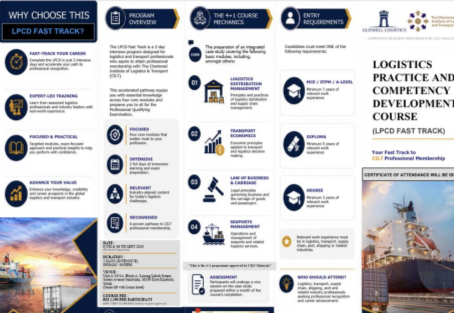
The proposed two-day intensive programme provides a timely platform for logistics practitioners, transport operators, port and shipping personnel, freight forwarders, supplychain executives, and aspiring CILT members to strengthen the core competencies required in a changing trade environment.
Delivered through four integrated case-study modules—Logistics Distribution Management, Transport Economics, Law of Business and Carriage, and Seaports Management—the programme addresses the operational and strategic foundations of a modern logistics ecosystem.
For Sabah, these competencies are directly relevant. Logistics distribution management supports more efficient movement of cargo between production centres, industrial areas, inland markets, and ports as well to understand imminent future in the world of transport technology like that of the drone technology industry as a ‘Low Altitude Economy’.
Transport economics equips participants to assess freight costs, service reliability, route choices, and investment decisions—critical issues for an economy seeking to reduce logistics costs and improve market access. Knowledge of business and carriage law strengthens commercial confidence and risk management in shipping, forwarding, customs, and multimodal transport transactions.
Meanwhile, seaport management builds understanding of terminal operations, port productivity, shipping connectivity, and the role of gateways such as Sapangar Bay in supporting Sabah’s wider trade ambitions.
The LPCD Fast Track can therefore be positioned as more than a professional developmentcourse.
It is a human-capital intervention for Sabah’s logistics future. By developing a shared professional language and practical competency base among public-sector planners, port and airport stakeholders, logistics firms, shippers, educators, and young professionals, the programme can contribute to a stronger and more coordinated logistics community.Its two-day intensive design is particularly suitable for working professionals: it offers targeted learning, practical application, and an accessible pathway toward CILT professional membership and formal recognition.
The programme’s emphasis on casebased learning and a concluding viva-style assessment also ensures that participants do not merely receive information but demonstrate their ability to apply logistics principles to real operational challenges.In this context, the programme can carry a clear message:
To link Sabah with the world and trade for the future, Sabah must invest not only in infrastructure, but also in people—professionals with the competence to plan, operate, govern, and innovate across increasingly complex supply chains.
The LPCD Fast Track represents a practical first step in building that capability: developing professionals who can connect hinterlands to gateways, businesses to markets, and Sabah’s economic potential to the opportunities of regional and global trade.