By Joe Fernandez
Students of the KDCA Story and Sabah’s development must look at submerged mass beneath engineering studies, economic reports and political histories!
Commentary And Analysis . . . Let élan (enthusiasm, vigour) celebrate above water.
Let law and engineering carry the weight below.
That’s how Sabah moves from the weltschmerz (world weariness) of “all talk” for enforceable, sustainable development.
KDCA Story
The true KadazanDusun Cultural Association (KDCA) story lies submerged.
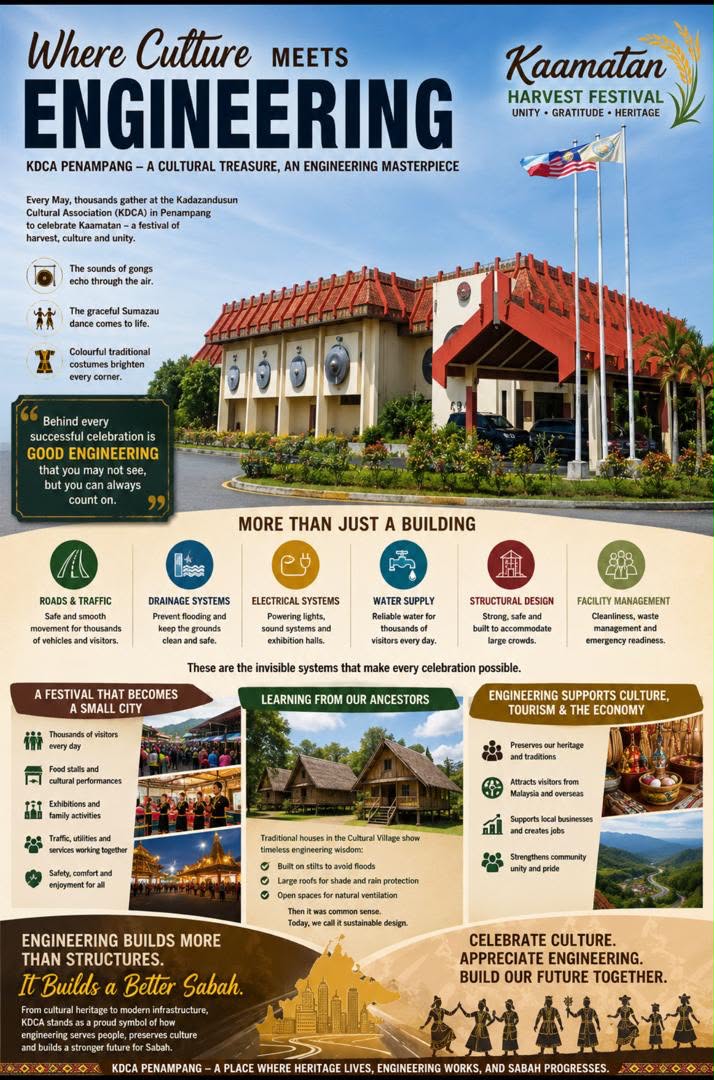
(https://www.theborneopost.com/2026/06/07/kdca-penampang-sabahs-cultural-and-engineering-landmark/ )
Cultural studies describe form.
Economic reports estimate cash flow.
Political histories claim symbolism.
Development, based on law, requires UBBL 1984 compliance, fire safety certification, drainage hydraulics, audited economic returns, and gazetted heritage status.
The UBBL (Uniform Building By‑Laws 1984) remains comprehensive set of subsidiary legislation enacted under the Street, Drainage and Building Act 1974 (Act 133) in Malaysia.
UBBL prescribes minimum standards for the design, construction, and maintenance of buildings for ensuring public safety, health, and amenity.
It governs, among other things, structural integrity, fire safety, ventilation, sanitation, and occupancy limits.
For buildings where large numbers of people assemble — such as the KDCA — the UBBL imposes stringent requirements for fire‑exits, crowd‑capacity calculations, and the issuance of a Certificate of Completion and Compliance (CCC).
In the context of the KDCA analysis, the UBBL represents the legal obligation beneath the visible celebration of culture: festival may be joyful, but the building that hosts it must, as a matter of law, comply with these by‑laws and ensure the safety of every visitor.
Until students lift that seven‑eighths of the story, the KDCA remains beautiful belletristic (pertaining to literary style) icon, not proven engine of progress.
Contradictions Resolved
Two apparent contradictions have surfaced in the public narrative around the KDCA. They are not genuine conflicts; they are symptoms of the hollow iceberg, and they dissolve upon contact with the law.
Contradiction 1: “KDCA is a cultural treasure” versus “KDCA must meet modern safety codes.”
Resolution: There is no conflict.
The heritage value of the KDCA is a de facto social fact; its statutory duty to comply with UBBL 1984 and the Fire Services Act 1988 is a de jure obligation.
Under the National Heritage Act 2005, preservation cannot override public safety.
The ancestral stilt houses in the Cultural Village provide prima facie evidence of passive cooling, but the modern Hongkod Koisaan — hosting thousands of visitors — must still hold a valid Certificate of Completion and Compliance (CCC). Heritage informs design; statutes mandate safety.
Contradiction 2: “Engineering is invisible when it works” versus “students must study the submerged mass.”
Resolution: This is likewise a false opposition.
Res ipsa loquitur — the thing speaks for itself — operates when systems function smoothly; their silent operation is the best proof of due care.
However, for students of development, res ipsa proves due care only after the factum probandum — the facts — are established through inspection reports, maintenance logs, and independent audits.
Invisible success is the outcome; the submerged studies and reports are the onus probandi (burden of proof). One may celebrate the outcome; one cannot substitute it for the proof.
Issues
Culture vs. Code: The community’s desire for an open cultural space versus the UBBL’s fire‑exit and occupancy mandates.
Tourism vs. Capacity: SMJ 2.0’s push for greater visitor numbers versus the de jure road and drainage capacity under JKR standards.
Heritage vs. Access: Preservation of traditional stilt houses versus the accessibility duties under the Persons with Disabilities Act 2008.
Politics vs. Audit: Political histories that celebrate the KDCA versus the public demand for transparent maintenance spending under the Financial Procedure Act 1957.
Chronology
Pre‑1970s: Ancestral Kadazan‑Dusun engineering: stilt houses with passive ventilation, representing prima facie sustainable design.
1992: Hongkod Koisaan (KDCA Building) completed at KM8, Jalan Penampang.
Every May since 1960: Kaamatan Festival held; the KDCA compound functions as a temporary “small city.”
2005: National Heritage Act 2005 enacted; KDCA becomes a potential heritage object.
Ongoing (2020s): SMJ 2.0 development plan references the KDCA as a cultural and infrastructure node.
7 June 2026, 6:01 AM: The Borneo Post article is published, serving as a prima facie cultural report, not a legal or engineering audit.
Cultural Beacon
The KDCA building, Hongkod Koisaan, rises from Penampang as both a cultural beacon and physical structure.
Every May, the Kaamatan Festival transforms its grounds into living tapestry of sound, dance, and communal identity.
The Borneo Post article of 7 June 2026 paints this scene with affection and pride.
It praises the invisible engineering that supports the festival, the economic ripple effects of tourism, and the architectural homage to indigenous wisdom.
It is, in every sense, a beautiful postcard.
The postcard is not development study.
Beneath the surface of gongs and Sumazau lies a vast, largely unexamined mass: the structural calculations, fire safety certifications, drainage reports, heritage gazettements, and audited economic returns that alone can transform cultural celebration into sustainable, accountable progress. — TJT
Longtime Borneo watcher Joe Fernandez has been writing for many years on both sides of the Southeast Asia Sea. He should not be mistaken for a namesake formerly with the Daily Express in Kota Kinabalu. JF keeps a Blog under FernzTheGreat on the nature of human relationships.