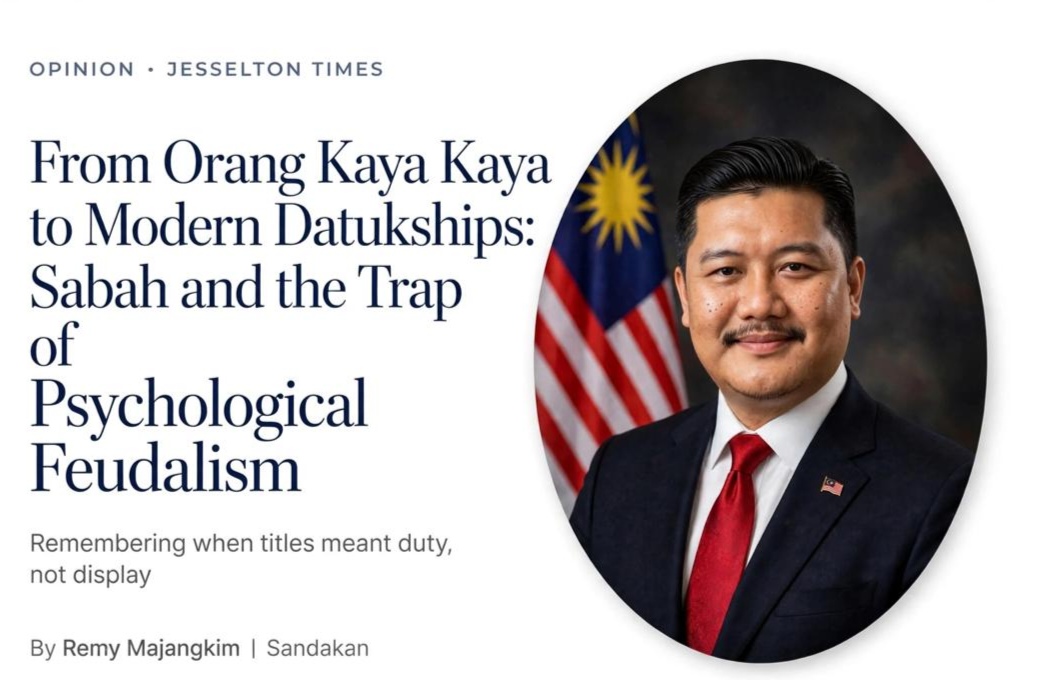
By Remy Majangkim
SANDAKAN: In any maturing society, the measure of public leadership rests on competence, integrity, and tangible service to the community. Yet across Malaysia, an escalating obsession with state honorifics has steadily distorted our civic values.
What was once designed to recognize extraordinary contributions to the public good has increasingly been turned into a currency for business leverage, political patronage, and personal prestige.
To understand why this trend is so damaging to our progress, it is worth revisiting the work of the late Malaysian sociologist Syed Hussein Alatas.
In his landmark 1968 study on feudalism in Malaysian society, Alatas observed that while the nation modernized its legal and economic institutions, it never shed its underlying feudal mindset.
He termed this phenomenon psychological feudalism, a social condition in which modern elites remain fixated on rank, ceremony, and outward symbols of superiority rather than substance and merit.
Nowhere is this sociological shift more striking than in Sabah.
Unlike the states of Peninsular Malaysia, Sabah did not possess a centuries-old local royal sultanate system conferring aristocratic titles.
Historically, our indigenous communities organized leadership around customary authority and functional responsibility. Even the title Orang Kaya Kaya, or OKK, carries a lineage rooted in genuine governance rather than empty prestige.
Originating during the era of the Brunei Sultanate to recognize influential non-royal local chiefs who bridged coastal administration and interior communities, the title was later adopted and formalized by the British North Borneo Chartered Company for paramount Native Chiefs, alongside Orang Tua for village headmen.
An Orang Tua or an OKK could not buy or lobby for their rank. They earned respect through daily administration, the adjudication of Native Courts, and direct accountability to the people they served. The title was inseparable from the duty.
It was only after the formation of Malaysia in 1963 that Sabah introduced a modern state honors system through the State Honours Enactment, establishing awards such as the Panglima Gemilang Darjah Kinabalu carrying the title Datuk, and the Seri Panglima Darjah Kinabalu carrying the title Datuk Seri Panglima.
Over the decades, however, what began as a system to honor genuine pioneers and public servants has gradually absorbed the wider national culture of title inflation.
For far too many recipients today, an honorific is no longer the quiet culmination of a lifetime of service. Instead, it is treated as a commercial asset used to open corporate doors, project instant authority in boardrooms, and secure political mileage.
This commercialization has been accompanied by a noticeable decline in basic protocol. Traditional etiquette strictly separates state honors from private commerce and personal vanity.
Yet titles are now routinely displayed on corporate signboards, social media profiles, and commercial branding. In its most troubling extreme, families have even taken to chiseling non-hereditary state titles onto gravestones, overlooking both official protocol and spiritual teachings on equality in death.
According to Alatas’s framework, this preoccupation with hollow status symbols carries a heavy cost for a developing region.
When economic and social advancement depend on proximity to titled figures rather than innovation, hard work, and ethical enterprise, genuine meritocracy is sidelined. Alatas warned that such an environment fosters what he called bebalisma, an uncritical public attitude that accepts mediocrity simply because it is wrapped in an impressive title.
For Sabah, the way forward does not require inventing new traditions, but remembering our own.
Our historical benchmark of leadership was never defined by how many syllables preceded a person’s name, nor by the pomp surrounding their arrival.
It was defined by the grounded, earned respect accorded to an Orang Tua or an Orang Kaya Kaya who stood with their community and upheld justice.
Restoring dignity to our public honors requires more than stricter vetting processes.
It calls for a quiet cultural maturity among citizens, institutions, and leaders alike to value character over rank, and service over status.
Only when we stop mistaking titles for substance can Sabah build a truly progressive and meritocratic future.