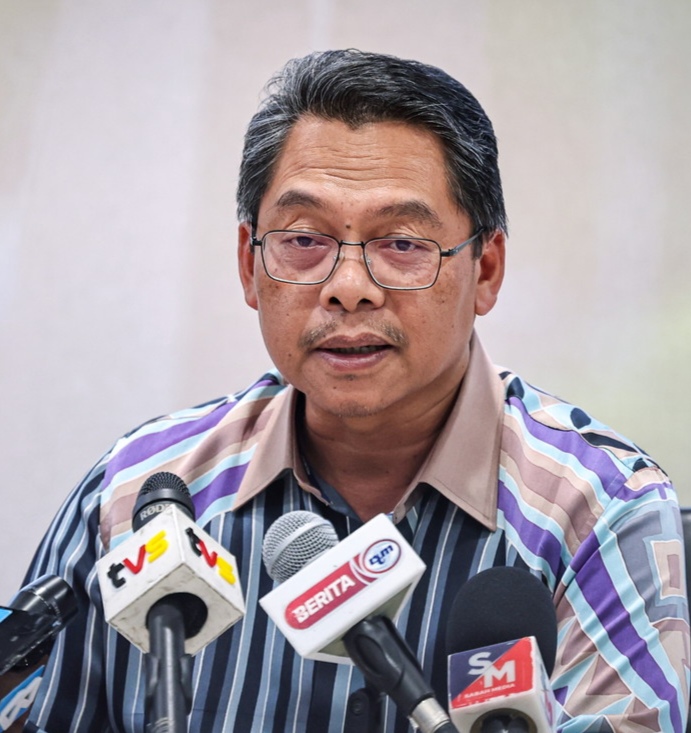
KOTA KINABALU: Datuk Mustapha Sakmud, Minister in the Prime Minister’s Department overseeing Sabah and Sarawak Affairs, is widely seen as fulfilling a crucial role in linking the federal government with the two East Malaysian states.
This function has been particularly evident in speeding up development initiatives and addressing matters tied to the Malaysia Agreement 1963 (MA63).
As reported by Demi Sabah, Dr. Hussain Yusri Zawawi, a Senior Lecturer at the Faculty of Law and International Relations, Universiti Sultan Zainal Abidin (UniSZA), noted that Mustapha’s appointment aligns with the MADANI Government’s strategy to strengthen ties between the federal center and the Borneo regions.
He explained that Mustapha does more than coordinate policies—he serves as a strategic conduit ensuring the goals of Sabah and Sarawak are effectively translated into actionable policies and tangible development outcomes.
Among the notable initiatives introduced under his oversight is the MA63 Dashboard, a tool that enables clearer, more systematic tracking of progress across 29 key MA63 issues.
To date, 13 issues have been resolved, five have reached interim agreements, and two have received foundational rulings.
The remaining matters are still under discussion or awaiting decisions from top-level authorities, he stated in an opinion piece published by Sinar Harian.
Dr. Hussain highlighted several additional accomplishments, such as the restoration of administrative control over Sipadan and Ligitan Islands to Sabah, the handover of regulatory authority for liquefied petroleum gas (LPG) to Sarawak, the formal recognition of Sabah and Sarawak’s Public Works Department (JKR) and Irrigation and Drainage Department (JPS) as Technical Departments, and the transfer of electricity supply regulation to the Sabah State Government.
On the financial front, he noted that the MADANI Government raised Sabah’s Special Interim Grant from RM600 million to RM1.5 billion and finalized the process for claiming 40 percent of state revenue.
Dr. Hussain also emphasized that Mustapha’s strategy—centered on field-level monitoring, coordination, and practical problem-solving—has enhanced the efficiency of federal development projects in Sabah.
He pointed out that ongoing efforts to tackle stalled projects through consistent oversight, collaboration across agencies, and plans to set up a dedicated committee for issues involving the Main Technical Department (JTU) demonstrate a proactive, solution-driven approach.
Nonetheless, he acknowledged that key unresolved matters remain, including the Territorial Sea Act 2012, continental shelf rights, petroleum cash payments, and the expansion of parliamentary seats.
“Still, what sets the current situation apart is that these issues are now formally recognized by the government and are being tracked through a more systematic framework,” he said.