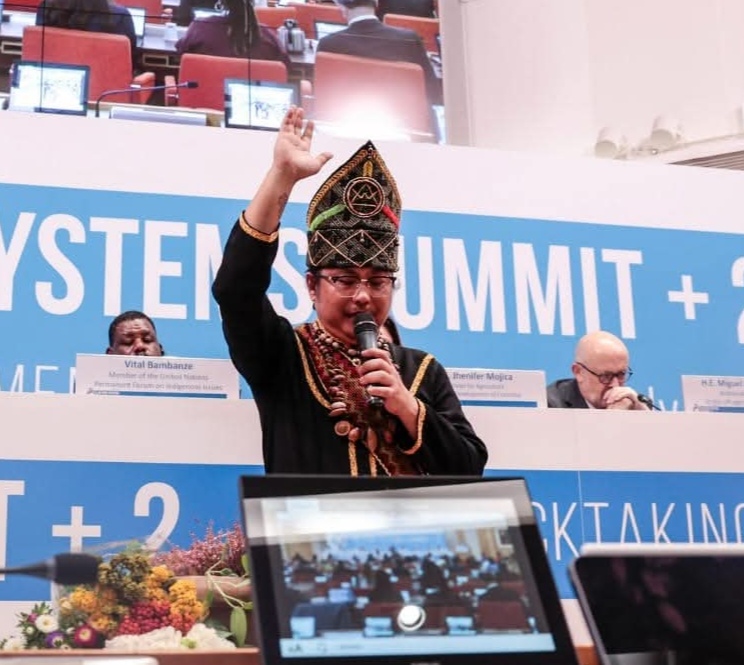
KOTA KINABALU: Dato’ Petinggi Andrew Ambrose Atama Katama has called for Kaamatan to be seen not only as a harvest festival, but as a living platform for global advocacy on Indigenous Peoples’ traditional food systems, cultural heritage, biodiversity and the rights of future generations.
Speaking in conjunction with Kaamatan International Week & Jungle Food Labs 2026, he said Kaamatan carries a message that is far bigger than ceremony, performance or seasonal celebration.
At its heart, Kaamatan is about the relationship between people, land, food, spirit, memory and responsibility.
According to him, the festival has significant global value because it holds the wisdom of Indigenous food systems at a time when the world is searching for better ways to address food security, climate change, biodiversity loss and cultural survival.
“Kaamatan teaches us that food does not come from the market first. Food comes from the land, from the forest, from the river, from the seed, from the weather, from the hands of our people, and from the wisdom of our ancestors,” he said.
“This is why we must bring the message of Kaamatan to the global stage. Our traditional food systems are not backward. They are intelligent, sustainable and deeply connected to life.”
Dato’ Petinggi Andrew said his continuing work with global Indigenous platforms, including processes linked to the United Nations Food and Agriculture Organization, the Global Indigenous Youth Forum in Rome, Italy, the Global-Hub on Indigenous Peoples’ Food Systems, and the World Food Forum, has strengthened his belief that Borneo has an important voice to offer to the world.
He said the ideas developed through these international spaces show that Indigenous Peoples’ food systems are not merely cultural traditions, but living knowledge systems that can contribute to policy, research, youth leadership, climate resilience and sustainable futures.
“Our work with Indigenous youth at the global level has shown us that young people do not want to inherit empty symbols. They want meaning. They want roots. They want to understand where their food comes from, why their culture matters, and how their knowledge can help shape the future,” he said.
He added that Jungle Food Labs 2026 was created as part of this larger vision — to connect Kaamatan with global advocacy for Indigenous Peoples’ traditional food systems.
Through the theme “Citarasa Hutan Sunsuron,” Jungle Food Labs highlights the food wisdom of the Dusun Tambunan community and the wider Indigenous food traditions of Borneo. It presents food not only as a dish, but as a complete system of knowledge involving gathering, planting, fermenting, smoking, wrapping, sharing, healing, storytelling and respecting nature.
“Our food tells us when to plant, when to harvest, what to preserve, what to share, what to respect, and what not to destroy. In every traditional food, there is memory. There is ecology. There is spirituality. There is identity. There is responsibility,” he said.
Dato’ Petinggi Andrew, Chairman for Kaamatan International Week Jungle Food Labs 2026 said the future of Kaamatan must continue to be built on the idea of biocentrism, where life and nature are placed at the centre of how people think, celebrate and plan for the future.
“For us, biocentrism is not a foreign idea. Our elders already practised it. They understood that the forest is not just timber. The river is not just water. The land is not just property. The seed is not just a crop. All of these are part of life,” he said.
He said this understanding must remain at the core of Kaamatan as the festival continues to grow beyond the Kadazandusun community and becomes appreciated by other Indigenous peoples, cultural partners and international friends.
“Kaamatan was born from the Kadazandusun people, but its values can speak to the world. The values of gratitude, balance, respect for nature, food sharing, community unity and care for future generations are universal values,” he said.
Dato’ Petinggi Andrew said the global advocacy for Indigenous Peoples’ traditional food systems must also be honest about the threats facing communities today.
He said many traditional food systems are being weakened not only by changing lifestyles, but also by larger pressures such as chemical dependency, pesticide pollution, ecosystem poisoning, loss of customary farming lands, displacement from traditional food landscapes, and laws or market systems that make it harder for communities to freely protect, exchange and continue their heirloom seeds.
“These are the real dangers we must talk about. When pesticides poison the soil and water, they do not only damage crops. They damage food memory. When traditional farming lands are taken away or converted, communities do not only lose land. They lose their food system, their identity and their future,” he said.
He added that the issue of seeds is especially important because Indigenous communities have safeguarded local seed varieties for generations through sharing, selection, adaptation and customary practice.
“If heirloom seeds become controlled only by laws, markets or corporations, then our people may one day become strangers to the very seeds of their ancestors. This is why we must defend the right of communities to protect, plant, exchange and pass on their traditional seeds,” he said.
Dato’ Petinggi Andrew said this is why Kaamatan must continue to carry a clear message on food sovereignty, ecological responsibility and customary land protection.
“Kaamatan cannot speak about harvest without speaking about the land. It cannot speak about food without speaking about seeds. It cannot speak about culture without speaking about the ecosystems that make culture possible,” he said.
He said the future of Indigenous food systems depends on protecting the relationship between people, land, forest, water, seeds and community knowledge.
“Our challenge is not only to celebrate what our ancestors left behind. Our challenge is to protect the living conditions that allow this knowledge to continue for the next seven generations,” he said.
He also said that Kaamatan International Week does not replace the traditional meaning of Kaamatan, but expands its message so that the festival can contribute to wider conversations on Indigenous rights, food heritage, biodiversity, women’s knowledge, youth empowerment and cultural diplomacy.
“This is how Kaamatan grows. It remains rooted in its origin, but it opens its message to others. It becomes a bridge between peoples, between cultures, and between generations,” he said.
Dato’ Petinggi Andrew said the recognition of Ropuhon Kiasu Highland, the Jungle Food Labs Tambunan 2025 Champion, reflects the importance of community knowledge holders in shaping the future of Indigenous food advocacy.
He said women, elders, farmers, cooks, foragers and village food practitioners must be recognised as experts because they carry knowledge that is often not written in books, but is kept alive through practice.
“Our mothers, grandmothers, farmers, cooks, foragers and youth are part of the knowledge system. If we lose them, we lose more than recipes. We lose a way of understanding life,” he said.
He added that the foundations being laid through Kaamatan International Week and Jungle Food Labs are meant to serve the next seven generations.
“We must think beyond one event, one year or one committee. We must think of the next seven generations. Will they still know their food? Will they still know their seeds? Will they still understand the forest? Will they still speak about the land with love and responsibility?” he said.
Dato’ Petinggi Andrew, Chairman for Kaamatan International Week since 2023 said the journey towards the World Food Forum and the Global Indigenous Youth Forum 2026 in Rome, Italy is part of a bigger effort to bring the voices of Borneo Indigenous communities into global spaces.
“We want our youth to go out into the world with confidence, not empty-handed, but carrying the knowledge of their people. They must know that their heritage is not small. Their food systems are not small. Their stories belong to the world,” he said.
He concluded that Kaamatan must continue to grow as a festival of gratitude, unity and life, while also becoming a serious platform for Indigenous Peoples’ global advocacy.
“The world is searching for better ways to live with nature. Indigenous Peoples have carried many of these answers for generations. Through Kaamatan, we can share these answers with humility, pride and responsibility,” he said.