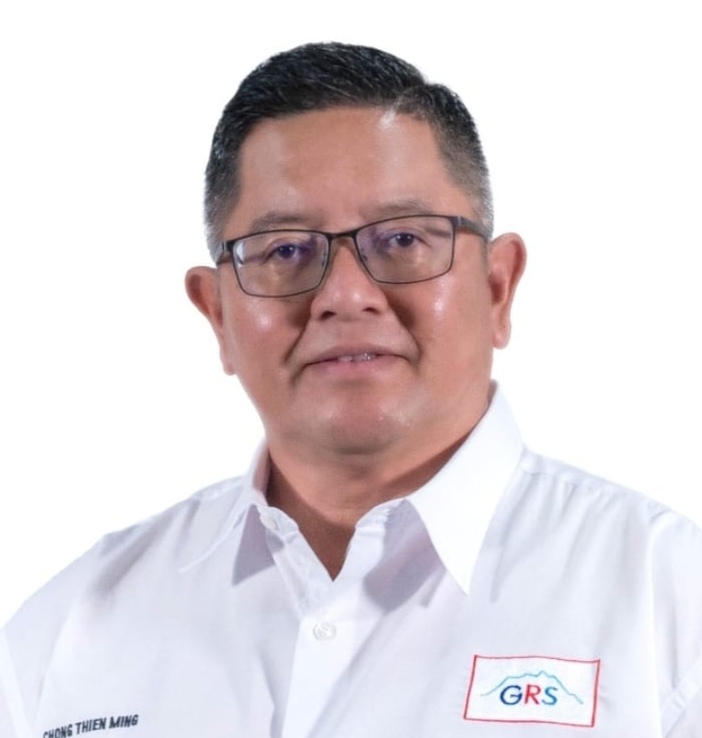
SANDAKAN: Sabah should be given a bigger and more meaningful allocation in the coming National Budget, especially to address the state’s long-standing infrastructure, healthcare, education and agricultural development needs, said LDP-GRS Vice President Chong Thien Ming.
With the National Budget expected to be tabled in October, Chong said the coming Budget would be particularly important for Sabah as the country approaches another general election cycle.
“We have another year before the general election, and if the government is committed to completing the full five-year term, all major promises and commitments to Sabah should be at the final stage of implementation, or at least 90 per cent completed, before Parliament is dissolved,” he said.
“Sabahans deserve to see the fulfilment of the promises made by the Federal Government. The Budget should therefore reflect the urgency of closing the development gap between Sabah and West Malaysia.”
Chong proposed that the following areas be given priority:
1. Infrastructure and flood mitigation
Sabah JKR is facing tremendous pressure to keep up with infrastructure needs throughout the state, particularly in rural areas where roads, bridges, water supply pipelines and drainage systems still require substantial upgrading.
At the same time, suburban and urban areas are increasingly facing flash floods, resulting in millions of ringgit in property and business losses.
Chong said road conditions should receive immediate attention.
“While the Pan Borneo Highway remains an important project, the Federal Government must not overlook other federal roads throughout Sabah. Many roads have developed serious potholes and deteriorated surfaces over the past two to three years.”
He said badly damaged roads should be properly resurfaced or undergo deep patching rather than repeated temporary repairs.
“Road safety is a serious concern. Sabahans should not have to risk their lives simply because federal roads have not been properly maintained.”
2. Healthcare facilities and medical services
Chong said Sabah also needed greater investment in healthcare, including replacing ageing medical equipment that frequently breaks down.
“It is worrying when doctors and medical personnel have to work with outdated equipment that may not provide the level of accuracy and information required for proper diagnosis.”
He said major hospitals and Klinik Kesihatan should be equipped with modern medical equipment, while more Klinik Kesihatan should be built in areas where population growth has created additional demand.
Sabah’s vast geographical landscape also requires greater emphasis on mobile healthcare services, he said.
“Healthcare should reach the people, especially those living in remote areas. We cannot expect rural residents to travel long distances every time they need basic medical attention.”
Chong also called for more permanent doctors and medical personnel in Sabah, supported by better remuneration and incentives to attract and retain qualified professionals.
3. Education and rural schools
While more schools have been developed in urban and suburban areas, Chong said rural Sabah still required greater attention.
“Rural schools need proper facilities, including teachers’ quarters, hostels and boarding facilities for students who come from interior areas.”
He said education infrastructure should be planned according to Sabah’s geography and the needs of rural communities, rather than concentrating development mainly around major towns.
4. Agriculture, food security and technology
Agriculture remains one of Sabah’s important economic sectors, while food security is becoming increasingly important, Chong said.
He proposed greater support for farmers and agricultural businesses through tax-free or reduced-tax imports of modern agricultural machinery and equipment.
“Sabah also needs stronger research and development capabilities in agriculture and agro-based industries. We must help our farmers increase productivity, reduce production costs and move towards modern and technology-driven agriculture.”
He said stronger R&D could also help Sabah develop higher-value agricultural products instead of depending mainly on raw commodities.
5. Prudent implementation of taxes
Chong also urged the Federal Government to carefully review the timing and impact of new taxes.
“Lately, we have seen various taxes and additional costs being introduced. While taxation is necessary for national development, the Government must also consider the economic condition of individual states.”
He said many businesses, particularly SMEs in Sabah, were still recovering from the impact of the Covid-19 pandemic.
“In Sandakan, we have seen factories closing operations, while shops, restaurants and other businesses continue to struggle. Any additional tax burden will eventually be passed on to consumers through higher prices.”
Chong said taxation policies should therefore take into consideration the economic recovery of Sabah and avoid putting unnecessary pressure on businesses and consumers.
“Sabah needs a Budget that provides confidence and creates opportunities, rather than one that creates further uncertainty and increases the cost of doing business.”
He stressed that Sabah remained years behind West Malaysia in terms of infrastructure and overall development and that the Federal Government needed to accelerate efforts to close the gap.
“This is a crucial Budget for the Madani Government. Sabahans are not asking for special treatment. We are asking for fair and meaningful development that reflects Sabah’s needs and contribution to Malaysia.”
“More reliable funding must be channelled towards infrastructure, healthcare, education, agriculture and economic development so that Sabah can move forward together with the rest of the country,” Chong said.