By Datuk Ts Dr. Hj Ramli Amir, former President of the Chartered Institute of Logistics and Transport (CILT) Malaysia and Vice-President of CILT International for Southeast Asia
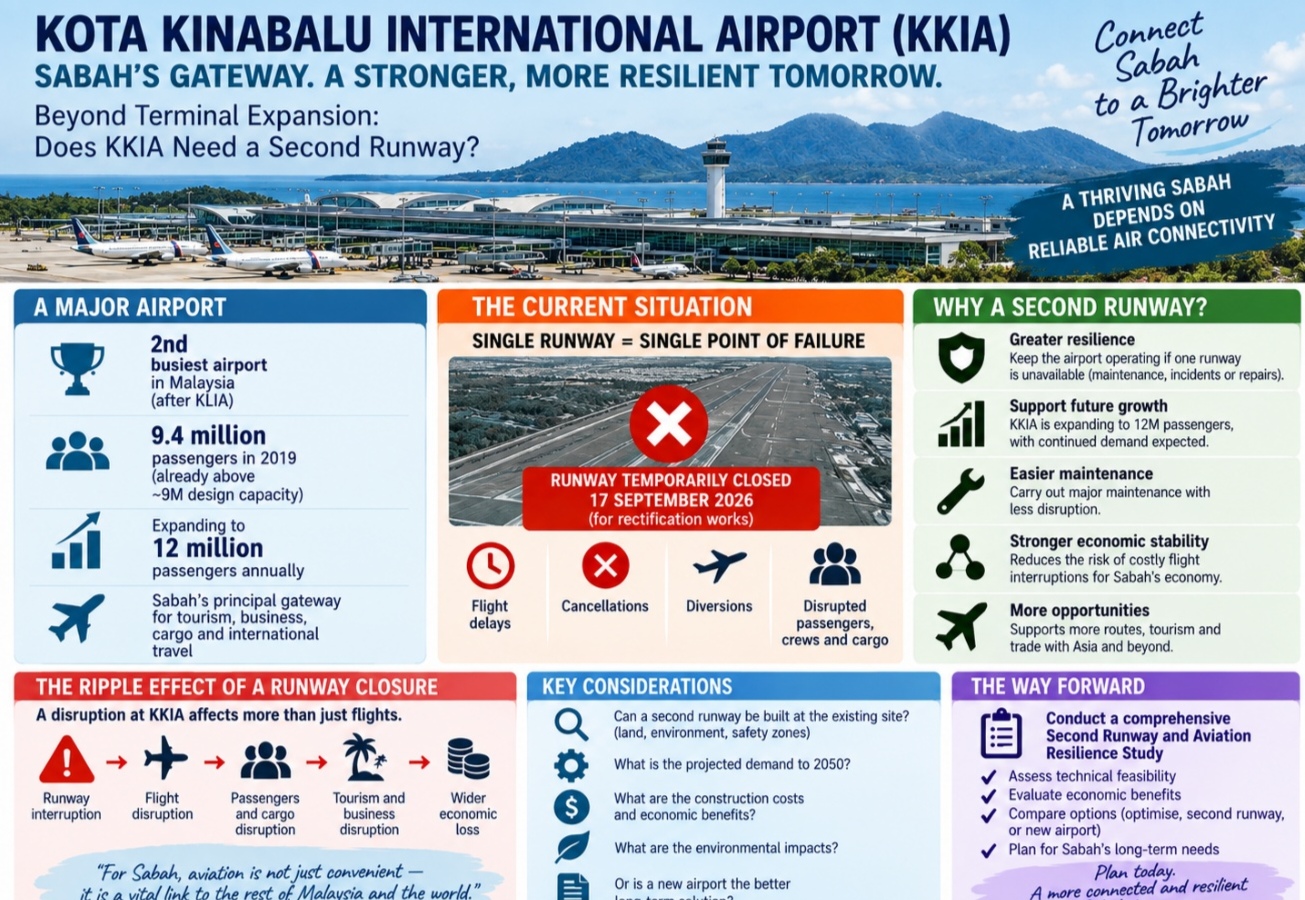
KOTA KINABALU: The temporary closure of the runway at Kota Kinabalu International Airport (KKIA) on 17 September 2026 should prompt a question that goes beyond delayed, cancelled and diverted flights.
Should Sabah’s principal aviation gateway continue to depend on a single runway?
The question is timely because KKIA is undergoing substantial expansion.
Terminal capacity is being increased from about nine million to 12 million passengers annually, together with additional aircraft parking bays and supporting facilities.
These investments are necessary. But expanding the terminal does not remove a fundamental vulnerability: every arriving and departing aircraft still depends on essentially a single runway.
KKIA is Malaysia’s second-busiest airport after Kuala Lumpur International Airport and Sabah’s principal aviation gateway.
Its importance therefore extends far beyond the airport boundary. It supports tourism, business travel, domestic and international connectivity, air cargo and Sabah’s links with the rest of Malaysia and the wider Asian economy.
A Single Point of Failure
The strongest argument for examining a second runway is not simply congestion. It is resilience.
A single-runway airport has an inherent single point of failure. If that runway becomes unavailable due to pavement problems, an aircraft incident, emergency maintenance, inspection, or other operational reasons, the airport can lose much of its ability to receive and dispatch aircraft.
The events of 17 September demonstrated this vulnerability. Urgent runway rectification resulted in flight delays, cancellations and diversions.
The lesson is straightforward.
An airport may have a bigger terminal, more aircraft parking bays and modern passenger facilities, but if its only runway is unavailable, much of that infrastructure becomes operationally stranded.
A second runway would provide a degree of redundancy. Depending on the nature of an incident, one runway could potentially continue operating while maintenance, inspection or rectification takes place on the other.
It would not eliminate every form of airport disruption, but it would significantly reduce dependence on a single piece of critical infrastructure.
The Economic Cost Goes Beyond the Airport
A runway closure does not affect only airlines..
When an aircraft cannot land, it may be diverted. Passengers miss connections. Aircraft and crews end up in the wrong locations. Subsequent flights are disrupted. Tourists lose parts of their itineraries. Business appointments are missed. Air cargo and urgent consignments may be delayed.
The effects can therefore continue long after the runway itself reopens.
The economic chain can be expressed simply:
Runway interruption → flight disruption → passenger and cargo disruption → tourism and business disruption → wider economic loss.
This is particularly important for Sabah. Unlike a city connected to surrounding regions by extensive motorway and railway networks, Sabah relies heavily on air travel for rapid connectivity to Peninsular Malaysia and international markets.
KKIA should therefore be viewed not merely as transport infrastructure, but as critical economic infrastructure.
A second runway consequently has another value beyond additional aircraft capacity: the economic value of redundancy.
Growth Makes the Question More Urgent
There is also the issue of future demand.
KKIA handled about 9.4 million passengers in 2019, exceeding its terminal design capacity of approximately 9 million.
The current expansion will raise capacity to 12 million passengers annually, while the Ministry of Transport projects passenger numbers could reach approximately 12.4 million by 2034.
This raises an important planning question.
If Sabah is preparing its terminal to accommodate substantially more passengers and aircraft activity, should the runway system supporting that expanded airport remain dependent upon the same single-runway configuration?
Passenger numbers alone do not determine the need for another runway. Aircraft movements, peak-hour demand, taxiway configuration, aircraft mix and air traffic management must also be considered.
But growth strengthens the case for investigating the question now.
Maintenance Is Also Part of Resilience
Every runway requires maintenance.
Pavement must be inspected and repaired. Rubber deposits must be removed. Lighting, markings and drainage systems require attention.
Eventually, substantial resurfacing and rehabilitation become necessary.
With only one runway, major maintenance creates an unavoidable choice between maintaining the runway and keeping the airport operating.
As traffic increases, finding suitable maintenance windows becomes progressively more difficult.
A properly configured second runway could allow certain maintenance activities to take place while retaining some airport operational capability.
This is why runway redundancy should be considered not only for emergencies, but also for the long-term reliability of KKIA.
But Can KKIA Accommodate Another Runway?
There is an important qualification.
Being Malaysia’s second-busiest airport does not automatically mean that a second runway should be constructed immediately.
The existing runway is substantial and capable of handling large aircraft.
A technical study must establish present and projected runway utilisation, peak-hour aircraft movements, maintenance requirements and future aviation demand.
There is also the physical constraint of KKIA’s location.
Its proximity to Kota Kinabalu is one of its greatest advantages, but surrounding urban development may make it difficult to construct a properly separated parallel runway.
Land requirements, taxiways, approach paths, safety zones, environmental considerations and surrounding development would all require detailed examination.
The real question therefore becomes:
Can an operationally effective second runway be developed at the existing KKIA site, and if not, what should Sabah’s long-term aviation strategy be?
Sabah Should Commission a Second-Runway Study
Rather than immediately declaring that another runway must be built, Sabah should undertake a comprehensive study on the KKIA Second Runway and Aviation Resilience.
The study should examine projected aircraft movements to 2050, peak-hour runway utilisation, maintenance requirements, economic losses from runway closures, land availability, engineering feasibility, environmental implications and construction costs.
It should compare three broad possibilities:
Optimise and strengthen the existing single-runway system; develop a second runway at or adjacent to the present airport; or, if physical constraints make this impractical, secure land and develop a longer-term alternative airport strategy.
Importantly, the study should calculate not merely how many additional aircraft another runway could handle, but also the economic value of keeping Sabah connected when one runway becomes unavailable.
Beyond Terminal Expansion
The current KKIA expansion is necessary, but terminal expansion should not be the end of Sabah’s aviation planning.
Terminal capacity determines how many passengers can be processed. Apron capacity determines how many aircraft can be accommodated. Runway capacity determines how efficiently aircraft can arrive and depart.
Runway redundancy determines how resilient the airport is when something goes wrong.
The events of 17 September have made that distinction very clear.
The question is therefore no longer simply whether KKIA needs a bigger terminal.
It is whether Sabah’s principal aviation gateway—and one of the State’s most important pieces of economic infrastructure—should continue into the coming decades dependent upon a single runway.
A second runway may ultimately prove feasible at KKIA, or detailed engineering studies may point towards another solution.
But Sabah should begin answering that question now, rather than after the next runway closure or when future traffic growth leaves fewer options available.
For Sabah, the second-runway question is ultimately not only about airport capacity.
It is about connectivity, resilience, and protecting the continuity of the State’s economy.