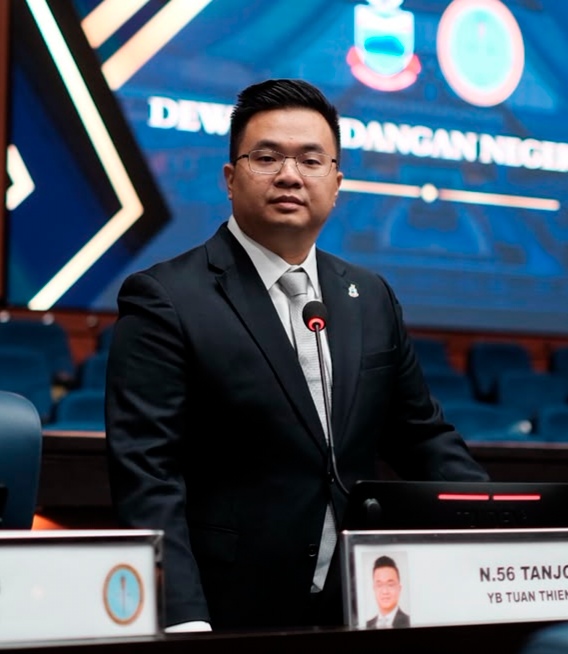
SANDAKAN: Tanjong Papat Assemblyman Alex Thien Ching Qiang said the government has yet to put forward a comprehensive and effective solution to address the continued rise in global fertiliser prices and increasing agricultural production costs, leaving farmers to shoulder the burden on their own with the additional costs eventually being passed on to consumers.
He said a conflict taking place thousands of kilometres away in the Middle East has not only affected global energy markets but has also further disrupted the global fertiliser supply chain.
Following the Covid-19 pandemic in 2020; the Russia-Ukraine war in 2022; the recent escalation of tensions in the Middle East that has disrupted transportation routes; as well as China’s tightening of fertiliser exports, the global supply of agricultural raw materials has once again come under pressure, resulting in a continued increase in international fertiliser prices.
He said prices of major fertilisers in the international market, including nitrogen, phosphate and potash fertilisers, have continued to rise, with urea recording the sharpest increase of nearly 60 per cent.
At the same time, fluctuations in crude oil and natural gas prices have further increased fertiliser manufacturing, transportation and logistics costs, creating multiple layers of cost pressure.
Alex Thien pointed out that fertiliser is an essential input in agricultural production. As fertiliser prices continue to rise, production costs will inevitably increase.
Although consumers eventually see higher prices for agricultural produce, farmers do not necessarily benefit, as they also have to bear higher costs for fertilisers, pesticides, diesel, labour and transportation.
He said what is even more worrying is that the crisis will not end immediately even if the situation in the Middle East temporarily eases.
Global agricultural supply chains will still require time to recover, while energy prices and international logistics remain highly uncertain. Whether fertiliser prices will return to stable levels remains unclear.
Alex Thien said that although the government has introduced assistance measures, including the BUDI Agri-Komoditi programme, to help the agricultural sector cope with rising diesel costs, many grassroots farmers have reported that not all are able to benefit.
Some are still unable to receive assistance due to registration requirements, eligibility criteria or application procedures. At the same time, the government has yet to introduce a more comprehensive and effective strategy to address the long-term impact of rising fertiliser prices.
He said agricultural policy should not wait until food prices increase before discussing ways to stabilise the market.
Instead, efforts should begin at the source by reducing agricultural production costs, ensuring a stable supply of agricultural inputs, and reviewing whether existing assistance mechanisms are genuinely reaching grassroots farmers.
In addition, he said the government should expand production assistance for smallholders and review the existing support system to ensure that both large-scale farms and smallholders engaged in agricultural production receive timely assistance to strengthen the long-term resilience of the country’s agricultural sector.
He proposed that the government introduce several immediate measures to help farmers cope with rising fertiliser prices, including implementing centralised government procurement of fertilisers, providing targeted fertiliser assistance and improving price transparency.
In the medium and long term, he said the Government should formulate a strategy to stabilise agricultural inputs, encourage domestic fertiliser production, make full use of Malaysia’s natural gas resources to develop the fertiliser industry, utilise palm oil biomass to produce organic fertilisers, and study the establishment of a national fertiliser reserve to stabilise market supply and prices.
As part of its long-term planning, he said the government must accelerate agricultural modernisation by helping farmers adopt smart farming and precision agriculture technologies. I
It should actively promote the use of automation, drones, the Internet of Things (IoT) and data management systems to improve fertiliser efficiency, reduce production costs and increase agricultural productivity.
At the same time, he said the government should promote a more systematic and large-scale approach to farming by drawing on the successful experience of advanced agricultural countries.
This would enhance the competitiveness of locally produced agricultural products in terms of both price and quality, while narrowing the cost and price gap with imported agricultural products.
Alex Thien stressed that agriculture is not merely an issue concerning farmers but one that affects the nation’s food security.
If the government continues to ignore rising agricultural production costs, more people will leave the farming sector, the country’s domestic food production capacity will gradually decline, and Malaysia’s dependence on imported food will continue to increase. Ultimately, consumers across the country will bear the consequences