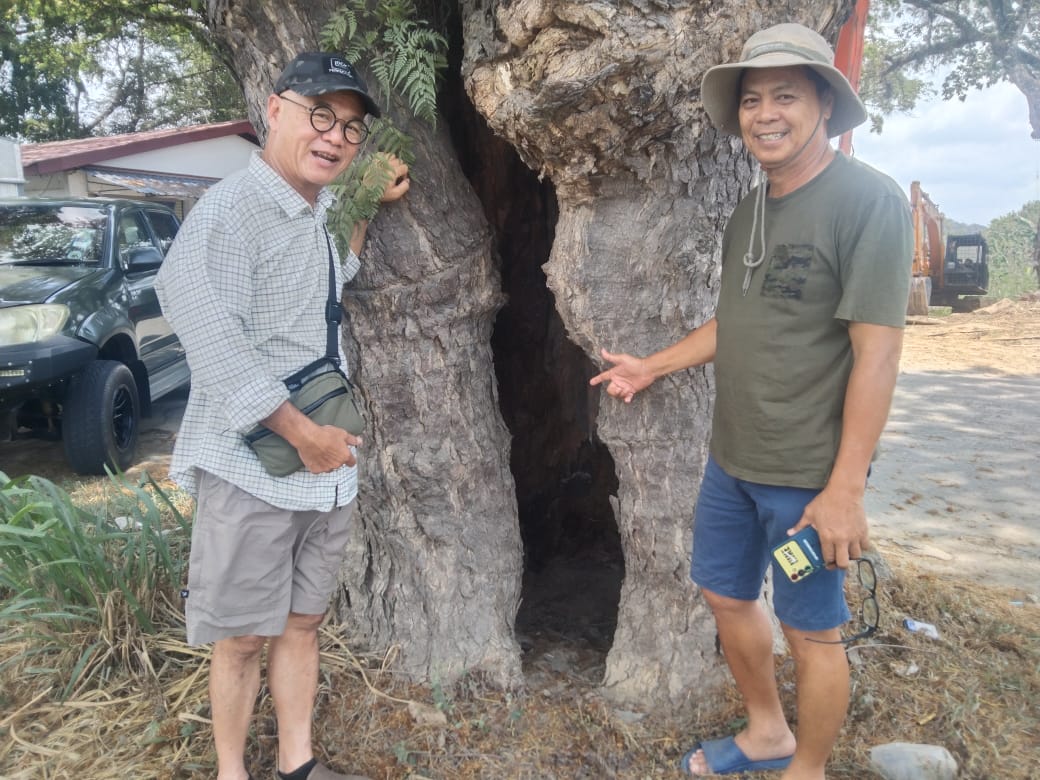
Caption: Eric (left) and former Moyog Uppm Joe Suleiman looked at the tree that said to be damaged.
By Percy G
PENAMPANG: One of the five ‘rain trees’ iconic to Donggongon here at Jalan Kasigui and earmarked for removal, supposedly tomorrow (2 April), has been deemed healthy and not damaged.
The Penampang Municipal Council (PMC) in their latest notice yesterday has postponed the felling of Samanea saman trees in the Kasigui area. No new date decided yet for the removal.
Landscape architect and registered arborist Eric Ye said that the tree is healthy but suggested that to ensure its preservation, a three-stage level 3 advanced tree assessment needed to be conducted on it.
He said the three-stage tree assessment involves the use of sophisticated equipment to carry out testing of wood structure and root exposure to inspect its root system and soil structure.
This also includes canopy inspection to check for potential structural problems on the upper structure of the tree.
“This assessment provides a more in-depth look at specific tree parts and their potential for failure by assessing a tree’s roots, stem, or crown and may include climbing and examining the roots with machinery.
“The techniques are site evaluation, soil testing, aerial evaluation, decay testing, root and collar excavation, load testing, trunk lean evaluation and storm and wind load analysis,” he said.
Located along the roadside not far from the Dewan Sigah, many residents are against its removal, as cutting it down would eliminate the district’s charm and valuable treasure.
“Hence, we need to do all we can to preserve this natural treasure that has been here for more than 80 years. It is a symbol and identity for the local people in this district.”
“Also known as ‘pokok Hujan-Hujan’, it has the ability to heal itself if it sustains damages. Therefore, I am confident that this tree can survive for another 20-50 years,” he said.
The healing process of the tree can be seen on its wound surface, which is noted to be covered with a layer of tissue called ‘callus’. In arboriculture, when a tree is wounded, it produces a tissue known as ‘callus’. This tissue forms around the edges of the wound and gradually covers it.
“Over time, the callus tissue develops into new bark and wood, effectively sealing off the damaged area which happened to one of the Hujan-hujan trees, or its scientific name, Samanea Saman, in that area.
“I can see the tree is already undergoing a healing process. It can take years depending on the size and severity of the wound, but what I see here is a testament to the tree’s resilience and ability to recover.
“These Raintrees, even though they have big holes in their stumps, are actually still intact and strong. The dry surface and the torn marks are actually signs of its recovery.
“The stump will not break, and even if left alone, it will become a healthy tree. Just look at the branches and foliage that are growing lushly,” he said, pointing at the tree canopy.
Eric is also a forest therapy guide. He claimed that the decision to remove the trees was purely based on imagination and not firmly on facts because, in actuality, the tree is still deeply intact.
Eric said that trees have an incredible ability to heal themselves, a process that sets them apart from many other organisms.
He said, unlike animals, trees cannot move to escape injuries or diseases, so they have developed unique mechanisms to protect and repair themselves. This self-healing capability is not only fascinating but also crucial for its survival.
One of the primary ways the trees heal themselves is via a process called ‘compartmentalisation’. When a tree is injured, it isolates the damaged section by creating barriers around the wound, he added.
“Environmental stressors such as drought, pollution and extreme weather can cause significant damage to the trees. However, the trees have evolved to cope with these challenges.
“It can close their stomata to reduce water loss during drought, produce protective chemicals to combat pollution, and grow thicker bark to withstand harsh conditions. These adaptive responses are part of the tree’s remarkable ability to heal and survive,” he explained.
While trees have an innate ability to heal themselves, proper care can enhance their natural healing processes.
Regular pruning, adequate watering and protecting trees from mechanical damage are essential practices for maintaining tree health, he said.