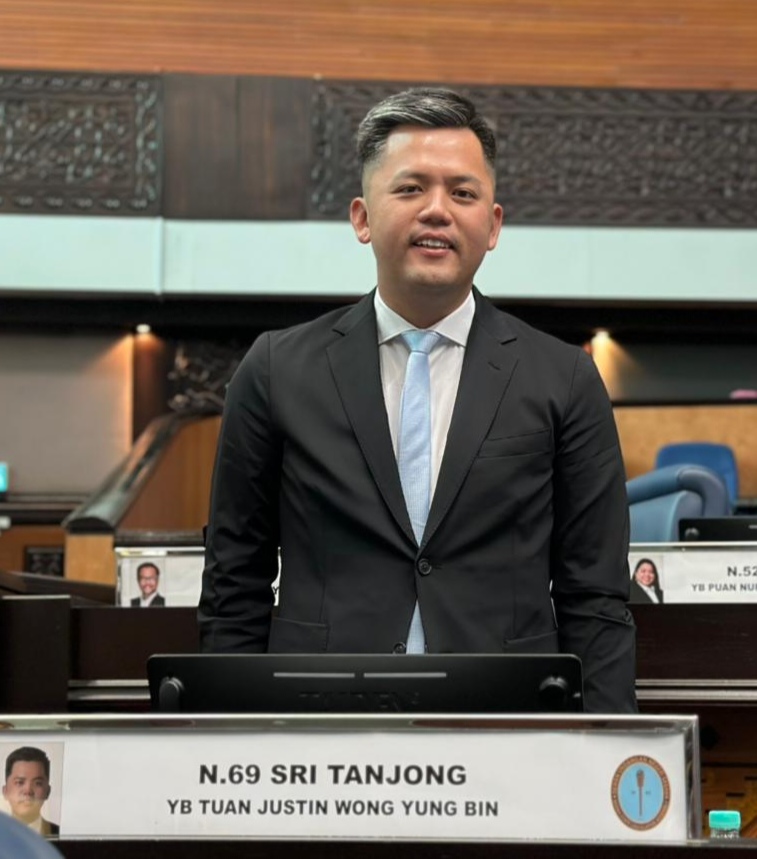
TAWAU: Commenting on the statement by Sabah Chief Minister Datuk Hajiji Noor denying the existence of the so-called “Borneo Bloc,” Sri Tanjong State Assemblyman Justin Wong described the remark as a classic example of contradictory political positioning.
According to him, denying something that had previously been raised by the same leadership reflects inconsistency and raises questions about integrity in governance as well as commitment to principles that were once strongly advocated.
“When a leader denies or contradicts statements that were previously made, it shows that in order to maintain their position, some are willing to set aside principles and the trust of the people. This also proves that the repeated emphasis on autonomy and the defence of Sabah’s rights over the years was merely rhetoric,” he said.
He noted that based on media reports several years ago, Hajiji had held discussions with Sarawak on the idea of forming a Borneo Bloc.
“At that time, he stated that the Borneo Bloc was meant to ensure political stability and to support a federal government that would benefit both Sabah and Sarawak. Moreover, when he left Bersatu, the reason given was to defend Sabah’s rights and to pursue greater autonomy for the state. Yet today, that very position appears to have been denied,” he added.
Justin Wong also believes that the denial may have been made to avoid the issue becoming sensitive ahead of the upcoming elections, particularly to prevent potential differences with parties in the federal government.
“When a leader fails to uphold the trust of the people, the consequences are far-reaching. It not only damages personal credibility but also raises questions about administrative accountability and weakens public confidence in government institutions,” he said.
He was responding to Hajiji’s statement that Malaysia should not be divided into different political blocs and that all states should instead work together for the country’s stability.
However, Justin Wong stressed that the concept of a Borneo Bloc is not intended to divide the country.
“In my view, the term ‘Borneo Bloc’ simply reflects the rise of local parties in Sabah and the growing awareness among Sabahans about their rights and interests. This development is beneficial, not harmful, to Sabah,” he said.
He emphasised that Warisan has consistently fought for Sabah’s rights, including the demand for the return of 40 per cent of Sabah’s net revenue, in line with the spirit of the Malaysia Agreement 1963.
“This struggle is not merely about forming the government, but about ensuring that Sabah’s rightful interests are not compromised or traded away for political gain,” he said.
He added that cooperation between Sabah and Sarawak could serve as a catalyst for the implementation of decisive policies and more meaningful reforms.
“We must recognise the reality that Sabah and Sarawak does not possess a one-thirds majority to exercise veto power on its own. However, by building consensus with Sarawak, we can still defend the rights and interests of the people of Borneo,” he said.
According to him, the strong support shown by voters for local parties in elections also reflects the people’s desire for Sabah’s rights and interests to continue being defended by local leadership.