KOTA KINABALU: The State Government’s substantial allocations for education and human capital development programmes this year demonstrate its capability and strong commitment to helping the people of Sabah progress.
Chief Minister Datuk Seri Panglima Haji Hajiji Haji Noor said the commitment also reflected the government’s concern in ensuring that the state’s education ecosystem remained conducive, inclusive and competitive.
He said these efforts were further strengthened through the implementation of the Sabah Maju Jaya (SMJ) 2.0 Development Roadmap for 2026 to 2030, which serves as the main strategic plan to enhance Sabah’s competitiveness, productivity and economic value in a sustainable and inclusive manner.
“The State Government has placed human capital development as one of the main pillars of the SMJ Development Roadmap. This is because education is an important foundation in shaping the future of a state and nation.
“Education is also the key to transforming the fortunes of families, eradicating poverty and subsequently driving Sabah’s progress to greater heights,” he said.
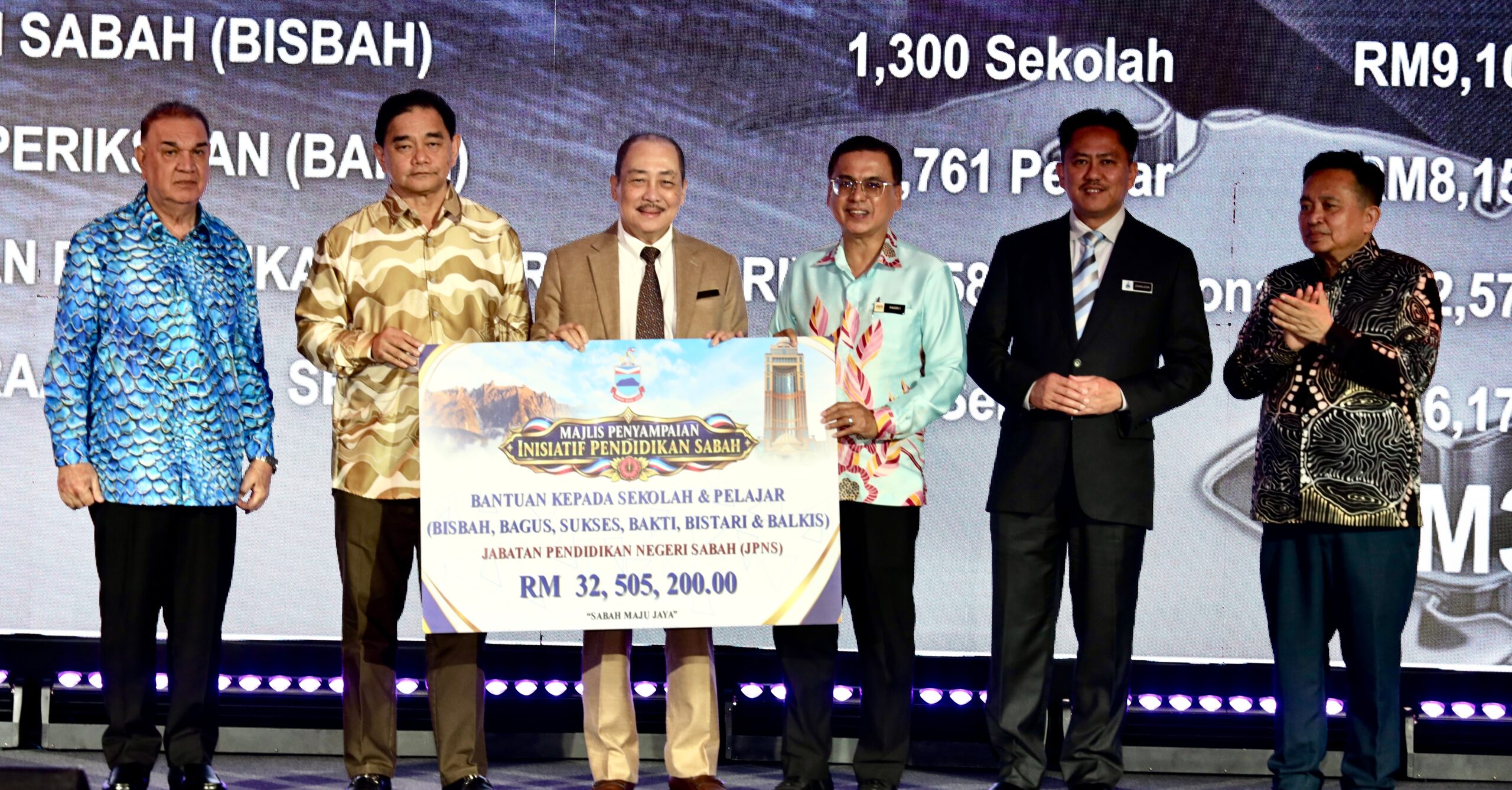
He said this at the Sabah Education Initiatives Presentation Ceremony 2026 at Dewan Bankuasi, Menara Kinabalu, here today.
Hajiji said the State Government’s principle was clear, which was to prioritise the ‘Sabah First’ agenda and guarantee access to education for all, ensuring that no Sabahan child was left behind in obtaining quality education.
He said although education essentially fell under the jurisdiction of the Federal Government, the State Government had always adopted a proactive approach and worked closely with the Ministry of Education Malaysia (MOE).
According to him, the State Government’s main focus was to ensure fair and equitable access to education for all segments of society, regardless of family background, economic status or place of residence.
“In this regard, various educational assistance initiatives have been implemented to help students from low-income families, particularly through financial assistance, scholarships and schooling support, so that no child is deprived of education due to financial constraints,” he said.
Hajiji said the State Government had implemented 14 educational assistance initiatives, including the MUET Examination Fee Assistance (BAYU) for B40 students, benefiting schools, Parent-Teacher Associations (PTAs), students of higher learning institutions and Sabah student associations both locally and abroad.
“Of these, 13 initiatives under the Sabah Ministry of Education, Science, Technology and Innovation are being implemented this year with an allocation of RM87.5 million and will continue next year,” he said.
“Among these initiatives are the One-Off Higher Education Institution Registration Cash Assistance (BUDI), Computer Assistance (BAIK), Special Examination Cash Assistance (BAKTI), State Education Savings Assistance (BISTARI), PTA Activity Assistance (BAGUS), Sabah School Assistance (BISBAH) and Minor School Maintenance Assistance (BALKIS).”Other initiatives include the Special Education Programme Assistance (BANTU), Sabah Education Excellence Awards (AKSA), Sabah Student Secretariat Malaysia (SEMESTA), Sabah Student Flight Ticket Subsidy (GRS-SUBFLY), Financial Contribution for Higher Education Students in Sabah (SENTOSA) and One-Off School Activity Contribution (SUKSES),” he said.
Hajiji said over the past five years of implementing these assistance initiatives, the State Government had spent RM254 million, benefiting 141,635 higher education students and 277,124 school students.
The allocations also benefited 1,537 schools, including religious schools, and 67 Sabah higher education student associations, while enabling the implementation of 476 educational programmes.
In addition, he said educational assistance was also channelled through several State Government agencies, statutory bodies and assistance organisations, which could be accessed through the Sabah Education Sponsorship Portal (PTPS).Among these was the Sabah State Government Scholarship (BKNS), which provides scholarships and higher education sponsorships, with its allocation increasing almost threefold to RM161 million as of October 31, 2026, compared with RM55 million in 2021.
Educational assistance was also provided by Yayasan Sabah and the Sabah Islamic Religious Council (MUIS).
Hajiji said the State Government would continue to strengthen and improve its various educational assistance initiatives to ensure more effective and transparent delivery to the intended target groups.
He also called on all parties, including government departments, schools, educational institutions, parents and local communities, to work together in supporting these efforts for the future of the younger generation, who would become the human capital, leaders and professionals contributing to the development of Sabah and the nation in the years ahead.