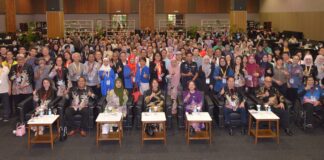
Guangzhou mission seeks agricultural know-how and business partnerships to strengthen local production and open new markets for Sabah enterprises.*
KOTA KINABALU: Sabah is looking to China’s agricultural technology to help strengthen food security, with a government-business delegation heading to Guangzhou to explore modern farming, aquaculture and commercial partnerships.
Organised by the Malaysia-China Chamber of Commerce (MCCC) Sabah, the Nov 11–14 mission will be jointly led by Sabah Agriculture, Fisheries and Food Industry Minister Datuk Jamawi Jaafar and MCCC Sabah president Datuk Dexter Lau.
It brings together government and business representatives in an effort to connect the state’s agricultural priorities with Chinese expertise and market opportunities.
According to the organisers, the mission aims to encourage modern agricultural technology adoption, strengthen food supply resilience and open direct commercial channels for Sabah enterprises within China’s Greater Bay Area.
The approach places public-sector development goals alongside private-sector efforts to identify partners, suppliers and customers.
For Sabah’s farmers and aquaculture operators, the potential value lies in identifying technology and production methods that can be adapted to local conditions.
Better resource management, more efficient production and stronger links with buyers could support a more resilient food sector, although their adoption would depend on suitability, affordability and follow-through after the visit.
The delegation’s Nov 12 programme includes scheduled visits to Guangdong HAID Group, Nansha Fisheries Industrial Park and Mingzhu Modern Urban Agriculture Experimental Park in Guangzhou’s Nansha district.
The visits are intended to expose participants to agricultural and aquaculture technologies and provide opportunities to discuss potential cooperation with Chinese counterparts.
Nansha provides a relevant setting for these exchanges through its development of aquaculture, agricultural research, processing and supply-chain infrastructure.
For Sabah delegates, the opportunity is to examine how these activities connect across the production chain and assess which approaches could help strengthen the state’s agriculture and fisheries industries.
On Nov 13, the delegation is scheduled to visit Sun Yat-sen University for an academic exchange covering governance, technology and knowledge transfer.
The programme is expected to address how technical expertise and data-informed decision-making can support sustainable development, including the blue economy, which encompasses economic activities linked to oceans and coastal resources.
A business-matching session that afternoon will bring Sabah enterprises together with Chinese counterparts through company introductions, rotating meetings and procurement discussions.
These exchanges are intended to help participants identify potential buyers, suppliers and partners, while gaining a clearer understanding of commercial requirements and opportunities in the Chinese market.
According to the organisers, four strategic memoranda of understanding involving MCCC Sabah and Chinese chambers are planned for signing during a government-business exchange dinner on Nov 13.
The proposed agreements are intended to support cross-border trade, industrial collaboration and marine-related economic cooperation, with further business discussions also scheduled.
For Sabah, the mission’s lasting value will depend on translating these contacts into practical partnerships, suitable technology adoption and sustained trade.
As part of wider Malaysia–China economic engagement, the Guangzhou visit offers an opportunity to connect stronger local food production with broader commercial opportunities for the state’s enterprises.