By Datuk Ts Dr. Hj Ramli Amir
KOTA KINABALU: If Malaysia’s logistics system is internationally competitive, why do Sabah businesses still struggle with port delays, unpredictable deliveries and expensive distribution?
Introduction
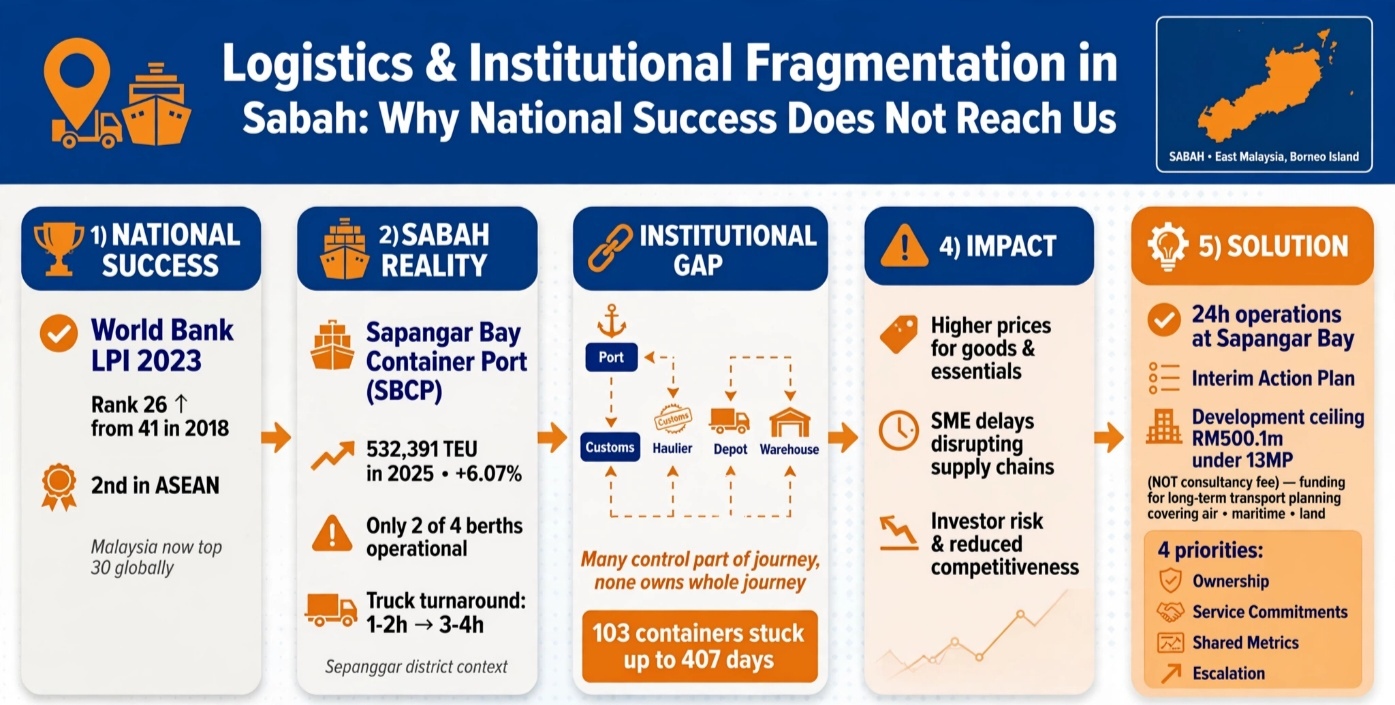
Malaysia jumped 15 ranks in the World Bank Logistics Performance Index (LPI) 2023 to 26th, the second-best-performing ASEAN country after Singapore. This was a significant improvement from 41st in 2018. [Source: Malaysiakini, The Edge Malaysia – Malaysia Productivity Corp statement, April 26, 2023; NST]
Yet national progress does not guarantee equivalent performance across every state or supply chain. National rank is an average. Sabah’s experience is a distribution.
For Sabah, the deeper issue is not simply logistics fragmentation. It is logistics fragmentation compounded by institutional fragmentation: disconnected operations managed through organisations whose mandates, budgets, decisions and performance measures do not necessarily converge.
The result is an accountability gap. Many organisations control part of the journey, but who is answerable for the journey as a whole?
Two Forms of Fragmentation, One Economic Burden
Logistics fragmentation concerns the movement of goods: weak connections between shipping, ports, depots, roads, warehouses and final destinations.
Institutional fragmentation concerns the arrangements governing those connections: separate planning processes, divided responsibilities, incompatible operating practices and insufficient authority to resolve cross-agency problems.
The distinction matters. A congested terminal may need more equipment. But if containers cannot leave because receiving depots are closed, additional cranes alone will not resolve the problem.
This does not argue that multiple agencies are undesirable. Specialisation is necessary. Fragmentation arises when specialised responsibilities lack a binding framework for joint delivery.
Sapangar Bay Reveals the Coordination Problem
Sabah’s growing cargo volumes make integration more urgent. Container throughput at Sabah Ports Sdn Bhd rose 6.07% in 2025 to 532,391 twenty-foot equivalent units (TEU). Of that volume, 396,964 TEU, or 74.6%, passed through Sapangar Bay Container Port (SBCP). [Source: BursaKL, Bernama – Statement by Deputy Chief Minister III Datuk Ewon Benedick, Oct 2026]
But capacity has not kept pace with coordination. Only two out of four berths at Sapangar Bay Container Port are operational [Source: MICCI Sabah chairman via Hellenic Shipping News], and transporters report that delays at the port have already slowed downloading operations from one to two hours per container to three to four hours, with transporters now only able to move an average of two to three containers per day. [Source: Daily Express – DP World Sabah Berhad report]
The October 2026 approval of 24-hour operations at Sapangar Bay exposes the institutional challenge particularly clearly.
The Sabah Cabinet has approved 24-hour operations for the Sapangar Bay Container Port (SBCP) to address logistics congestion [Source: Daily Express, Newswav, Borneo Bulletin], but implementation depends on the industry ecosystem’s overall readiness, as well as the readiness of related government departments and agencies.
[Source: Daily Express / Bernama]
Most local factories and depots are not yet equipped for continuous operations, with some closing as early as 5 p.m. Coordinating operating hours across the supply chain is therefore essential before the port can fully implement extended hours. [Source: BursaKL – Ewon Benedick statement]
A Cabinet decision can establish direction. It cannot, by itself, synchronise every organisation’s staffing, commercial incentives and operating hours. An open terminal gate is not the same as an operational supply chain.
The Interim Action Plan shows the government understands this. Measures include establishing additional temporary container yards, implementing revised deterrent charges, enforcing regulations on containers exceeding the allowed storage period, and upgrading port equipment to improve logistics efficiency. [Source: Nabalu News – Interim Action Plan briefing]
When Each Organisation Performs, but the System Fails
Consider an illustrative shipment originating from Sepanggar district. Customs completes clearance. The terminal at Sapangar Bay makes the container available. A haulier obtains a collection slot. However, the receiving warehouse in Sepanggar Industrial area has closed. Each organisation may have fulfilled its immediate responsibility, yet the shipment remains delayed.
Sapangar Bay’s long-stay containers demonstrate why incentives matter alongside infrastructure. New charges led to the removal of 103 containers idle for more than 21 days, with the longest at 407 days. [Source: Malay Mail, July 2026 – Ewon Benedick].
The Minister explained that previous rates were too low and had encouraged owners to store containers at the port instead of renting space at external depots. [Source: Malay Mail / Daily Express]
Records also show that 120 containers exceeded the stipulated storage duration, including 103 that had already obtained Customs clearance but remained at the port, with some there for more than a year.
[Source: The Borneo Post, Nabalu News]
The lesson is not simply that users should collect containers faster. Rules, tariffs, storage alternatives and enforcement must work together.
Institutional Boundaries Become Business Costs
Businesses experience fragmented governance through its practical consequences: uncertain release times, repeated coordination, missed delivery windows and difficulty identifying who can resolve a problem.
Economists note that geographical challenges and limited transport links made delivering goods to interior areas in the two East Malaysian regions more difficult and expensive. [Source: Free Malaysia Today – UiTM Sabah economist Firdausi Suffian].
‘When we bring in goods from the peninsula, there are shipping, handling and transport costs, as well as additional logistics costs to deliver them to the interior.’ [Source: FMT]
For SMEs, this can require larger inventories and more working capital. For manufacturers, it can undermine production scheduling. For households in Putatan, Penampang, and interior communities in Sepanggar district and beyond, avoidable logistics costs drive higher landed prices.
Move from Consultation to Joint Delivery
Sabah already has active coordination efforts.
A task force chaired by Ewon meets each month, bringing together shipping industry representatives and government agencies to oversee 10 interim action plans. Measures include temporary trailer parking within Kota Kinabalu Industrial Park (KKIP). He reported SBCP’s physical expansion at 68.1% complete, with completion expected by October 2027. [Source: BursaKL]
The next step should be to make coordination measurable and operationally binding:
1. Establish clear ownership – Designate a lead institution responsible for coordinating end-to-end logistics outcomes, with an empowered secretariat and escalation route.
2. Agree on service commitments – Port operators, clearance agencies, hauliers, depots and major receivers should establish compatible operating windows and contingency arrangements.
3. Measure shared outcomes – Publish truck turnaround, container dwell time, clearance-to-collection time and delivery reliability.
4. Resolve disputes systematically – Persistent cross-agency bottlenecks should move through a documented escalation process, with deadlines and responsible parties.
Make the Master Plan an Institutional Agreement – Clarification on RM500.1 Million
The proposed Sabah Integrated Transport and Logistics Master Plan provides the opportunity to address both physical and institutional fragmentation.
For longer-term transport planning, Ewon said his ministry had finalised terms of reference for the Sabah Integrated Transport and Logistics Master Plan. Its scope spans air, maritime and land transport, backed by a RM500.1 million development ceiling under the 13th Malaysia Plan. [Source: BursaKL – Oct 18, 2026; Bernama; Daily Express; Newswav]
It is critical to interpret this figure accurately:
This is a development ceiling under the 13th Malaysia Plan (2026-2030), not a consultancy fee to prepare the master plan document. A ceiling is a planning limit for the portfolio that can be approved, not cash already allocated for construction.
The Minister mentioned the finalisation of the master plan’s terms of reference and the RM500.1 million ceiling in the same statement about longer-term transport planning. Media reporting has linked the two, but the ceiling refers to the broader long-term transport planning portfolio that includes the master plan, not to the master plan alone.
To ensure long-term connectivity, his ministry has finalised the terms of reference for the Sabah Integrated Transport and Logistics Master Plan, covering land, sea and air modes, supported by a development ceiling of RM500.1 million under the 13th Malaysia Plan. [Source: Bernama / Warta Oriental]
The master plan should therefore specify more than projects. It should identify who decides, who funds, who implements, who maintains and who reports results.
Proposals such as Putatan-Papar logistics yards or direct shipping incentives for Sapangar Bay should be tested against cargo flows, total costs and institutional readiness. An asset without workable access, operating agreements and commercial demand risks becoming another disconnected investment.
Sabah’s challenge is therefore not merely to build more connections. It is to govern those connections as a system. National logistics success will reach Sabah more meaningfully when institutions share responsibility for the complete journey, rather than only their own segment of it.