By Datuk Ts Dr. Hj Ramli Amir, former President of the Chartered Institute of Logistics and Transport (CILT) Malaysia and Vice-President of CILT International for Southeast Asia
KOTA KINABALU: Sabah possesses many of the physical components needed for a modern logistics economy: seaports on both coasts, an international airport, regional airports, an expanding road network, industrial parks, warehouses, freight forwarders, shipping services, haulage operators and growing digital infrastructure.
Yet these assets should not be mistaken for an integrated logistics system.
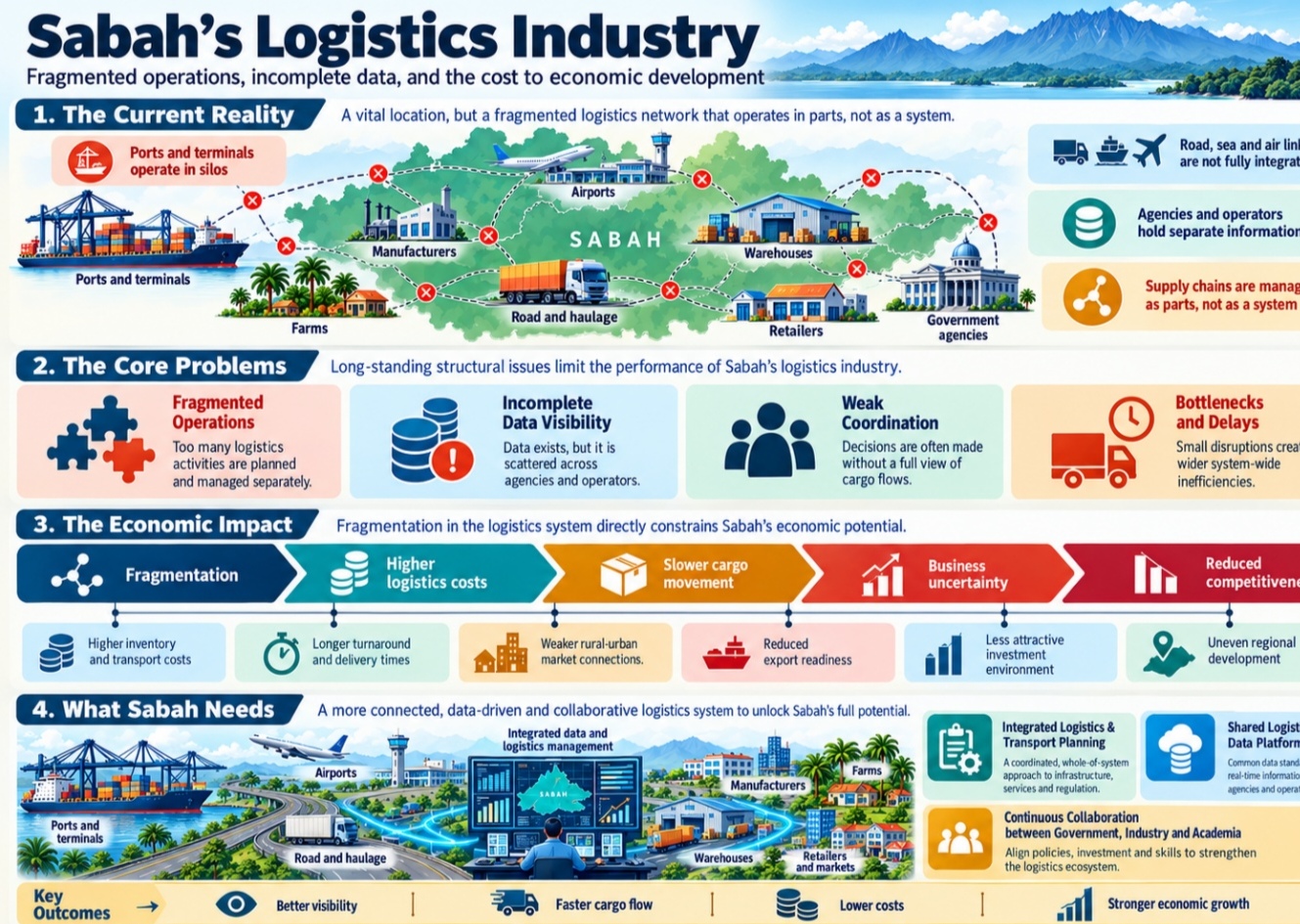
The central challenge is that much of Sabah’s logistics ecosystem still operates in a fragmented, siloed manner. Ports are managed largely from a port perspective.
Roads are planned mainly as transport infrastructure. Airports focus on aviation requirements. Industrial areas are promoted as investment locations. Customs, shipping companies, freight forwarders, hauliers, warehouses, manufacturers and government agencies maintain their own systems, priorities and information.
Each may perform its individual function reasonably well. But logistics does not create economic value through isolated components. Its value comes from how efficiently those components connect.
A container arriving at Sapangar does not complete its economic purpose when it is discharged from a vessel.
It must clear the terminal, pass regulatory processes, be collected by a haulier, travel through the road network, and eventually reach a warehouse, factory, retailer, or consumer.
Likewise, an agricultural product originating in Sabah’s interior must move from farm to collection point, perhaps through processing or cold storage, before continuing by road, sea or air to domestic or export markets. Every link matters.
A weakness in one part of the chain can reduce the efficiency of the entire system. Sabah’s logistics problems must therefore be understood not simply as port, road, or transport problems, but increasingly as whole-chain problems.
The Hidden Cost of Fragmentation
Fragmentation creates economic costs that are often difficult to see.
When shipping schedules are unreliable, businesses carry more inventory. When clearance takes longer, working capital is tied up. When trucks spend too much time waiting instead of moving cargo, productivity falls.
When ports, warehouses, and inland transport are poorly synchronised, containers pile up in the wrong places.
When rural producers lack reliable access to collection centres, cold-chain facilities or efficient transport, economic opportunities remain concentrated around better-connected areas.
These effects seldom appear under a single heading called “logistics inefficiency”. Instead, they surface throughout the economy as higher freight charges, longer delivery times, greater inventory costs, increased consumer prices, lost export opportunities, weaker investment competitiveness and uneven regional development.
In this sense, fragmented logistics becomes a hidden tax on the economy. This is especially significant for Sabah because geography already imposes structural costs.
The State is separated from Peninsular Malaysia by sea, production centres are widely dispersed, and internal distances are substantial.
Sabah cannot change its geography. But it can reduce the economic penalty geography imposes through better logistics integration.
The Missing Logistics Picture
Behind the physical fragmentation lies another major weakness: incomplete visibility into logistics data.
Sabah already generates considerable logistics data. Ports collect vessel, cargo and container information. Customs maintains trade and clearance information. Shipping companies hold schedules and freight records.
Hauliers generate vehicle movement data. Airports maintain passenger and cargo statistics. Warehouses record inventory flows. Government departments possess road, industrial, investment and economic information.
The problem is not necessarily the absence of data.
The problem is that data is dispersed across different organisations, collected for different purposes, stored in different formats, and governed by different institutional arrangements. Consequently, Sabah may possess substantial logistics information without possessing a complete logistics picture.
Knowing annual container throughput is useful. But economic planning requires more.
Where did the cargo originate? Where is it going? What commodities are being moved? How long do containers remain at the port? How long do trucks wait? Which corridors are used? Where do delays occur? What does the total movement cost?
These are questions about flows, not isolated statistics.
Without this visibility, policymakers may treat symptoms rather than causes. A truck queue may look like a transport problem, but its root cause could be vessel bunching, yard congestion, equipment shortages, documentation delays, or warehouse operating hours.
That is why logistics data should increasingly be regarded as economic infrastructure. Physical infrastructure tells us what Sabah has built. Logistics data shows how effectively that infrastructure works.
Logistics Is the Economy in Motion
Logistics becomes clearer when Sabah’s economy is viewed as an ecosystem of supply chains.
Palm oil depends on plantations, mills, tankers, storage, roads and ports. Tourism depends on aviation connectivity, airports, ground transport and hospitality supply chains. Manufacturing depends on imported inputs, warehousing, reliable transport, and market access.
Agriculture depends on collection networks, processing, cold chains and distribution. Oil and gas requires specialised marine logistics and supply bases. The Blue Economy depends on ports, shipping, fisheries logistics, coastal communities and maritime connectivity.
Logistics therefore should not be seen merely as another economic sector. It is the connecting system through which virtually every other economic sector functions.
When logistics is fragmented, economic development itself becomes fragmented.
From Projects to Systems
Sabah is entering a period of substantial investment in ports, roads, airports, industrial development, border connectivity and digital infrastructure.
This presents enormous opportunity, but also a risk.
If Sabah develops each project independently, it may end up with better individual assets without a better logistics system.
A larger port does not automatically create more cargo. A wider road does not automatically create more trade. A logistics hub does not automatically generate supply chains. Digitalisation does not automatically create integration if every organisation builds its own platform.
The emphasis must therefore shift from developing projects to developing systems.
Ports must connect effectively with their hinterlands. Road planning must reflect cargo flows. Industrial policy must align with freight planning.
Airports must consider air-cargo potential. Border infrastructure must support trade corridors. Digital platforms must allow information to move across institutional boundaries.
Towards an Integrated Sabah Logistics System
Three foundations are particularly important.
First, Sabah needs an Integrated Logistics and Transport Master Plan that provides the overall architecture for ports, roads, airports, industrial areas, logistics hubs and trade corridors.
Second, it needs a shared logistics data platform that consolidates strategic information across the logistics ecosystem.
Third, it requires a strong institutional mechanism for continuous collaboration among government, industry, academia and logistics professionals.
The masterplan provides direction. The data platform provides evidence. Institutional collaboration provides coordination. Sabah is not starting from zero. Infrastructure, institutions, and industry experience already exist.
The challenge is to connect what already exists.
The next logistics transformation should therefore be measured not simply by how many ports, highways, warehouses or digital systems Sabah builds, but by how efficiently goods, people and information move through the entire network.
Ultimately, logistics is the economy’s circulatory system. When that system is fragmented, economic activity slows, costs increase, and opportunities remain disconnected.
Sabah doesn’t just need more logistics infrastructure. It needs an integrated logistics system.
Achieving that integration may be one of the most important foundations for Sabah’s next phase of economic development.