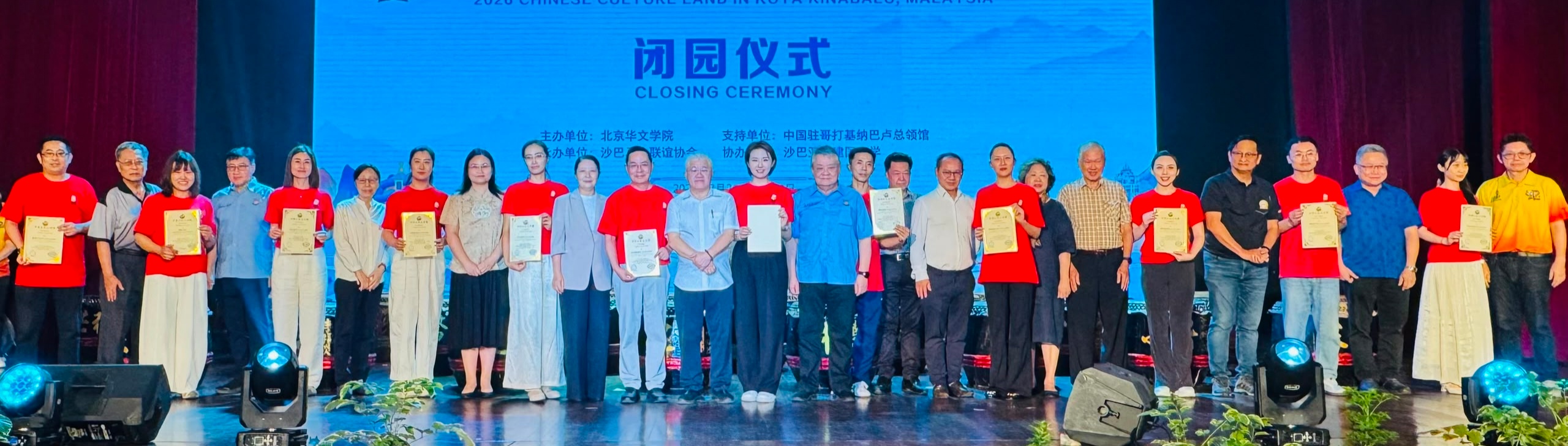
KOTA KINABALU (Sabah) : Chinese Culture Land In Kota Kinabalu” concluded today with a closing and graduation ceremony held at Kinabalu Chinese School. Nearly 400 primary and secondary school students from various parts of Sabah and different ethnic backgrounds successfully completed the programme, returning home enriched by their exposure to Chinese culture.
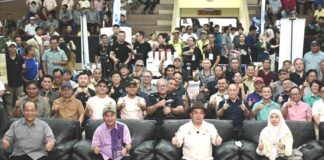
The closing ceremony was officiated by Chin Teck Ming, legal adviser of the Malaysia-China Friendship Association Sabah and state assemblyman for Kepayan. Also present were Xue Xiaoning, Deputy Consul General of the Consulate-General of the People’s Republic of China in Kota Kinabalu; Kong Xuemei, Deputy Dean of Beijing Chinese Language and Culture College and head of the Chinese Culture Land In Kota Kinabalu delegation; Datuk Clement Yeh, chairman of the board of Kian Kok Middle School and honorary president of the Malaysia-China Friendship Association Sabah; as well as guests, teachers, students and parents, who gathered to witness the successful conclusion of the cultural exchange programme.
In his speech, Chin said Sabah is a state rich in cultural diversity, where people of different ethnic groups live together harmoniously while respecting and learning from one another. He described this as Sabah’s most valuable asset.
He said the significance of the Chinese Culture Land In Kota Kinabalu lies not only in enabling students to learn about Chinese culture, but also in creating a platform for cultural exchange and mutual understanding, allowing the younger generation to learn appreciation amid differences and respect amid diversity.
“Cultural exchange is not about making everyone the same. It is about enabling people to know and understand one another. Today, nearly 400 students from different schools and ethnic backgrounds have gathered here because of Chinese culture. They have learned and grown together while forming valuable friendships.”
He noted that this year marks the 52nd anniversary of the establishment of diplomatic relations between Malaysia and China. Bilateral ties have developed steadily over the years, while people-to-people exchanges remain an important foundation for strengthening friendship. Since its establishment 14 years ago, the Malaysia-China Friendship Association Sabah has continued to promote cooperation in culture, education, youth and sports, actively building bridges for communication and collaboration between Sabah and China.
“Today’s programme is an excellent example of people-to-people friendship between Malaysia and China. Graduation is not the end, but a new beginning. I hope the students will bring what they have learned over the days back to their schools and families, and become bridges between different cultures.”
Meanwhile, Datuk Clement Yeh said hosting the programme at Kian Kok Middle School had infused the campus with a strong Chinese cultural atmosphere and provided students with the opportunity to experience the richness and depth of Chinese culture through a wide range of courses.
He said courses such as Chinese dance, lantern-making, calligraphy and painting, and drumming were not merely lessons in knowledge, but also the sowing of seeds for cultural inheritance.
“The transmission of Chinese culture cannot remain confined to textbooks. It requires experience, practice and exchange so that the younger generation can truly understand and appreciate the culture, and willingly take on the responsibility of preserving and passing it on.”
He expressed appreciation to the Consulate-General of the People’s Republic of China in Kota Kinabalu, Beijing Chinese Language and Culture College, the Malaysia-China Friendship Association Sabah, the Kota Kinabalu Hokkien Association, as well as the organising committee, board members, teachers and staff for their collective efforts in ensuring the successful implementation of the programme.
He hoped the students would bring what they had learned back to their schools and families, allowing Chinese culture to continue taking root, blossoming and bearing fruit in Sabah. He also looked forward to further cultural and educational exchanges with Beijing Chinese Language and Culture College and other relevant organisations.
In her closing speech, Kong Xuemei said that since the opening of the programme, the campus of Kian Kok Middle School had been filled with the atmosphere of Chinese culture, with the sounds of drums, recitations and laughter coming together to create a vibrant picture of cultural exchange.
She said the programme offered 12 courses, including Chinese culture, large drum performance, ethnic dance, martial arts, Baduanjin, vocal music, recitation, handpan drumming, lantern-making, paper-cutting, calligraphy and painting, and shadow puppetry. Through hands-on practice and personal experience, students gained a deeper understanding of China’s outstanding traditional culture.
“Many students were coming into close contact with traditional Chinese culture for the first time. However, through their enthusiasm and hard work, they have engraved Chinese culture deeply in their hearts. The Chinese teachers were deeply moved to see the students actively interacting and learning with dedication.”
Kong stressed that the conclusion of the Chinese Culture Grand Garden was not the end of the cultural experience, but a new starting point for cultural inheritance. To allow the students’ passion for culture to continue, Beijing Chinese Language and Culture College donated all the teaching materials used during the programme to Kian Kok Middle School, including costumes and props, calligraphy and painting supplies, handicraft materials, handpans and shadow puppetry equipment, for future Chinese cultural education activities.
She hoped these teaching resources would continue to accompany Sabah students as they explored the beauty of Chinese culture. She also expressed the hope that Kian Kok Middle School would continue to deepen its Chinese-language education efforts, enabling more Malaysian youths to discover a spiritual connection with Chinese culture.
She also thanked the Chinese diplomatic missions in Malaysia, the Malaysia-China Friendship Association Sabah, Kian Kok Middle School, all teachers, staff and parents for their strong support and cooperation in making the programme a success.
Meanwhile, Dance Group participant Liaw Yi Xuan, speaking on behalf of all campers, expressed her heartfelt appreciation to the 13 instructors from Beijing Chinese Language and Culture College for travelling from China to Sabah to conduct the programme.
She said the instructors had brought a wide range of engaging and enriching cultural courses, making every day of the camp an exciting learning experience.
Liaw also thanked the parents for supporting their children’s participation in the programme during the school holidays, describing the camp as a unique opportunity to experience and appreciate Chinese culture.
On behalf of all participants, she extended her gratitude to the teachers of Kian Kok Middle School for dedicating their holiday time to serve as teaching assistants, preparing materials and attending to the many logistical needs of the camp.
Sharing her personal experience in the Dance Group, Liao said she initially found it challenging to remember the movements and keep up with the rhythm.
“Having trained in ballet since I was young, learning Uyghur and Dai ethnic dances for the first time was a completely new experience and a significant challenge. However, as the days went by, I gradually adapted and discovered the joy and freedom that these dances bring,” she said.
She added that participants from other groups had similarly enjoyed their respective classes, with some describing Chinese drumming as exciting and energetic, while others found lantern-making rewarding and shadow puppetry fascinating.
According to Liaw, the instructors not only taught practical skills but also shared the cultural stories and historical background behind each art form, allowing students to gain a deeper understanding of Chinese culture beyond what is taught in textbooks.
“We will bring what we have learned back to our homes and schools and share it with our families and friends. We hope to meet our teachers again in the future, and perhaps one day visit China to experience firsthand the origins of the cultural traditions we have come to appreciate through this camp,” she said.
The “2026 Chinese Culture Land In Kota Kinabalu” was organised by Beijing Chinese Language and Culture College, hosted by the Sabah Malaysia-China Friendship Association, co-organised by Kian Kok Middle School, and supported by the Consulate-General of the People’s Republic of China in Kota Kinabalu. Since its commencement in late August, the programme has attracted nearly 400 students, promoting Malaysia-China people-to-people exchanges and deepening understanding and friendship between the youths of both countries through a variety of Chinese cultural courses and interactive activities.
With nearly 1,000 attendees present and outstanding student performers sharing their reflections, the closing ceremony of the Chinese Cultural Land concluded successfully. Through a series of presentations and performances, the participants showcased the knowledge and skills they had acquired throughout the programme, bringing this year’s Chinese Cultural Land to a meaningful and memorable close.
The organizers expressed their hope to further strengthen Malaysia–China cultural and educational exchanges in the future, enabling Chinese culture to continue flourishing and being passed on in Sabah, while injecting greater youthful energy into the enduring friendship between Malaysia and China.