

(A Special Report in Conjunction with the 2026 State-Level Kaamatan Festival)
By Ratatouille (Majangkim Office)
KOTA KINABALU: In the misty highlands of =, where the Pegalan River cuts through the Crocker Range and the spirit of Mat Salleh still haunts the hills, a boy was born on 17 August 1940 who would grow to become a legend.
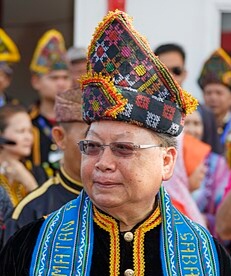
His name is Joseph Pairin Kitingan. The Kadazan Dusun Murut community calls him by another name: Huguan Siou — the Paramount Leader.
He is the first Kadazan and Sabahan indigenous person to qualify as a lawyer in Malaysia.
A Colombo Plan scholarship took him to the University of Adelaide, where he read law and returned not to chase wealth but to lift his people.
But titles do not capture a life. Let us try.
The Lion of Tambunan
They say the Kadazandusun community was sidelined, lagging, searching for a voice. They found it in Pairin.
In 1975, he entered politics. In 1976, he won the Tambunan state seat under BERJAYA. But he grew restless. He came to politics to change the landscape of his village—and its entirety, to this day.
By 1984, he left to form a new party – Parti Bersatu Sabah (PBS) – and in April 1985, at the age of 44, he was sworn in as the 7th Chief Minister of Sabah.
Here was a son of the soil, carrying the hopes of his community into the highest office of the land.
He served from 1985 to 1994. Those were not easy years. He fought for Sabah’s rights. He stood firm against federal pressure.
He refused to bow to agendas that would erode the dignity of his people.
And for that, he was punished — humiliated, ostracised, charged with corruption, and his aides and brother arrested for supposedly planning to secede from Sabah.
The political establishment tried to break him. But they did not understand: you cannot break a man whose roots run as deep as Tambunan’s hills.
Then came 1994. PBS won the state election with a slim majority. But defections — the slow poison of Sabah politics — cost him the government.
One by one, his own assemblymen crossed the floor. Within weeks, the man who had led the Kadazan Dusun renaissance was reduced to five seats, forced to concede, and left to watch as everything he built crumbled from within.
That is the wound that still aches.
The Labuan Annexation and the Birth of a Paramount Leader
Before 1984, the Kadazan Dusun community was powerful but fractured. Warring clans, competing interests, and a lack of unified leadership meant that while they were strong in numbers, they were weak in voice.
Then came the Labuan annexation. In 1984, the federal government unilaterally carved out the island of Labuan from Sabah and declared it a federal territory.
It was a political amputation made without the consent of the people whose land it was. For the Kadazan Dusun, this was not just territorial loss. It was the final insult.
For the first time, the community realised that if they did not unite, they would be swallowed piece by piece. They needed a leader who could stand, not for a village or a clan, but for the entire indigenous heart of Sabah.
They found him in Joseph Pairin Kitingan.
Within months of the annexation, Pairin broke from the ruling party. In December 1984, he contested the Tambunan by-election as an independent and won.
His popularity was not manufactured. It was forged in the fire of betrayal.
The Bobohizan, the high priestesses of the Kadazan Dusun, anointed him Huguan Siou — the Paramount Leader — in a symbolic ceremony at Kampung Tuavon, Penampang. It was not a political appointment. It was a calling.
By April 1985, he was the 7th Chief Minister of Sabah. His Parti Bersatu Sabah (PBS), formed with the support of the community, swept the state election. For the first time, all the warring clans fought as one — and they won.
The Unwinnable War: Project IC and the Dilution of a People
The victory did not last long. The federal government had a weapon far more devastating than tanks or laws. It was called Project IC.
Project IC was a large-scale operation by federal agencies to systematically grant Malaysian citizenship to Muslim immigrants from the southern Philippines and Indonesia.
The purpose was blunt: to increase the population in Sabah and dilute the political influence of the indigenous Kadazan Dusun and Christian communities.
Former Sandakan district chief Hassnar Ebrahim informed a Royal Commission of Inquiry regarding the presence of the alleged architects behind the scheme.
He testified that identity cards were processed in bulk and handed to illegal immigrants to change Sabah’s demographic outlook. Tuaran MP Datuk Seri Wilfred Madius Tangau later highlighted that 400,000 “missing” people in Sabah’s population records are actually the legacy of Project IC — people who were given citizenship for political votes.
And what did the Huguan Siou do? He fought. In parliament. In the streets. In every international forum that would listen.
But it was an unwinnable war. How do you fight against a federal government that controls the National Registration Department?
How do you stop a flood of identity cards when the same government that issues them also denies their existence?
Pairin fought anyway. He stood steadfast while his own government crumbled. He did not surrender. He simply watched as the community he united was slowly divided again — not by choice, but by demographic engineering.
The Paramount Leader
“Huguan Siou” is not a political title. It is a spiritual and cultural one, conferred in 1984 by the Kadazan Dusun community.
A lifetime honour, bestowed by the people, not by any government. It is akin to a sultan’s role.
Pairin wears it lightly. But its weight is immense.
He is the president of the Kadazandusun Cultural Association (KDCA), a position he has held for decades.
Through the KDCA, he has worked tirelessly to preserve native traditions, advocate for community rights, and remind Sabahans that their identity is not for sale.
Even in his 80s, he remains active. In April 2025, he was re-elected to lead the KDCA Central Committee for the 2025–2028 term. At the 2025 Kaamatan Festival, he urged
Sabahans to guard their traditions against the misuse of artificial intelligence, warning that unchecked technology could lead to cultural erosion. That is a man who never stops watching over his people.
Bagus Bagus Ko Disana.
We wrote those words for our own mothers. But Pairin has lived them for his community.
Bagus bagus ko disana—Be good there.
Take care. Don’t forget who you are.
That is the message he has carried from Tambunan to Kota Kinabalu, from the halls of parliament to the cooling evening air of Hongkod Koisaan. He represented his people in the Dewan Rakyat for 32 years.
That is not ambition. That is duty.
In 2016, at 76, he said he was 99 per cent sure he would not contest the coming elections.
He wanted to retire, he said, to spend time with his grandchildren and to finish writing a book. But in 2018, he still contested—and lost.
But that loss was not the sign of an ageing, discarded politician.
Instead, it was a wake-up call for him to dive into a new adventure—a higher purpose to unite his people and serve as an inspiration to the newer generations.
When asked about the legacy he would like to leave behind, he said: “Remember the good things and forget about the bad.” That is Huguan Siou’s grace.
Meeting the Father of the Community
The brutal life lesson is that you can lose everything.
The wake-up call is remembering your mother’s love, knowing your purpose in life, and recognising the ones who stood by you. Pairin is a father who stayed.
Meeting him personally, one cannot help but be completely awestruck by his presence. There is a quiet, magnetic dignity to him.
When he looks at you, you see the unmistakable, warm twinkling in his eyes—a gaze that has witnessed decades of history but hasn’t lost its light. And when he reaches out, he gives one of the firmest handshakes you will ever experience in your life.
It is a good, grounding grip. It is the handshake of a man who knows exactly who he is and who has held the weight of an entire people in those very hands.
For native leaders, the greatest gift in retirement is not an easy exit but the profound moments of reflection on the sacrifices made and the hard decisions weighed over the years.
Today, his true joy lies in the eyes of his grandchildren and a new generation that looks up to him as a father figure. It is found in a quiet morning, feeling the cool mountain air brush against his face, with the book he long promised to write finally nearing completion.
What the Huguan Siou Means for Sabah Today
Pairin stood. He stood for the 40 per cent revenue entitlement long before it became a courtroom fight.
He stood for MA63 before it was fashionable. He stood for the protection of native customary lands, for the Kadazan Dusun language in schools, and for a Sabah that does not bow.
In 2024, at the signing of a pact between PBS and STAR, the elderly Pairin grew emotional when asked about the fracturing of his community. “I don’t want to go back there,” he said. “It hurts and saddens me.”
Then he added: “Do not disappoint us again.” That is not a politician speaking. That is a father.
There have been calls to appoint Pairin as the next Sabah governor (TYT). Whether that day comes or not, the title “Huguan Siou” already outranks any government appointment. It was given by the people. It cannot be taken away.
Not a Farewell
He is now in his mid-80s. We do not write this as an obituary. We write this as a tribute to a living legend. Joseph Pairin Kitingan is not perfect. He has made mistakes and has said so himself.
But in the misty highlands of Tambunan, where the reeds sway and the Pegalan River flows, they still remember the boy who left and came back a Huguan Siou. They remember the man who came to politics to change the landscape of his village—and its entirety—to this day.
Bagus bagus ko disana, Huguan Siou. We see you. We thank you. We remember.
By Remy Majangkim (Majangkim Office) for the Paramount Leader who fought the unwinnable war and never asked for forgiveness.

