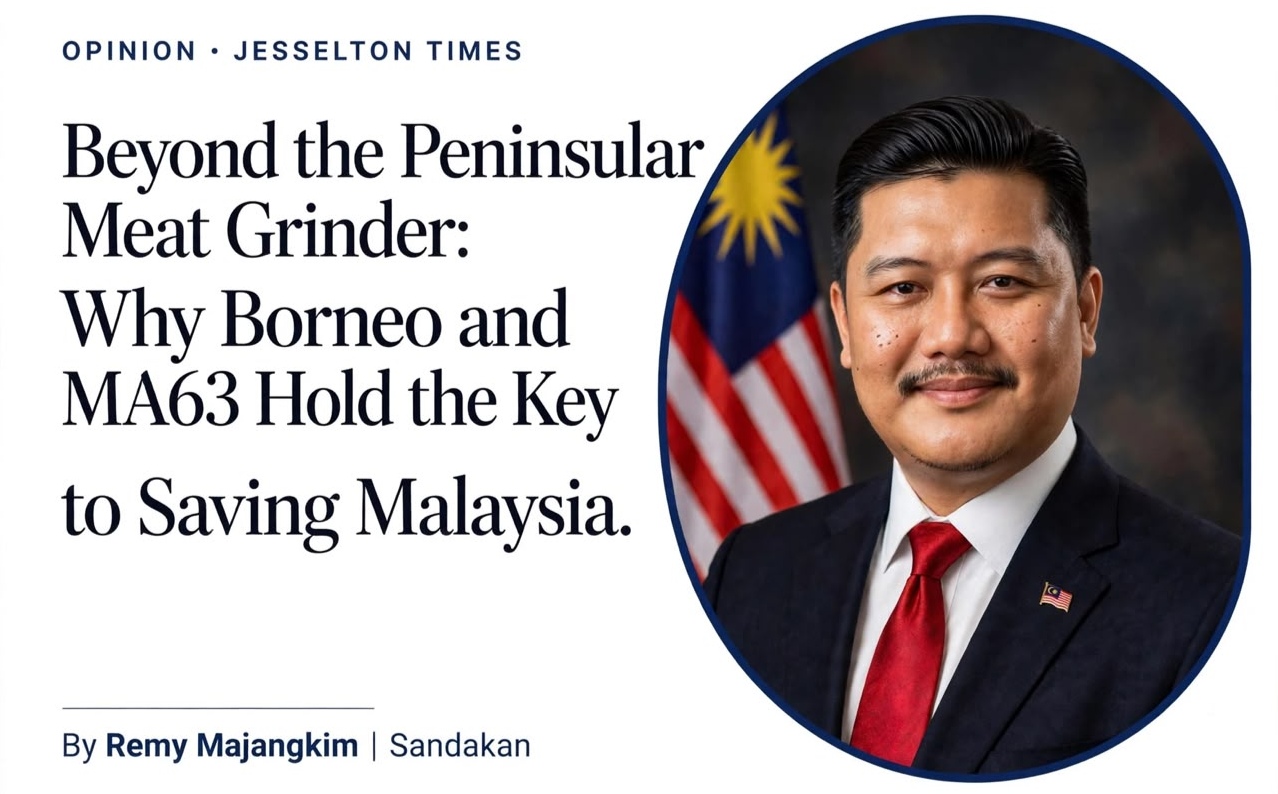
By Remy Majangkim
KOTA KINABALU: Look across the political landscape of Peninsular Malaysia in 2026, and a sobering picture emerges.
Through the state elections in Johor, Negeri Sembilan, and Melaka, Malayan coalitions have become locked in an endless war of attrition.
Pakatan Harapan, Barisan Nasional, and Perikatan Nasional continue to burn political capital in a zero sum meat grinder of shifting pacts, ideological gridlock, and communal polarization.
While the Peninsula exhausts itself in perpetual political combat, a quiet but decisive transformation is unfolding across the South China Sea.
Seen clearly, the Borneo States and the Malaysia Agreement 1963 (MA63) are no longer merely regional grievances to be managed; they are the constitutional anchor capable of stabilizing and saving the Malaysian federation.
Two Shots Fired Across Borneo
The shift began almost exactly one year ago, on November 29, 2025, when Sabah fired the first shot in the 17th Sabah State Election. Voters delivered a blunt verdict against Peninsular coalitions: Pakatan Harapan was reduced to a single seat, DAP was wiped out across its urban strongholds, and Barisan Nasional fell to just six seats. Instead, Sabahans rallied behind homegrown forces, propelling Gabungan Rakyat Sabah (GRS) to 29 seats and Parti Warisan to 25.
One year later, on November 28, 2026, Sarawak answered with a thunderous echo. When nominations closed for the 13th Sarawak State Election, Gabungan Parti Sarawak (GPS) won a record 29 of 82 seats unopposed, surpassing the state’s previous high of 19 walkovers in 1996.
Nearly a third of Sarawak’s electorate did not even need to cast a ballot to register their mandate.
When major Peninsular coalitions opted to sit out the 2026 Sarawak polls entirely, it was an admission that East Malaysia’s political terrain no longer belongs to Kuala Lumpur.
Sarawak’s Fortress and Sabah’s Shaky Ground
Yet as both states march toward the 16th General Election (GE16), a stark divergence separates them.
Sitting in the front row as Malaysia endured years of federal instability and Peninsular polarization, Sarawak closed ranks and built real institutional muscle. GPS turned regional sentiment into a governing shield by neutralizing the very issues tearing the Peninsula apart:
• Inclusive Education: Retaining English as an official state language, implementing English instruction for Science and Mathematics across schools, establishing state international schools offering the Cambridge syllabus, and recognizing the Unified Examination Certificate (UEC) alongside free tertiary education at state institutions.
• Social Harmony: Protecting multiracial and multi religious coexistence through institutional support such as UNIFOR, insulating Sarawak from identity politics.
• Economic Sovereignty: Building real leverage through Petroleum Sarawak Berhad (PETROS), a controlling stake in Affin Bank, green energy investments, and the Sarawak Sovereign Wealth Future Fund.
To Malaysians weary of Peninsular gridlock, Sarawak’s unity and policy clarity have become an object of genuine envy.
Sabah, by contrast, fired the opening shot in 2025, yet the coalition leading the state stands on far shakier ground.
Unlike GPS, which commands decisive dominance and speaks with one voice, GRS emerged from the 2025 polls with only a plurality of 29 out of 73 seats, relying on a patchwork post election pact with former rivals, including Barisan Nasional and Pakatan Harapan, to govern.
Caught between grassroots demands for purely local autonomy and continued entanglement with Peninsular parties, GRS faces a crisis of identity and inspiration.
While Sarawakians point to tangible milestones, many Sabahans still contend with daily frustrations over water, power, infrastructure, and the unfulfilled promise of the 40% constitutional revenue entitlement.
Without the courage to stand firmly on its own feet and unite behind a transformative vision, Sabah risks entering GE16 hesitant and divided.
MA63: The Blueprint to Save the Nation
Why does Borneo’s strength matter to every Malaysian, from Johor Bahru to Kota Kinabalu? Because the Peninsular political model has reached a dead end. A system driven by ethnic division and centralized control cannot carry Malaysia forward.
MA63 offers the exact antidote. Signed in 1963 to unite equal partners into a secular, pluralistic, and decentralized federation, MA63 was designed to guarantee regional autonomy, protect diversity, and prevent any single bloc from dominating the nation unchecked.
Restoring the spirit and letter of MA63, including Borneo’s rightful parliamentary representation, fiscal autonomy, and decentralized governance in education and healthcare, does not weaken Malaysia. It rescues the federation from the dysfunction of hyper centralization.
Borneo’s Moment of Truth
For more than six decades, Borneo has too often been treated as a silent partner in the nation it helped build.
That era is ending, not because Putrajaya granted permission, but because Borneans themselves are awakening to their own worth.
Sarawak has proven what happens when leaders refuse to be divided by external politics and focus on building, protecting, and delivering.
Sabah holds that same untapped spirit, waiting for leadership bold enough to rise above survival politics and match the courage of its voters.
As Sarawakians head to the polls on December 12, the message resonating from Kuching to Kota Kinabalu is unmistakable: Borneo will no longer be dragged into the Peninsular meat grinder, nor will its destiny be written in Kuala Lumpur.
When Sabah and Sarawak stand together, anchored in the promise of MA63, they do more than claim their rightful place ahead of GE16. They offer Malaysia a model of unity, moderation, and hope that can save the nation itself.