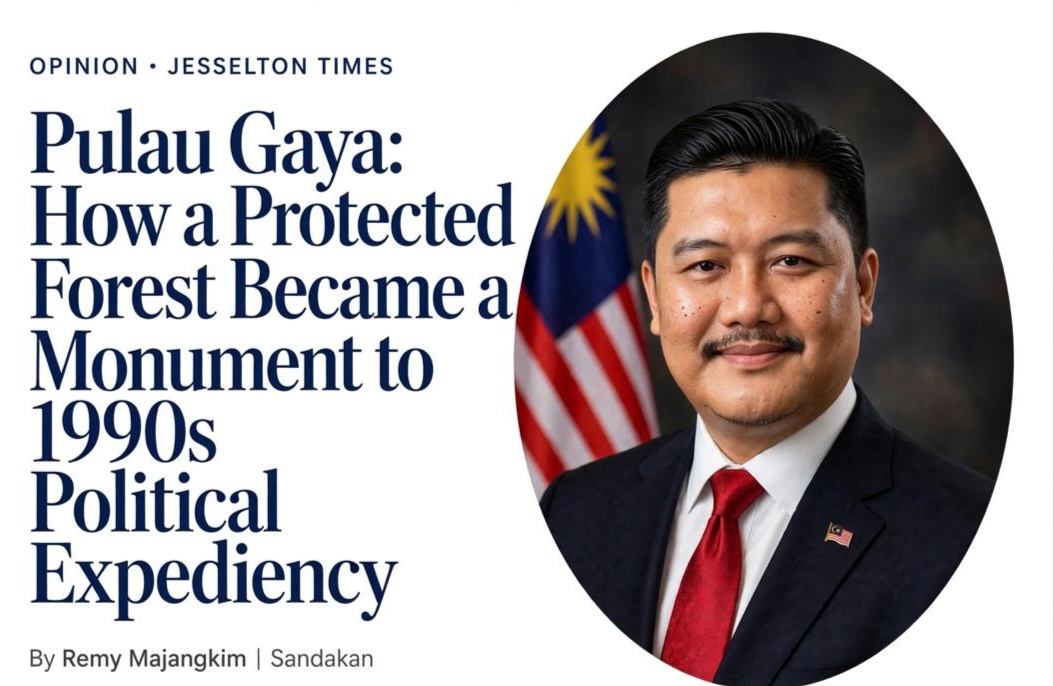
By Remy Majangkim
KOTA KINABALU: Anyone who stood along the Kota Kinabalu waterfront in the 1990s knew the daily rhythm of the channel.
Across a narrow stretch of water sat Pulau Gaya, gazetted as a Forest Reserve in 1923 and later incorporated into Tunku Abdul Rahman National Park in 1974.
In those early years, the island’s waters were clean enough to watch herds of Bornean bearded pigs (Sus barbatus) swimming across the strait between intact coastal rainforest and the mainland.
Yet right at the city jetties, a very different migration was unfolding in plain sight.
Small boats shuttled back and forth all day, ferrying blue plastic jerrycans of mainland tap water, planks of timber, and zinc sheets across to an island that had no rivers, no piped water, and no legal residential land.
Individuals deported one month would quietly reappear at the very same jetty two weeks later, hammering together new stilt homes over the shallow reefs with their own hands, paying no rent, holding no title, and answering to no municipal plan.
Now, more than three decades later, Dewan Bandaraya Kota Kinabalu’s (DBKK) issuance of 14-day demolition notices on 16 November 2026, ordering unapproved structures in Kampung Pondo cleared by 30 November, has forced Sabah to confront an uncomfortable truth: today’s generation is being left to clean up a structural disaster engineered in the 1990s.
From Colonial Lesson to Gazetted Sanctuary (1882 to 1974)
History had already proven Pulau Gaya unsuitable for dense urban settlement. When the British North Borneo Chartered Company established its first West Coast outpost on the island on 26 September 1882, it abandoned the site within fifteen years. This happened not only because resistance leader Mat Salleh burned the station down on 9 July 1897, but also because the island lacked fresh water and fertile land.
The British moved across the water to Api-Api, founding Jesselton (now Kota Kinabalu) in 1899.
Recognising its ecological value and physical limits, the state gazetted Pulau Gaya as a Forest Reserve in 1923 and placed it under the Tunku Abdul Rahman National Park in 1974. Legally and environmentally, the island was meant to remain protected forest.
The 1990s Watch: Statutory Declarations, “Project IC,” and the Revolving Door
That mandate collapsed during the political turbulence of the 1990s and early 2000s.
Following the fall of Parti Bersatu Sabah (PBS) in 1994 and the rise of the Barisan Nasional (BN) and UMNO administration in Sabah, the state entered an era later laid bare by the 2012 to 2014 Royal Commission of Inquiry (RCI) on Illegal Immigrants in Sabah.
As the RCI documented, this was the era of “Project IC,” where syndicates and corrupt officials systematically facilitated the issuance of Malaysian identity cards to undocumented migrants from the southern Philippines and Indonesia, frequently relying on unverified Statutory Declarations (SDs) in place of genuine birth records.
During this era of rampant documentation, a critical constitutional loophole was routinely exploited.
Under Article 160 of the Federal Constitution, newcomers who professed Islam and spoke basic Malay could be registered broadly as “Malay” on federal identity cards.
Yet under Sabah’s Interpretation (Definition of Native) Ordinance (Cap. 64), federal classification as “Malay” does not confer the legal status of Anak Negeri (Native of Sabah).
On the ground in Pulau Gaya, the demographic shift was unmistakable: standing amidst the sprawling wooden walkways of the 1990s, the distinct indigenous dialects of Sabah’s traditional Bajau Samah and Bajau Ubian islanders had become almost entirely drowned out.
With Kota Kinabalu providing low-wage work and free access to mainland water at the jetties, self-built stilt colonies such as Kampung Pondo and Kampung Lok Urai sprawled rapidly over the coral reefs.
Enforcement became a revolving door: deportees sent back across the Sulu Sea returned within weeks via porous maritime routes, while politicians during that era treated the growing settlements not as an urgent breach of sovereignty and conservation, but as an expanding vote bank under the old Gaya parliamentary seat (and later Putatan and Tanjung Aru).
State Land, Unlicensed Graves, and the Exhumation Dilemma
Despite decades of unchecked growth, Sabah’s statutes leave zero ambiguity about the legal status of unauthorized occupation on Pulau Gaya.
Under Sections 5 and 6 of the Sabah Land Ordinance (Cap. 68), all State land and reserved land vests exclusively in the Government.
Decades of self-built occupation never create adverse possession or a legal right to a title, and Part IX empowers authorities to summarily evict trespassers and demolish unapproved structures.
Furthermore, under the Forest Enactment 1968, the Parks Enactment 1984, and Section 23 of the Land Ordinance, no new customary rights can be created on gazetted forest reserves, park land, or State foreshore and seabed.
This strict statutory rule extends beyond the living to the dead, creating one of the most sensitive flashpoints of the November 2026 eviction order.
Under Section 29(c) of the Sabah Land Ordinance, no land may be used to bury a human body without written authority under the Burials Ordinance (Cap. 19). Under Cap. 19, any burial ground requires a formal licence from the Yang di-Pertua Negeri via the Director of Lands and Surveys.
Where corpses are buried on State land or gazetted forest reserves without a licence, a Magistrate holds full legal authority to order the exhumation and removal of the remains.
On Pulau Gaya, decades of unapproved settlement led to burials taking place on island land without formal burial ground licensing. Following DBKK’s November 2026 notice, the fate of the Pulau Gaya Muslim cemetery immediately triggered public appeals from Tanjung Aru assemblyman Datuk Wong Hong Sun, urging authorities not to clear the graves alongside illegal dwellings.
Under Sabah law, however, unlicensed burials on State land enjoy no automatic protection unless they qualify under a very specific statutory exception: genuine native customary burial grounds.
Native Customary Rights (NCR): Separating Genuine Sabahan Islanders from Encroachers
This is where the distinction under Sabah’s land laws becomes critical. Under Section 15 of the Sabah Land Ordinance, Native Customary Rights (NCR) exist even without a formal paper title when a claimant proves customary tenure, maintained fruit trees, or ancestral burial grounds and shrines under Section 15(f).
Similarly, Sections 12 to 14 of the Burials Ordinance exempt traditional native graves (tanah perkuburan adat) from formal licensing, provided they are fenced, properly maintained, and do not pose a public health hazard.
However, Sabah law places strict boundaries on who can claim these rights and where they apply:
• Strictly Limited to Anak Negeri: NCR applies exclusively to genuine Natives of Sabah (Anak Negeri) as defined under the Interpretation (Definition of Native) Ordinance (Cap. 64). Non-citizens, undocumented migrants, and naturalized individuals registered simply as “Malay” under Article 160 who do not qualify as Anak Negeri cannot legally acquire NCR, nor can their unlicensed burials be treated as native customary graves.
• Gazetted Reserves Override New Claims: Once Pulau Gaya was gazetted as a Forest Reserve in 1923 and a National Park in 1974, no new NCR could legally be created within the protected forest. Only pre-existing ancestral claims held by indigenous Sabahans remain valid.
• Foreshore Villages Require Section 78 Gazettement: Multi-generational indigenous Bajau Ubian and Bajau Samah fishing families have anchored along Pulau Gaya’s coast for generations, predating modern Jesselton.
Because their traditional stilt enclaves sit over State foreshore rather than terra firma, protecting genuine Sabahan islanders requires the state to formally survey and gazette their traditional village zones as a Native Reserve (Kampung Tradisi) under Section 78 of the Land Ordinance, a vital administrative step successive governments failed to complete.
Why Past Clearances Failed and What Must Happen Now
Sabah has seen this movie before. Between 2002 and 2003, DBKK demolished 986 structures in Kampung Pondo and relocated verified citizens to mainland housing schemes in Telipok.
Yet within a few years, many relocated families quietly rented out or sold their Telipok units, citing the distance from Kota Kinabalu jobs and daily bus fares, and moved straight back across the water to rebuild on Pulau Gaya.
Without permanent maritime enforcement at the jetties and shoreline, the stilt villages grew back larger than ever.
As the 30 November 2026 deadline arrives, repeating the half-measures of 2003 will only guarantee another crisis ten years from now.
Cleaning up a thirty-year political mess requires three uncompromising steps:
Vetting Before Bulldozing: Conduct a strict, transparent audit by the National Registration Department (JPN), Lands and Surveys, and the Native Court to separate genuine Anak Negeri Sabahans from undocumented occupants. Ancestral native burial grounds must be verified, fenced, and preserved, while genuine Kampung Tradisi zones are finally gazetted under Section 78.
Permanent Maritime Control: Station a continuous marine enforcement presence on Pulau Gaya and strictly monitor timber and water-ferrying traffic from Kota Kinabalu jetties so cleared foreshore and unlicensed burial sites cannot be reoccupied within weeks.
Zero Political Interference: Politicians across Putatan, Tanjung Aru, and Kota Kinabalu must stop shielding illegal encroachments for electoral convenience.
Pulau Gaya’s history began as a protected natural heritage and a clear lesson in the island’s physical limits. It is long past time Sabah stopped letting the political shortcuts of the 1990s dictate the future of its capital’s waterfront.