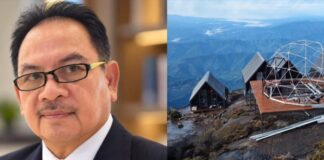
vhsBy Dr. Gaim James Lunkapis. He is one of Malaysia’s certified Social Impact Assessment practitioners
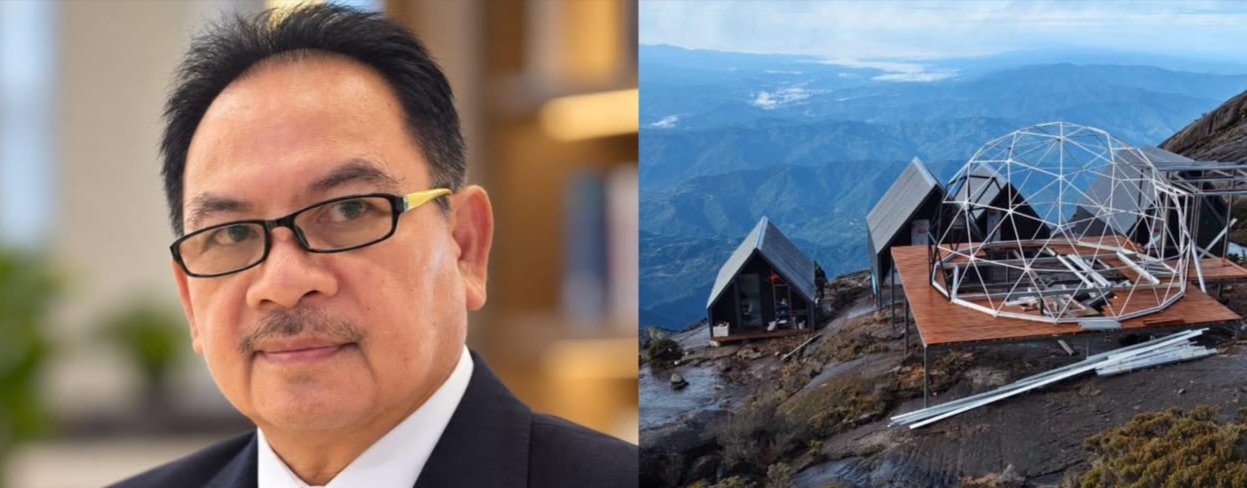
KOTA KINABALU: When photographs of dome-shaped platforms being built near Sayat-Sayat, more than 3,600 metres above sea level, began circulating on social media across Sabah, the public uproar was neither random nor irrational.
The reaction was spontaneous and deeply personal. Within hours, social media feeds turned into passionate virtual arenas of debate. Mountain guides, porters, Native elders, local tour operators, and ordinary citizens across Sabah—and perhaps even some international observers—all asked the same troubling question:
How could permanent construction begin on a sacred UNESCO World Heritage Site without the people of Sabah knowing about it first?
Official explanations soon followed in an attempt to reassure the public. Authorities stated that the High Altitude Training Centre (HATC) originated from a 2015 park development plan.
They noted that the buildings use lightweight modular materials rather than heavy concrete, and that Kinabalu Park’s recent revalidation as a UNESCO Global Geopark demonstrated responsible stewardship.
However, as a Social Impact Assessment (SIA) practitioner—a professional discipline dedicated to evaluating how development affects human lives, livelihoods, and cultural heritage—this controversy highlights a profound lesson for the State of Sabah.
When development moves forward without a structured, transparent process to reach early agreement between the government and the people, confrontation on the ground becomes almost inevitable.
To understand why this issue is so sensitive, we must look honestly at the gap between how decisions are made inside government boardrooms and how they are experienced by affected communities.
On paper, a project can appear completely orderly. A committee meets, a master plan from a decade ago is reopened, a contractor is appointed, and a ceremonial ritual is held.
From a purely administrative standpoint, all requirements appear to have been fulfilled.
Outside those boardroom walls, however, reality looks very different.
A master plan drawn up in 2015 belongs to an era before the devastating June 2015 Ranau earthquake—a tragedy that permanently altered the geology of Mount Kinabalu, triggered fatal rockfalls, and scarred the collective memory of Sabah.
Relying on a ten-year-old file without fresh, publicly disclosed geological and environmental audits on fragile, post-seismic granite slopes naturally alarms communities who still remember the mountain shaking beneath their feet.
Moreover, Sabah’s Native communities and ordinary citizens are sharp observers. When a project is introduced to the public as a specialized training centre for rescuers and high-altitude athletes, people are willing to listen.
Yet when promotional flyers simultaneously advertise luxury overnight stays under names like “Sky Lodge,” public trust evaporates immediately.
To the people living at the foot of the mountain, this looks less like public service and more like quiet commercialization—an encroachment into a protected area where ordinary locals risk being priced out due to high costs while private commercial interests take over.
Every villager in Kundasang and Ranau also understands the simple law of gravity: what goes up a mountain eventually comes down. When structures are built at an altitude of 3,600 metres, how is human waste treated, and where does wastewater flow when heavy tropical rain lashes the summit?
Downstream villages rely on those mountain streams for their daily water needs. Without transparent disclosures, fear and suspicion naturally fill the silence.
Beyond local sentiment, Mount Kinabalu carries binding international obligations. In December 2000, Kinabalu Park became Malaysia’s first UNESCO World Heritage Site under the 1972 World Heritage Convention.
It is crucial for our leaders to recognize that holding a UNESCO Global Geopark status—which celebrates geological heritage alongside sustainable community activity—does not relax or override the far stricter conservation rules of a World Heritage Site.
Under Paragraph 172 of UNESCO’s Operational Guidelines, Malaysia is required to notify the World Heritage Committee before carrying out any irreversible physical interventions inside a World Heritage property, supported by an independent Heritage and Environmental Impact Assessment measuring impacts against the site’s Outstanding Universal Value.
Bypassing early public and international transparency risks bringing formal UNESCO Reactive Monitoring upon Sabah, or worse, tarnishing our reputation in the eyes of the world.
As an SIA practitioner, the true turning point here is not merely about assigning blame over a single project; it is about recognizing why such misunderstandings keep recurring across Sabah, and how we can prevent incidents like this from happening again.
Too often in public administration, impact assessments are viewed with hesitation, as if they were bureaucratic hurdles designed to delay progress or frustrate investors.
In reality, a properly conducted Social Impact Assessment (SIA) is the exact opposite.
The SIA process is a practical, constructive prerequisite for development—a structured bridge that brings the state government, project proponents, and local communities into genuine agreement before a project begins.
Imagine what happens when an SIA is placed at the very start of the planning process rather than treated as an afterthought.
Instead of officials designing a project behind closed doors and hoping the public will accept it later, an SIA opens a formal, respectful dialogue early on. It systematically examines how a proposed project will affect local water sources, daily livelihoods, traditional customs, and spiritual values.
The SIA process can bring Native Chiefs (Ketua Anak Negeri), village heads, mountain guides, environmental experts, and ordinary residents to the discussion table while plans are still flexible enough to be shaped by local wisdom.
When communities see their concerns taken seriously and their insights written into a legally binding Social Impact Management Plan, hostility turns into shared ownership.
Rather than facing social media protests, viral backlash, project delays, and costly stop-work orders later, the Government gains a stable and peaceful environment for project implementation where development can succeed with the blessing of the people.
Right now, however, Sabah suffers from a critical legal blind spot that leaves both our lawmakers and our citizens without this vital protection. In 2017, Peninsular Malaysia amended its Town and Country Planning Act 1976 (Act 172) to make standalone Social Impact Assessments mandatory by law for major, sensitive, or public-interest developments.
Unfortunately, Act 172 does not apply to Sabah. Because land and town planning fall under State jurisdiction under the Federal Constitution, Act 172 does not cover Sabah.
Under our Town and Country Planning Ordinance (Sabah Cap. 141), Social Impact Assessments remain merely advisory guidelines rather than binding legal prerequisites. Because there is no statutory requirement to display SIA and Heritage Impact reports, Sabahans are routinely kept in the dark until heavy machinery appears before their eyes.
When formal doors for dialogue are locked, social media inevitably becomes the people’s courtroom. Lawmakers should never view vocal netizens as enemies of progress; citizens are simply asking for the space for discussion that our planning laws have not yet provided.
At the same time, this moment is an empowering call to action for Sabah’s Native communities and traditional institutions. Under international standards endorsed by Malaysia, including the United Nations Declaration on the Rights of Indigenous Peoples (UNDRIP), the Native Communities of Sabah hold the right to Free, Prior, and Informed Consent (FPIC) whenever development touches their ancestral lands, waters, and sacred sites.
True FPIC cannot be fulfilled through a closed-door briefing or a symbolic ceremony after contracts have already been signed. When—and hopefully soon—Sabah institutionalises SIA as a mandatory prerequisite, Native leaders and villagers will gain a formal, recognized platform to articulate their Adat, protect their watersheds, and negotiate fair local benefits, transforming community voices from reactive protests into proactive partners in nation-building.
When lawmakers and Native communities sit at the same table through a transparent SIA process, better and wiser solutions will naturally emerge.
Sabah now stands at a historic crossroads, and our leaders have the power to turn this controversy into a model of governance for all of Borneo. Therefore, the following measures are proposed:
First, the State Government should suspend the relevant works to allow for a full SIA / HIA study to be conducted at Sayat-Sayat, and publish a complete, independent post-2015 geological, environmental, and heritage audit so that every Sabahan can see the facts clearly.
Second, the authorities should relocate non-essential training and lodging facilities to gateway towns in the buffer zone, restricting structures in the summit area strictly to basic emergency safety shelters.
Third, our lawmakers must act decisively, first by issuing an immediate State Planning Directive under Cap. 141 and the Sabah Land Ordinance (Cap. 68), and subsequently amending Cap. 141 alongside the Environment Protection Enactment 2002—to make the implementation of Social and Heritage Impact Assessments, complete public display periods, and legally enforceable Social Impact Management Plans mandatory prerequisites before any major or sensitive development is approved in Sabah.
Fourth, Malaysia (Sabah) should proactively share full project documentation with UNESCO under Paragraph 172 to uphold international trust.
True progress is never built on silence, and lasting development is never achieved through confrontation. By making Social Impact Assessments the foundation of how we plan and build in Sabah, lawmakers can honour the wisdom of our Native custodians, protect ordinary citizens from unforeseen harm, and ensure that the state and the people move forward in genuine agreement.
Mount Kinabalu has watched over Borneo for millions of years, and we are only its temporary caretakers. If we choose transparency over secrecy and partnership over division today, Aki Nabalu will continue to stand proud, sacred, and unscarred for generations to come.