

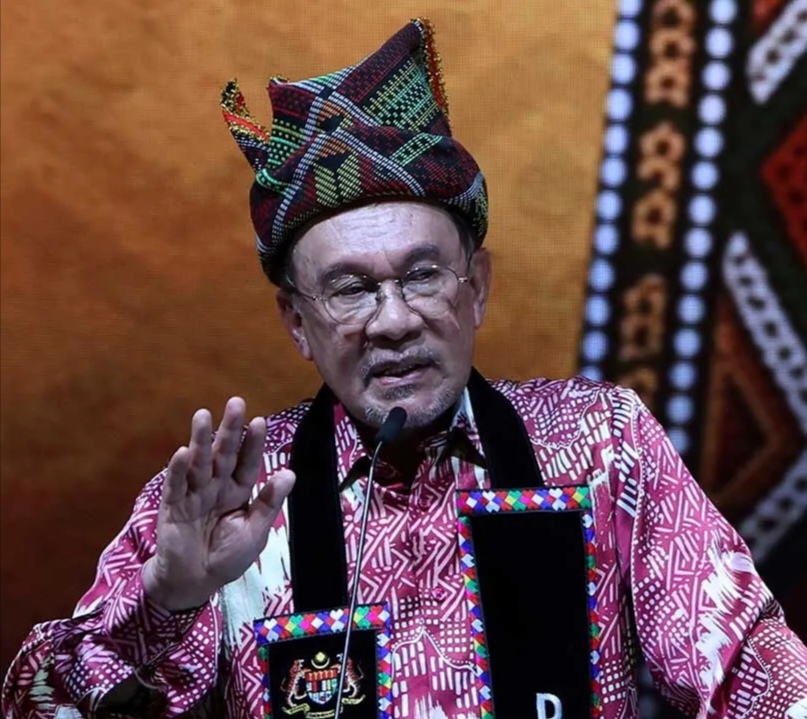
Source – Utusan Borneo
KOTA KINABALU: Malaysia’s 10th Prime Minister Datuk Seri Anwar Ibrahim is ushering in a transformative era for Sabah and Sarawak’s political landscape.
Within a remarkably short timeframe, he has successfully championed numerous commendable initiatives rooted in the spirit of the 1963 Malaysia Agreement (MA63), strengthening development and safeguarding the rights of Sabah and Sarawak’s citizens.
These achievements include the landmark decision to increase interim annual allocations for both Sabah and Sarawak to RM1.5 billion each, commencing this year—a historic milestone as the first Prime Minister to authorize such substantial interim payments.
For Sabah specifically, this allocation represents a remarkable surge from the previous RM600 million, substantially exceeding the original allocations ranging from RM26.7 million to RM125.6 million received in prior years.
This latest payment rate serves as a temporary measure while awaiting finalization of implementation procedures for Sabah’s entitlement to 40% of net state revenue under MA63.
Most significantly, the Prime Minister announced that the Federal Cabinet has approved in principle the expansion of parliamentary seats for both Sabah and Sarawak—a decisive move that underscores his unwavering commitment to empowering these vital regions.
According to Anwar, a prominent political figure known for advocating moderation, understanding and interfaith harmony, the Federal Government has committed to amending the Federal Constitution to ensure that the representation ratio of parliamentary seats for Sabah and Sarawak is substantially higher compared to Peninsular Malaysia, in alignment with the spirit of MA63.
The majority of citizens in Sabah and Sarawak have responded positively to the increased interim allocation and the proposal to add parliamentary seats, and it is not uncommon for some of them to refer to PMX as a ‘precious gem’ for these two Borneo states.
This may also be because no previous number one leader had ever implemented such reforms—increasing the interim allocation to RM1.5 billion and adding parliamentary seats for Sabah and Sarawak.
The pressing question now is: what is the true significance of the additional parliamentary seats for Sabah and Sarawak?
A political observer and author of the book Gundohing Musli Oli shares his perspective on this matter.
He explains that Malaysia’s formation was fundamentally based on the assurance that the new territories within the Malaysian Federation would not face domination.
Musli notes that Singapore’s Prime Minister Lee Kuan Yew consistently emphasized this point during negotiations before MA63 was sealed in London.
According to historical records, Musli states that Lee Kuan Yew proposed that at least one-third of all parliamentary seats should be allocated to the three new territories—Sabah, Sarawak, and Singapore.
This was designed to ensure that any new legislation or constitutional amendment could not be passed with a two-thirds majority without the support of representatives from Singapore, Sarawak, and Sabah, he explains.
Musli notes that when Malaysia was formed, Sabah was allocated 16 parliamentary seats, Sarawak received 24 seats, and Singapore held 15 seats, which together comprised approximately 35% (or one-third) of the total parliamentary seats, while Peninsular Malaysia held the remaining 65%.
However, he points out that after Singapore’s withdrawal from the Federation in 1965, Singapore’s 15 parliamentary seats in the House of Representatives were redistributed solely to states within Peninsular Malaysia.
Starting from the increase in parliamentary seats allocated to Peninsular Malaysia, Sarawak and Sabah no longer possess meaningful counterbalancing power.
“With each redistricting exercise, the additional seats granted to Peninsular Malaysian states have been disproportionately larger, resulting in their combined representation exceeding the 2/3 threshold,” he stated.
Currently, Musli noted that of the 222 total seats in the House of Representatives, 148 are located in Malaya, while Sarawak holds 31 and Sabah holds 25.
“Although the Federal Constitution contains special provisions under Article 161E that safeguard the rights, status, and autonomy of Sarawak and Sabah from being amended or revoked without the consent of their respective Heads of State,
“it frequently occurs that new legislation or constitutional amendments affecting the interests of Sabah and Sarawak are passed without consulting the Heads of State of both states,” he explained.
Musli attributed this situation to the fact that without the support of representatives from Sarawak and Sabah, the House of Representatives can readily obtain the required 2/3 majority approval.

