By Datuk Ts Dr. Hj Ramli Amir, former President of the Chartered Institute of Logistics and Transport (CILT) Malaysia and Vice-President of CILT International for Southeast Asia
KOTA KINABALU: The Chartered Institute of Logistics and Transport (CILT) is more than a professional body for qualifications, networking, and continuing professional development. Its real strength lies in its members: professionals who work across government, industry, academia, ports, transport operations, freight, supply chains, infrastructure, technology, and education.
Through this diverse professional community, CILT serves as an important
bridge between government policy and operational reality.
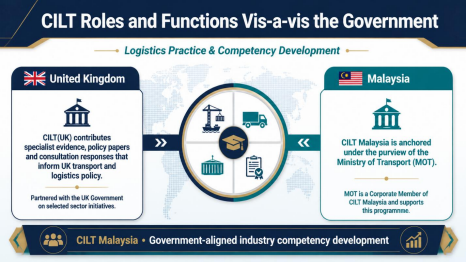
Members provide the practical insight needed to ensure that transport and logistics policies are workable, evidence-based, economically sound, and implementable.In the United Kingdom, CILT(UK) has long contributed expert views to public-policy discussions.
In Malaysia, CILT Malaysia’s close relationship with the Ministry of Transport Malaysia (MOT) gives the Institute a meaningful platform through which professional expertise can support national transport and logistics priorities.
Professional Expertise MattersTransport and logistics policy affects every sector of the economy. Decisions on ports, roads, railways, aviation, public transport, freight regulation, warehousing, digitalisation, decarbonisation, safety, trade facilitation, and skills development have direct consequences for businesses and communities.
However, policy is most effective when it is informed by people who understand how the system works in practice. A transport planner may understand network design; a port professional understands vessel turnaround, yard capacity, cargo flows, customs interfaces, and hinterland connectivity; a logistics manager understands delivery reliability, inventory costs, vehicle utilisation, warehouse constraints, and customer expectations.CILT members bring these perspectives together.
They include:Logistics and supply-chain practitioners; port, shipping, aviation, rail, road, and public-transport professionals; freight forwarders, warehouse operators, transport planners, and infrastructure specialists; government officers, regulators, and local-authority personnel.
Academics, researchers, educators, and students; corporate leaders, technology providers, and sustainability specialists.
This broad professional base allows CILT to present balanced views that take account of public interest, commercial viability, operational practicality, sustainability, safety, workforce capability, and long-term economic development.
The UK ExperienceCILT(UK) provides a useful example of how a professional institution can contribute to the policy process.
The Institute has policy groups and specialist forums that draw on the knowledge of members across transport, logistics, supply chain, freight, aviation, rail, bus and coach, rural transport, and environmental issues.CILT(UK) states that it has no political affiliation and does not support particular vested interests. Its policy work is intended to promote effective and efficient transport and logistics systems through objective analysis, practical experience, and professional expertise.
When the UK Government, the Department for Transport, a regulator, or another public body issues a consultation, CILT(UK) can submit a consultation response.
Such a response is not a government instruction or a law. It is a structured contribution that presents professional evidence, identifies practical issues, and recommends improvements to a proposed policy, regulation, investment programme, or implementation plan.
Freight and road-network performanceA good example is CILT’s response to the Office of Rail and Road consultation concerning the monitoring of Highways in England.
CILT argued that the strategic road network should be evaluated not only in terms of private car travel but also in terms of freight and coach operations.Its response called for stronger freight data, freight-relevant performance measures, better assessment of congestion and journey-time reliability, and greater recognition of the economic impact of delay on freight operations.
It also encouraged an integrated view of road and rail freight.This is important because freight delay is not simply an inconvenience.
It can affect delivery times, vehicle productivity, driver hours, warehouse scheduling, customer service, fuel consumption, inventory costs, and business competitiveness.
Professional members help convert these operational realities into evidence that government and regulators can consider when shaping infrastructure and transport policy.
The UK example shows that CILT members do not replace government decision-making. Rather, they help policymakers test whether proposals are practical, proportionate, implementable, and likely to deliver their intended outcomes.
Malaysia: Institutional Connection With MOTIn Malaysia, CILT Malaysia occupies an important position within the national transport and logistics ecosystem. CILT Malaysia falls under the purview of the Ministry of Transport Malaysia, which is a corporate member of CILT Malaysia.
This close institutional relationship creates a valuable platform for engagement among the Ministry, professional members, industry leaders, academics, researchers, and other stakeholders.
It enables CILT Malaysia to contribute professional knowledge to national conversations on transport, logistics, supply chains, ports, aviation, road safety, public transport, trade facilitation, sustainability, digitalisation, and human capital development.
The relationship should be understood as a constructive professional partnership. CILT Malaysia does not replace the role of government, nor does it make policy on behalf of the Ministry.
Instead, the Institute can help bring together expert views, operational evidence, technical understanding, research capability, and professional development capacity to support more informed decision-making.
This connection is particularly valuable because modern logistics policy requires coordination across many parties. Government may establish the direction; industry understands the commercial and operational consequences; academia contributes research and analysis; and professional bodies such as CILT help organise knowledge, standards, talent, and constructive dialogue.Collaboration in Practice
A public example of CILT Malaysia’s contribution to a Ministry-linked initiative is the APEC Women in Transportation Data Framework and Best Practices Initiative.
The Ministry of Transport Malaysia approved Malaysia’s involvement in the initiative through the APEC Transport Working Group.For the Malaysian pilot project in the ports subsector, the Ministry appointed the Malaysia Institute of Transport (MITRANS) at Universiti Teknologi MARA to lead research and implementation, with support from CILT Malaysia and Talent Corp Malaysia.
The work focused on developing women leaders in the ports sector and produced a mentoring toolkit intended to support leadership development.
The Ministry has indicated that the toolkit could be adapted for other Malaysian transport and logistics sectors and used as a reference by other APEC economies.
This example demonstrates how CILT Malaysia can support public-sector goals through professional participation, industry engagement, research support, mentoring, talent development, and sector knowledge.
It also demonstrates that a professional institution can contribute to policy-related outcomes even where it is not the government agency responsible for formal policy approval.
What Members Can ContributeCILT members can contribute to government and national development in practical ways: Policy feedback: Identifying the likely operational effects of proposed regulations, standards, incentives, or infrastructure plans; Evidence and research: Providing data, case studies, operational analysis, and expert opinion for consultations and policy reviews; Implementation insight: Highlighting risks, resource requirements, compliance burdens, training needs, and unintended consequences before a policy is rolled out; Professional standards: Promoting competence, ethics, safety, and good practice across logistics and transport professions; Talent development: Supporting professional education, certification, mentoring, skills development, and leadership succession; Industry-government dialogue: Creating credible forums in which public-sector and private-sector participants can discuss practical challenges and possible solutions; and National and regional strategy: Supporting initiatives related to connectivity, trade facilitation, industrial development, maritime logistics, sustainability, and resilient supply chains.
For Malaysia, such contributions are increasingly important as the country pursues higher-value logistics services, more efficient trade corridors, stronger port and airport connectivity, digital transformation, greener freight systems, and a more skilled logistics workforce.
Relevance to Sabah and Regional DevelopmentThe role of CILT professionals is particularly relevant to Sabah.
The state’s logistics challenges and opportunities are closely connected to its geography, dispersed population, maritime dependence, port and airport infrastructure, rural connectivity, industrial development, tourism, agriculture, and cross-border economic links.CILT members in Sabah can provide practical insight on issues such as:Port development, terminal productivity, coastal shipping, and maritime connectivity; Integration of road, sea, and air transport for rural and remote communities; Logistics support for agriculture, fisheries, palm oil, manufacturing, tourism, and industrial parks; Trade facilitation and connectivity under BIMP-EAGA; Supply-chain resilience, cold-chain development, and food security; and Green logistics, digitalisation, and future transport skills.
The value of professional input lies in its ability to connect national transport and logistics objectives with Sabah’s specific operational and development realities. Policies developed without local technical knowledge may be difficult to implement; policies supported by practitioners, researchers, industry players, and public agencies are more likely to deliver meaningful outcomes.
A Call to CILT MembersCILT members should see themselves not only as beneficiaries of professional recognition, but also as contributors to the development of the transport and logistics profession, industry, and nation.
Members can participate in policy groups, professional forums, technical committees, research projects, responses to consultations, mentoring programmes, training activities, and industrygovernment engagements. Each contribution—whether from a young logistics executive, an experienced port manager, a transport academic, a public officer, or a corporate leader—can strengthen the quality of professional advice available to decision-makers.
The UK experience demonstrates how CILT members can contribute through independent, evidence-based consultation responses on matters such as freight performance, road-network monitoring, infrastructure, and regulation.
In Malaysia, CILT Malaysia’s position under the purview of the Ministry of Transport Malaysia, together with MOT’s corporate membership, strengthens the Institute’s potential role as a professional platform connecting government, industry, academia, and the wider logistics community.
Ultimately, CILT’s influence comes from the credibility, knowledge, ethics, and active participation of its members.
When members contribute their expertise collectively, CILT becomes more than a professional fraternity.
It becomes a trusted national partner in building efficient, resilient, safe, sustainable, and future-ready transport and logistics systems.