“A picture is worth a thousand words.”
By Remy Majangkim (Majangkim Office)
KOTA KINABALU: While Kuala Lumpur obsesses over the fate of Pakatan Harapan, the real political earthquake is happening 1,600 kilometres away.
In the paddy fields of Keningau, two of Sabah’s most formidable native leaders are working on a deal behind closed doors.
At the same time, in a function room away from the glare of PH’s national convention, a kamikaze party is emerging from the wreckage of PKR. And in Sarawak, GPS sits on its hands – for now.
The old opposition is dying. A new one is being born, and it does not answer to Putrajaya.
The Kaamatan Handshake: Shafie and Kitingan Draw a New Map
The annual Kaamatan Festival in Keningau is normally a celebration of harvest and tradition.
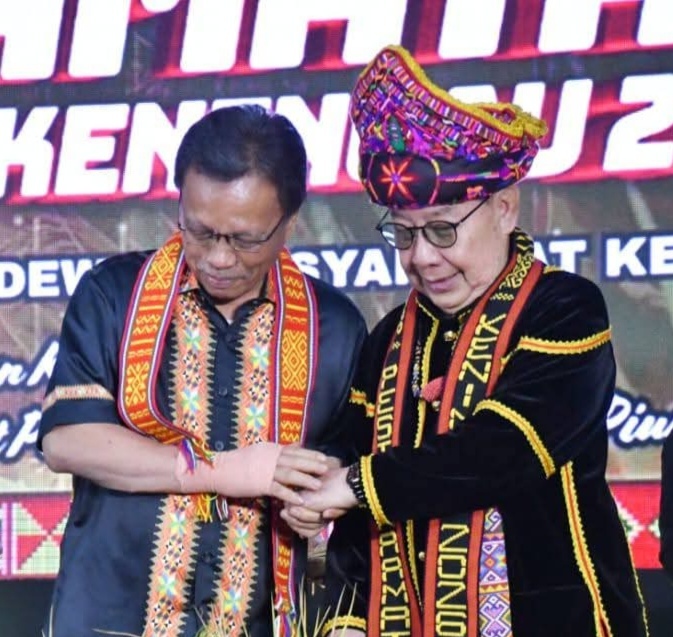
But this year, the VIP row told a different story. Warisan president Shafie Apdal accepted an invitation from Sabah STAR leader Jeffrey Kitingan to sit side by side at the festivities.
They cut the ceremonial paddy stalks together. They smiled for the same cameras. Across Sabah, politicians understood something has shifted.
Kitingan has been a restless partner within the GRS state government.
He pulled STAR out of GRS days before the 2025 state election, yet his MPs remain in the federal unity government while his state assemblymen sit on the government bench.
The arrangement has never been comfortable.
The Kaamatan invitation signals that a serious dialogue is underway between STAR and Warisan – a dialogue that could reshape Sabah’s parliamentary landscape.
For Shafie, the strategic prize is clear. Warisan dominates the coast, the urban mixed seats, and the Muslim‑majority areas.
But the interior Kadazan‑Dusun heartland has remained elusive.
That is precisely where Kitingan holds influence. STAR may have won only two state seats in 2025, but its grassroots networks in Keningau, Tambunan, and the surrounding highlands are deep and loyal.
A working understanding between Shafie and Kitingan would create a formidable Sabah bloc – one capable of challenging GRS not just in the State Assembly but also at the federal level.
Neither side has confirmed a formal pact. But the silence from both camps is louder than any press conference. When experienced politicians stop talking, they are usually sealing a deal.
The Numbers That Matter: A Borneo Kingmaker
Based on a conservative estimate using the 2025 state election results as a baseline, a combined Warisan‑STAR parliamentary bloc could realistically win 10 to 12 seats in Sabah. Warisan already holds three parliamentary seats; STAR holds one (Keningau).
With a coordinated strategy and a shared platform focused on Sabah’s constitutional rights, an additional six to eight seats are within reach – especially in urban mixed constituencies and Kadazan‑Dusun interior areas where the two parties complement each other.
What would 10 to 12 seats mean? In a hung parliament – increasingly likely given PH’s collapse and PN’s plateau – that bloc would be the decisive kingmaker. Neither Anwar nor Muhyiddin could form a government without Sabah’s backing.
Shafie’s price would be simple: binding implementation of the 40% revenue entitlement, full restoration of MA63 rights, and a deputy prime minister position for Sabah.
Far from hypothetical, this is the arithmetic of a fragmented Malaysia. It could shift further if the new MACC chief reopens the dormant Sabah mining scandal – a low-probability but high-impact wildcard that would damage GRS and boost Warisan’s momentum.
The Peninsula Parallel: Rafizi’s Kamikaze Party
While Sabah’s leaders were harvesting padi, another political bomb exploded in Petaling Jaya – deliberately timed to coincide with PH’s 2026 convention in Johor Bahru.
In a modest function room away from the convention’s glare, former PKR deputy president Rafizi Ramli and ex‑vice president Nik Nazmi Nik Ahmad announced the takeover of a dormant party, Parti Bersama Malaysia (MU), and declared that they would vacate their parliamentary seats, triggering by‑elections in Pandan and Setiawangsa.
Rafizi called it a “kamikaze mission”. He was not exaggerating.
The new party, still to be renamed, is no minor splinter. It is a direct challenge to Anwar Ibrahim’s leadership and an open invitation for disaffected PKR members to find a new home.
Rafizi was once Anwar’s most effective strategist; Nik Nazmi was a respected voice on urban governance and climate policy.
Their departure deprives PKR of its intellectual edge and signals to the reformist base that the old party has lost its way.
Why is this a parallel to Sabah? Both movements are driven by the same frustration: peninsula-centric politics has failed the peripheries – whether geographic (Sabah) or ideological (urban reformists).
Shafie and Kitingan offer a Borneo‑first alternative. Rafizi and Nik Nazmi offer a reform‑first alternative. Neither is willing to wait for PH to fix itself.
PKR and DAP in Freefall
The rise of these alternatives is possible only because PKR and DAP are in freefall.
Start with PKR.
Anwar’s own party is bleeding support. Internal surveys reportedly show a 32% drop in Chinese support and a 38% drop among Indian voters.
Rafizi’s exit is not an isolated event; it is a symptom of a party that has lost its ideological compass. The man who once led Reformasi is now perceived as a coalition manager, not a change agent.
His deputy president position is contested, his economic policies are criticised from within, and his authority is openly challenged by former allies now building their own vehicles.
Then there is DAP. The party that once commanded 40 parliamentary seats and dominated urban centres across the country has been reduced to managing its own retreat.
In the November 2025 Sabah state election, DAP lost all eight seats it contested – an average vote share collapse from 78.7% to 27.6%.
Secretary‑General Anthony Loke called it a “wake‑up call”, but a wake‑up call implies there is still time to act.
The truth is that DAP has been sleepwalking for years.
Its July 2026 special congress – where delegates will vote on whether DAP leaders should resign from government posts – is not a moment of renewal. It is a public admission that the leadership has lost control of its narrative.
If delegates vote to stay, DAP will be seen as a party that talks reform but accepts crumbs. If they vote to resign, DAP will be branded as a fair‑weather ally. Either outcome weakens DAP ahead of GE16.
The GPS Factor – Silence as Strategy
And through all this – the Shafie‑Kitingan courtship, the Rafizi kamikaze, and the PH collapse – Sarawak’s GPS has said nothing. No statement on Sabah.
No comment on the new party. No shift in federal alignment.
That silence is not passivity. It is the patience of a coalition that has already won its own fortress.
GPS learnt painful lessons from 2018, when it lost federal power by being tied too closely to BN. It learnt profitable lessons from 2020 to 2022, when it became the kingmaker. For GE16, its strategy is clear: wait for the numbers to crystallise, then move decisively.
Currently, GPS sits comfortably in Anwar’s unity government, holding federal ministries. But comfort is not loyalty. Abang Johari has repeatedly said GPS is “pragmatic” – it will support whoever respects MA63.
A hung parliament after GE16 would give GPS its strongest bargaining position ever: deputy prime minister, binding legislation on oil royalty, education autonomy, and border security.
Shafie and Kitingan would be natural negotiating partners for GPS. A Borneo bloc – Sabah plus Sarawak – could command 30+ parliamentary seats.
That is not a kingmaker. That is a coalition partner on equal footing with any peninsula bloc.
Conclusion:
The Old Order Is Dead
The political map drawn after GE15 – Anwar’s unity government, PH as the anchor, GPS as a junior partner, and Warisan as a marginal opposition – is being erased. In its place, a new map is emerging, drawn in Keningau, Petaling Jaya, and Kuching.
Shafie Apdal and Jeffrey Kitingan are not simply courting each other; they are building a Sabah‑based alternative that could hold the key to Putrajaya.
Rafizi Ramli and Nik Nazmi, far from being merely disgruntled ex‑leaders, are offering a reformist vehicle for voters who have abandoned PH’s tired formula.
GPS is not sitting idle; it is waiting for the right moment to extract maximum concessions.
PKR and DAP are not victims of bad luck. They are victims of their own inability to renew, to listen, and to lead. The July congress will not restore DAP’s aura. Anwar’s remaining authority will not stop the exodus.
The old opposition is dying.
What comes next will be fragmented, unpredictable, and open to new alliances. For the first time in decades, the kingmakers of Malaysia are not in Kuala Lumpur.
They are in Keningau and Kuching and a new party headquarters still being painted in Petaling Jaya. The old order is dead.
The next phone call for the prime minister may not come from a palace but from a village in Keningau or an office in Kuching.