During a searching panel discussion, aviation experts were pressed on the assumptions behind their competing proposals. The exchanges revealed that building a bigger airport would not necessarily deliver stronger connectivity, more investment or greater economic prosperity.
KOTA KINABALU: One of the most revealing moments in Sabah’s debate over the future of Kota Kinabalu International Airport came not when the aviation experts discussed constructing new runways or developing an entirely new airport.
It came when one of them questioned who would take responsibility for developing the economy surrounding the airport.
Edward Clayton, an airport strategy consultant, had been discussing improvements to KKIA during a public forum organised by the Chartered Institute of Logistics and Transport Malaysia (CILTM), Sabah Section.
He acknowledged that Malaysia Airports could expand terminal capacity and improve its existing facilities. But those improvements, he suggested, would not automatically produce the integrated aviation economy that Sabah’s policymakers increasingly envision.
“I don’t see anybody else thinking about the ecosystem around the airport either,” he told the audience.
Then came the question that captured one of the forum’s deepest unresolved problems.
“Who’s going to take responsibility to think about that whole system question, as opposed to simply keeping the airport running for the next 10 or 15 years?”
It was a question about governance as much as infrastructure.
And it exposed the distance between Sabah’s ambitions to become a more important regional aviation gateway and the institutions, investments and commercial strategies required to make that ambition a reality.
Challenging the assumptions
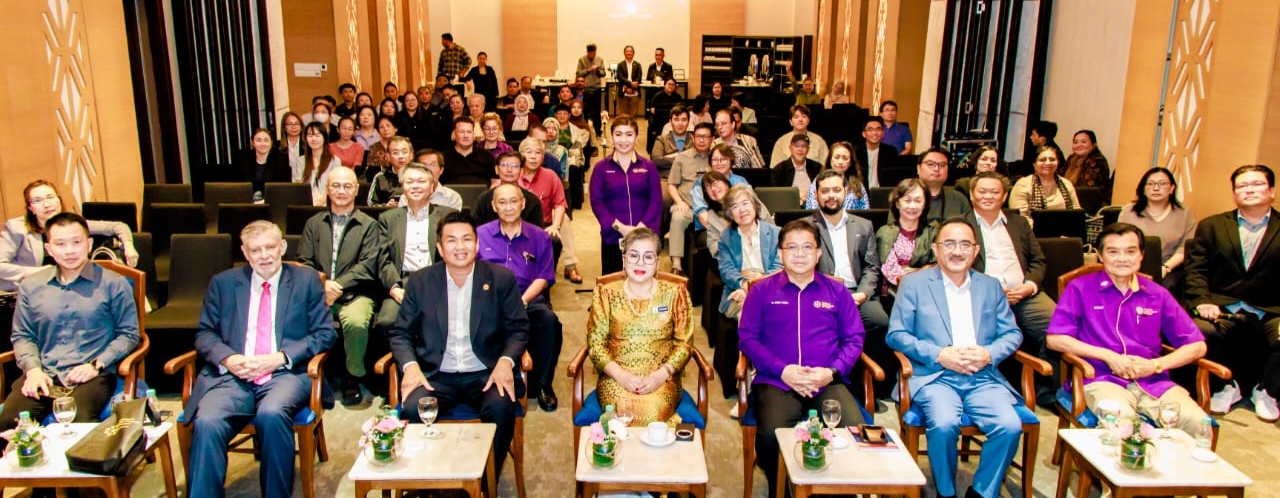
The exchange occurred during a moderated panel led by Ts. Daniel Doughty, Chairman of CILTM Sabah Section, following presentations by Clayton and Datuk Captain Chester Voo.
Instead of inviting the two aviation professionals simply to repeat their preferred approaches, Doughty pressed them to explain their assumptions, defend their economic reasoning and acknowledge weaknesses in their arguments.
One of his opening questions went directly to the foundation of the debate.
What, exactly, was the problem Sabah was trying to solve?
Was it terminal congestion, runway capacity, operational efficiency or the limitations that the current airport might place on future growth?
Clayton’s response was that the answer depended on Sabah’s development ambitions and its realistic expectations of future demand.
The distinction mattered.
An airport terminal struggling with congestion at peak hours does not necessarily mean its runway has reached maximum capacity. Nor does the technical ability to handle substantially more passengers establish that airlines will generate sufficient traffic to fill the additional space.
Clayton noted that major international airports operate with single runways serving far more passengers than KKIA currently handles.
His argument was not that Sabah should indefinitely depend on one runway. Rather, it was that any decision to construct additional infrastructure should be driven by demonstrated requirements, realistic forecasts and the economics of alternative investments.
Voo approached the problem differently.
He argued that technical compliance and passenger-handling capacity were insufficient measures of whether an airport was serving Sabah’s economic interests.
An airport might remain safe, functional and compliant for decades, he suggested, while still preventing or failing to support potentially valuable economic development.
When Doughty asked whether there was a technical threshold at which relocation would become necessary, Voo acknowledged that the existing airport could continue operating as long as it met applicable safety and regulatory standards.
But remaining operational was different from providing the conditions for economic transformation.
The exchange revealed an important distinction: an airport can be technically adequate without necessarily being economically optimal.
The hidden price of moving an airport
Another difficult issue emerged when the discussion turned to airport accessibility.
Clayton questioned the practicality of moving KKIA to a location substantially farther from Kota Kinabalu.
Potential sites to the north or south, he argued, could require journeys of 50 to 80 kilometres from the city, depending on their location.
That would introduce substantial new requirements for road or rail connections.
Voo maintained that an airport should ideally be accessible within approximately 45 minutes, while acknowledging that appropriate supporting infrastructure would be essential.
Doughty challenged the assumption that such journey times could be taken at face value.
In Sabah, he observed, a journey described as taking 45 minutes could become considerably longer in real-world traffic conditions.
He also raised the consequences for tourism operators, whose pricing and competitiveness could be affected by higher airport-transfer costs.
The implications extended beyond passenger inconvenience.
An airport developed at a new site would require more than aviation facilities. Reliable transport connections, water and electricity infrastructure, cargo distribution systems and access to economic centres would all become part of its development requirements.
Clayton subsequently made an important distinction during audience questions: an airport may be capable of financing its own development through project revenues, but major transport links outside the airport boundary could require separate public investment.
One participant, Winston, a tourism industry veteran, asked whether spending on a new airport might compete with pressing requirements for water, electricity and other infrastructure.
The question remained unresolved.
Neither expert presented a comprehensive, independently verified financing package demonstrating how every component of a relocated airport and its supporting infrastructure would be funded.
Would airlines actually come?
Perhaps the most direct challenge to the idea of building a larger, more modern airport came when Doughty questioned a commonly repeated assumption.
Would a bigger airport automatically attract more international airlines?
Clayton’s response was emphatic.
“Airlines do not come to an airport because it’s modern.”
He explained that airlines primarily choose destinations based on whether they can operate commercially viable routes.
A new terminal, attractive architecture or additional runway capacity may improve the conditions under which airlines operate. But such investments do not, by themselves, create the passenger demand required to sustain new services.
Voo broadly reinforced the point from an airline-operations perspective.
Passenger demand and route economics were fundamental, he said. Safety, reliability and operational efficiency then influenced how effectively airlines could serve that demand.
The exchange challenged a politically attractive but economically weak proposition: that physical infrastructure automatically generates connectivity.
Airlines are businesses. Unless passenger demand, route profitability and operating conditions support a service, airport capacity alone is unlikely to persuade them to provide it.
The challenge becomes even more complicated when Sabah describes its ambitions to become an aviation hub.
Doughty asked what such a hub would actually mean.
Would Sabah concentrate on tourism, passenger transfers, air cargo, aircraft maintenance or some combination of these activities?
Clayton pointed out that the business models were fundamentally different.
A passenger-transfer hub generally depends on an airline capable of coordinating connecting flights. A cargo operation requires freight demand, logistics capabilities and appropriate distribution networks. Aircraft maintenance requires specialised facilities, technical certifications and a skilled workforce.
Clayton also noted that Sabah lacks a locally based airline of the kind typically needed to support a major connecting hub.
The issue therefore went beyond the physical size of the airport.
Before deciding what infrastructure to build, Sabah would need to establish what kind of aviation business it could realistically attract and sustain.
An unexpected area of agreement
Despite their differences over long-term airport development, the two experts found common ground on one potential growth industry: aircraft maintenance, repair and overhaul, commonly known as MRO.
Clayton observed that global aircraft maintenance capacity had become more constrained since the Covid-19 pandemic.
Where airlines once had greater flexibility to choose maintenance facilities based on price, access to available maintenance slots had become an increasingly important consideration.
This changing market, he suggested, could create opportunities for new locations capable of developing competitive aviation maintenance services.
The industry also extends beyond aircraft hangars to high-value work involving engines, landing gear, avionics and other components.
Such activities could create skilled technical employment in Sabah, allowing more local engineers and technicians to develop careers without necessarily leaving the state.
Voo supported the potential, emphasising Sabah’s land availability and its ability to develop facilities alongside wider aviation infrastructure.
Yet the opportunity remained a proposition rather than an established investment case.
Developing an MRO industry would require evidence of demand, access to qualified personnel, technical certification, capital investment and competition from established maintenance centres elsewhere in the region.