Brendon Beliku is a corporate immigration and employment compliance professional based in Kota Kinabalu. He writes independently on Sabah’s economic governance, labour policy, regulatory affairs and Momogun empowerment.
KOTA KINABALU: Momogun communities often ask, with some discomfort: did we stop planting? It deserves a better answer than nostalgia or blame. Institutionally, it is not about whether a community lost interest in its land.
It is about whether the policies built to support agriculture are designed to keep land in use, and whether anyone is measuring if they do.
-Half the Fields, Full Allocations-
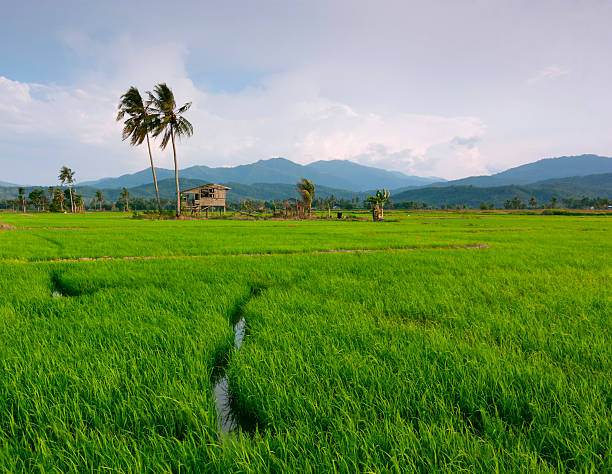
In August 2026, the state Agriculture, Fisheries and Food Industry Minister, Datuk Jamawi Jaafar, said Sabah has about 25,000 hectares of paddy fields, of which only about half are cultivated. Some have been idle for up to ten years.
The state aims to reopen 1,000 hectares soon and up to 10,000 over time, beginning in Kota Marudu and looking next at Kota Belud, Keningau, Ranau and Papar, districts where many Momogun families farm. Nationally, self-sufficiency has already fallen from 68 percent in 2018 to 54.3 percent in 2025.
Budget 2027, meanwhile, provides RM2.62 billion for paddy farmers, about RM4,300 per hectare in support, together with more than RM1 billion in agrofood financing through Agrobank, Bank Rakyat and the cooperative commission, replanting facilities with deferred or partial repayment, and a RM400 monthly subsidy for 290,000 smallholders.
The ploughing incentive has also been extended to Sabah and Sarawak.
Support is substantial, yet half of Sabah’s paddy land lies idle. The likely explanation is design.
Most of this support is paid per hectare planted, per kilogram produced or per approved application. It sustains those already farming, but does little for land that has stopped producing, because idle land generates no claim.
A subsidy system that rewards activity cannot, by itself, reverse inactivity.
-Three Institutional Gaps-
The first gap is measurement. Allocations are announced in detail; outcomes are not.
There is no published figure for how much of the national agrofood financing is taken up in Sabah, in which districts, or by whom. Prof Datuk Dr. Ts. Ramzah Dambul, Chief Executive Officer of the Institute for Development Studies (Sabah), has argued publicly that Momogun should be recognised as a common category in national statistics so that support for rural poverty and economic access can be properly targeted.
Agriculture shows why. Sabah can count idle hectares, but it cannot say whose land they are, so it cannot tell whether support is reaching the communities that hold that land.
The second gap is fit. Funding tends to reward activity that shows fast, measurable returns. The maritime economy, including fisheries, aquaculture and coastal enterprise, fits that model well.
The agrarian economy, with longer cycles, fragmented holdings and land that is often not fully surveyed, fits it poorly.
The result is not a shortage of money, but a mismatch between how support is designed and how agrarian communities hold and use land. That mismatch shows up as weaker business readiness and limited scale, even where allocations are generous.
The third gap is accountability. For paddy, the Sabah Padi and Rice Board took over paddy development from the State Agricultural Department in 2025, and leads the reactivation targets above.
But no public reporting schedule has been set out, and the board’s powers are still debated, with Sipitang’s Member of Parliament calling in July 2026 for greater authority over rice supply.
Reactivation relies largely on memorandums with private technology firms, six signed by August 2026. A memorandum records intent, not hectares returned to cultivation. Beyond paddy, idle native land under rubber or other crops has no equivalent lead at all.
-From Allocation to Accountability-
The generational shift behind the idle fields is not a failure. Many young Momogun moved into salaried and public sector work because it offered security that farming did not. Policy cannot reverse that choice by exhortation, only make farming a credible option again. Four steps are offered for discussion.
First, report against existing targets. The Sabah Padi and Rice Board should publish annual progress on hectares reactivated, and reconcile its self-sufficiency goal, announced at its launch in May 2025 as 60 percent by 2030 but reported in August 2026 as 30 percent by 2030.
Second, fund reactivation, not only production. A dedicated incentive for bringing idle native land back into use, paid in stages as land is cleared, planted and harvested, would reach the land that current subsidies miss.
Third, report uptake. Agencies and lenders should publish Sabah’s share of agrofood financing by district, and clarify whether native landholders with incomplete surveys qualify.
Fourth, count communities. Working with the Institute for Development Studies (Sabah), agricultural data should identify Momogun participation, while keeping Dusunic, Murutic and Paitanic detail visible.
So, did the Momogun stop planting? On the evidence, many fields did fall silent. But the more accurate reading is that the policy system kept funding planting while leaving the question of idle land without an owner.
Until that changes, generous allocations and idle fields will continue to exist side by side.
[Disclaimer]: The views, opinions and analyses expressed in this article are solely those of the author and do not necessarily reflect the views, policies or positions of the Jesselton Times, its editors, management or affiliated entities. This article is published for analytical and public discussion purposes and should not be construed as institutional commentary or endorsement.