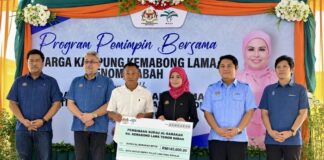
KOTA KINABALU: The Sabah State Education Fund (TPNS) has disbursed RM40 million in assistance since it was launched on 2 June 2022, directly benefiting 27,781 students throughout the State.
Chief Minister Datuk Seri Panglima Haji Hajiji Haji Noor said that from January to August this year alone, 11,383 people from across Sabah benefited from TPNS assistance amounting to RM15.89 million.
He said the establishment of TPNS, based on the theme “Sponsorship Opportunities for All”, had proven to be an important instrument in expanding access to educational assistance for the people.
“This event is important because we are not merely presenting assistance, but opening up space and opportunities for Sabah’s children to continue their studies, achieve their ambitions and build their future.
“This is among the major responsibilities of the State Government in developing Sabah’s human capital,” he said at the TPNS Assistance Presentation Ceremony and the launch of the TPNS Smart Application System at Menara Kinabalu here today.
Hajiji said a state would not be able to progress without a strong and quality education system, as development was not merely about building roads, bridges, buildings and infrastructure.
“We must produce a generation that is knowledgeable, skilled, has integrity and is able to compete. This is the most important investment for Sabah’s future,” he said.
He said the State Government’s commitment to education development was also reflected through the Sabah State Government Scholarship (BKNS), with an allocation of RM155 million this year, benefiting thousands of students at various levels, particularly in Science, Technology, Engineering and Mathematics (STEM).
He said the allocation had increased more than threefold compared with RM50 million in 2020, while between 2021 and 2025, a total of 14 education-related initiatives were introduced, including the Higher Education Institution Registration Cash Assistance (BUDI), Computer Assistance Programme (BAIK) and flight ticket assistance for Sabah students in Peninsular Malaysia, Sarawak and Labuan.
On the assistance presented today, Hajiji said 362 recipients from around the Kota Kinabalu district received assistance amounting to RM6.79 million.
“The presentation of this educational assistance is clear proof that the government has never allowed any Sabah child to be left behind in obtaining the educational opportunities they deserve,” he said.
In a related development, Hajiji said the wave of digital transformation in the delivery of the State’s education services began with the launch of the Sabah Education Sponsorship Portal (PTPS) on 2 July 2024.
He said PTPS serves as a “single-window platform” that brings together five of the State’s main education sponsorship and assistance agencies on one integrated platform.
“To further strengthen this modernisation momentum, today we are taking another step forward with the launch of the TPNS Smart Application System,” he said.
He said the mobile application enables TPNS assistance applications to be made fully online, while applicants can also check the status of their applications in real time through a more transparent and user-friendly process.
“With this facility, the application process is expected to become easier, faster and more organised, particularly for Sabah’s children throughout the State, especially those in rural areas,” he said.
Hajiji also called on more local and international corporations operating and generating profits in Sabah to come forward and fulfil their Corporate Social Responsibility (CSR) by contributing to TPNS.
He said cooperation between the State Government, private sector, government-linked companies (GLCs) and non-governmental organisations (NGOs) could help build a stronger education ecosystem for Sabah’s children.
Hajiji also described the 60th anniversary of the Yayasan Sabah Group this year as a significant milestone, with the agency playing an important role in empowering the people and driving the State’s development through education, human capital development, economic and social development, and environmental conservation.