By Remy Majangkim
KENINGAU: Sabah’s long-running constitutional debate is entering a new phase.
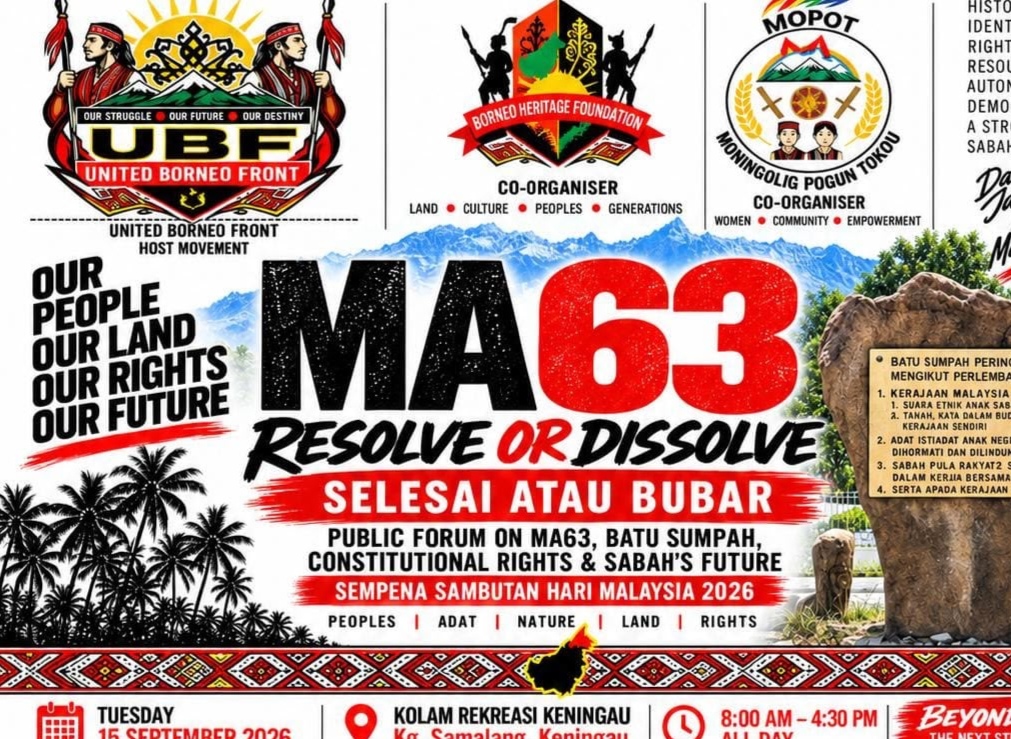
At the Forum Beyond MA63 in Keningau, political leaders, Indigenous representatives, civil society actors, community elders, youth and members of the public are gathering under a stark theme: “Resolve or Dissolve.”
The formulation is deliberately provocative, but its underlying argument is more serious than a slogan.
The forum asks whether the constitutional arrangements associated with the formation of Malaysia have matured into genuine political power, fiscal justice, institutional autonomy and meaningful self-government for the people of Sabah.
For decades, political debate in Sabah has returned repeatedly to the Malaysia Agreement 1963, constitutional safeguards, revenue rights, the 40 per cent entitlement, administrative autonomy and the historic assurances surrounding the formation of Malaysia.
The Beyond MA63 initiative argues that the debate must now move from the recognition of rights to the exercise of power.
From an internationalist perspective, this places Sabah within a much larger global conversation.
Across the world, Indigenous peoples, autonomous regions, stateless nations and historically incorporated territories continue to confront the same fundamental question: what does self-determination mean when constitutional recognition exists on paper but political, economic and institutional power remains concentrated elsewhere?
From the Pacific to the Arctic, from Latin America to Asia, Indigenous peoples have increasingly insisted that self-determination cannot be reduced to cultural recognition, ceremonial inclusion or development assistance.
It must also concern land, resources, governance, public finance, language, institutions and the ability of peoples to determine their own priorities.
This principle is reflected in modern international human-rights discourse, particularly through the global recognition of Indigenous peoples’ rights to participate in decision-making, maintain their institutions and pursue their own economic, social and cultural development.
The Sabah question must therefore be understood not merely as a dispute between Kota Kinabalu and Kuala Lumpur, but as part of the wider unfinished global process of decolonisation and democratic self-government.
KENINGAU AS A POLITICAL SYMBOL
The decision to hold the forum in Keningau is highly symbolic.
Keningau is home to the Batu Sumpah, one of Sabah’s most powerful political and historical symbols.
For generations, the monument has represented the understanding that the formation of Malaysia carried obligations toward the peoples of Sabah — including respect for customary traditions, land and religious freedom.
For many Sabahans, Batu Sumpah is therefore more than a memorial.
It represents a political covenant.
The central question raised by the Forum Beyond MA63 is whether that covenant has been fulfilled in substance.
The forum seeks to move the discussion beyond nostalgia and historical commemoration toward measurable political outcomes.
Have constitutional rights translated into institutional power?
Have financial safeguards translated into economic sovereignty?
Have Indigenous communities acquired greater control over land, resources and development?
Has federalism produced genuine partnership, or has decision-making increasingly become centralised?
These are questions that resonate far beyond Sabah.
They are questions faced by Indigenous and autonomous peoples throughout the world.
FROM MA63 TO SELF-DETERMINATION
The forum’s political sequence begins with history but does not end there.
Participants will examine colonialism, post-colonial state formation, federalism, economic dependency, Indigenous governance, Batu Sumpah, constitutional safeguards and the future of Sabah’s political status.
The objective is to construct a political education process capable of connecting Sabah’s historical experience with contemporary international principles of self-determination.
Importantly, self-determination does not automatically mean separation.
International political and legal practice recognises a wide spectrum of arrangements through which peoples exercise self-government — including autonomy, federalism, asymmetric constitutional arrangements, territorial self-government and enhanced participation in national institutions.
The most immediate question for Sabah is therefore one of internal self-determination:
Can Sabah exercise sufficient authority over its institutions, revenues, territories, resources and development priorities within the existing constitutional order?
If the answer remains uncertain, the Beyond MA63 initiative argues that Sabahans must be prepared to examine the deeper constitutional consequences.
This is the meaning behind “Resolve or Dissolve.”
It is presented not as a call for disorder, but as a demand for political clarity.
A constitutional partnership cannot survive indefinitely through ambiguity.
Either the foundational settlement is implemented meaningfully, or the legitimacy of that settlement will inevitably be questioned by future generations.
FROM LOCAL STRUGGLE TO INTERNATIONAL SOLIDARITY
The internationalist dimension of the forum is equally important.
Sabah’s Indigenous peoples are not isolated from the global Indigenous movement.
Across Asia and the world, Indigenous organisations increasingly collaborate on land rights, climate justice, food systems, customary governance, extractive industries, cultural survival and self-determined economic development.
Sabah’s experience belongs within that global exchange.
Internationalism, however, should not mean inviting outside powers to determine Sabah’s future.
It means the opposite.
It means recognising that peoples everywhere share a common struggle against political exclusion, economic dependency and the concentration of decision-making power.
It means building solidarity while defending the principle that Sabah’s future must ultimately be determined by the people of Sabah themselves through democratic, peaceful and informed processes.
The struggle for self-determination must therefore remain rooted in political education, constitutional advocacy, democratic mobilisation, legal scholarship and international human-rights engagement.
A CALL TO THE PEOPLE OF SABAH
One of the central moments of the forum will be the unveiling of a Call to the People of Sabah.
The declaration is expected to frame the constitutional question not merely as a dispute among political parties but as a civic question belonging to the entire population.
The forum will also propose a longer political sequence extending toward World Human Rights Day on 10 December 2026, where organisers hope Sabah’s constitutional and Indigenous rights discourse can be connected more directly with regional and international human-rights networks.
The political significance of the Beyond MA63 initiative may therefore lie less in any single speech than in the shift of language it seeks to produce.
For decades, Sabah politics has spoken about rights.
The next stage concerns power.
Power over institutions.
Power over revenues.
Power over territories.
Power over resources.
Power over development.
And above all, the democratic power of a people to participate meaningfully in determining their political future.
The international community has spent more than seven decades debating decolonisation, federalism, autonomy and self-determination.
Sabah’s experience now deserves to be understood within that broader history.
The question emerging from Keningau is therefore not only whether the promises of 1963 remain legally alive.
The deeper question is whether they remain politically credible.
For Sabah, the next chapter may depend on the answer.
BEYOND MA63
From Rights to Power.
Resolve the constitutional question — or confront the consequences of leaving it unresolved.