

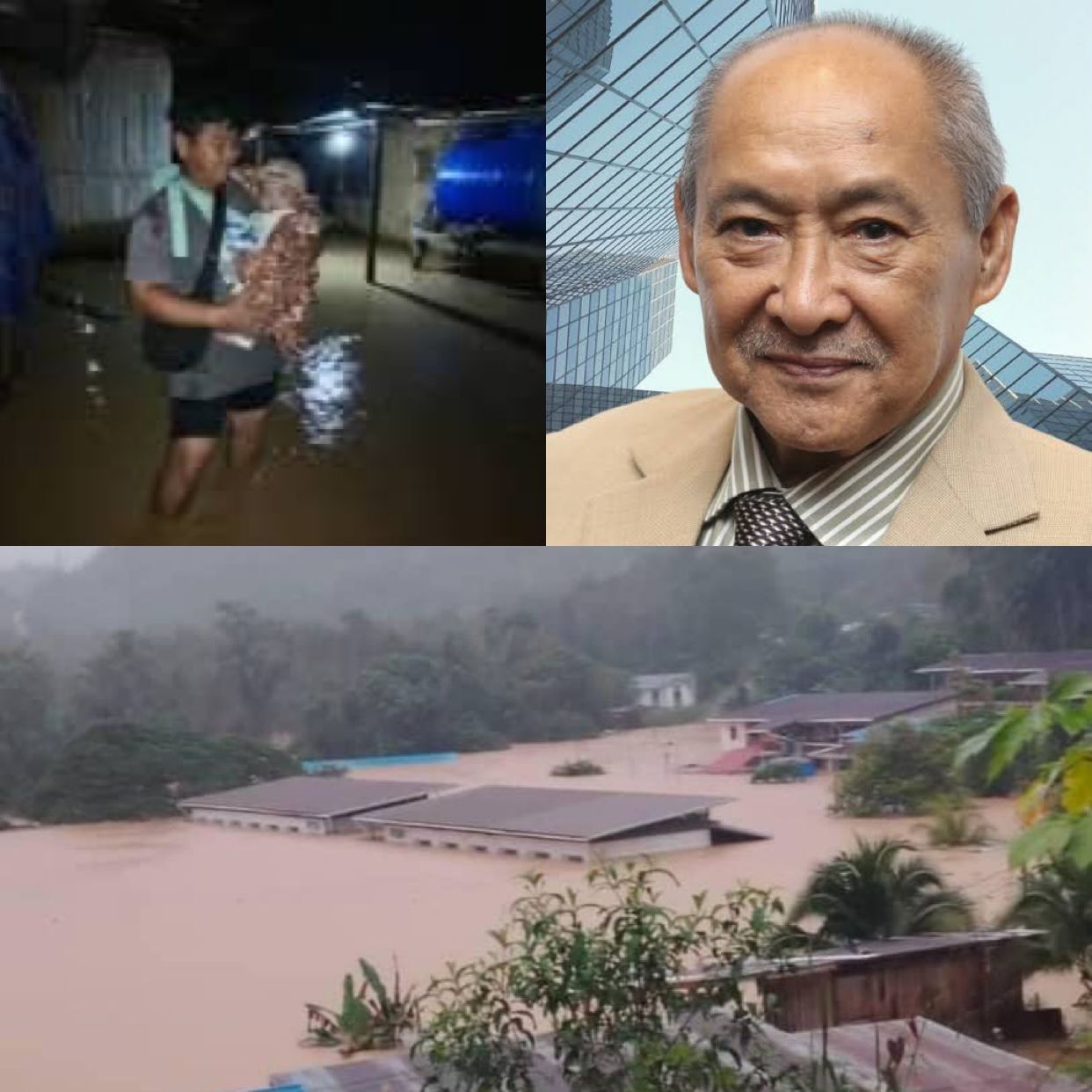
By Datuk Ts Dr. Hj Ramli Amir, former President of the Chartered Institute of Logistics and Transport (CILT) Malaysia and Vice-President of CILT International for Southeast Asia
KOTA KINABALU: Ramadan often arrives not in perfect weather but at the perfect time for the heart. In Sabah this year, the month Muslims call berkat and penuh keampunan walks in quietly over swollen rivers and saturated tanah, as Tenom joins Sook, Sipitang, Beaufort and Membakut in facing yet another round of floods.
Ramadan in the floodwaters
There is a particular kind of silence when you stand near a flooded kampung at night.
You hear only the hum of rescue boat engines, the calling of names in the dark, and the azan from a surau that now doubles as a relief centre.
In Tenom, families who were at home only yesterday now gather in dewan pemindahan, sharing thin tilam and thick worries, while water isolates 140 villages across several districts. In such a setting, Ramadan is no longer a comfortable ritual; it becomes a test of what we truly believe about sabar and tawakkal.
The meaning of “berkat” when life is muddy
We often speak of Ramadan as a month to “top up pahala”, to chase Lailatul Qadr, and to refine individual ibadah.
Yet in times like this, berkat is not just about how long we stand in qiyam, but about how far we extend our hands to those whose rumah, kebun, and memories are now underwater.
Maybe Allah is shifting our focus: from counting personal deeds to counting how many people we can feed at a pusat pemindahan, and how many families we can help rebuild when the water finally recedes.
Forgiveness, in this context, is not an abstract doa after witir—it is the willingness to look at those who are tired, frustrated, even angry at fate, and still respond with service rather than judgement.
A month that asks us to forgive
This “lovely forgiving month” is not lovely because everything feels nice.
It is lovely because it gives us a structured excuse, almost a divine command, to soften our hearts even when circumstances are hard.
For the flood victim who has lost their harvest and household goods yet again, Ramadan offers a language to interpret pain: every tear, every sleepless night on the floor of a hall, every anxious glance at the weather forecast can be turned into ibadah if carried with patience.
For the rest of us, it asks something uncomfortable: can we forgive the slow responses, the bureaucratic hiccups, the human imperfections in disaster management, even as we push for better planning, better drainage, better policies?
Forgiveness here does not mean blind acceptance.
It means choosing not to let bitterness define the narrative of our lives, even as we argue and work for systemic change.
It is possible to write a hard-hitting memo in the morning and still raise our hands in the evening, asking Allah to forgive us first—our neglect, our delays in planning, our tendency to forget vulnerable districts until the waters rise again.
When the surau becomes an ark
During the flood season, houses of worship quietly shift their functions.
Surau, masjid, and community halls in Sabah become modern-day arks, floating not on water but on the spirit of gotong-royong and adab.
In the same space where people line up for iftar, they also queue for relief aid; where sujud touches the sejadah, children sleep side by side, lulled only by the sound of adults whispering doa.
This merging of the sacred and the practical is, in a way, the essence of Ramadan: there is no neat separation between spiritual life and social responsibility.
If a masjid in a safe area prepares more food than it needs, it is not merely sedekah; it is a statement that no district stands alone, that Tenom’s pain is not Tenom’s problem but Sabah’s shared amanah.
When volunteers stand in the rain, helping evacuees step down from lorries, their wet clothes become an unofficial ihram—reminding them that service to people is a pathway to Allah, just as prayer and fasting are.
A gentle rebuke and a gentle hope
These recurring floods are also a gentle, insistent rebuke.
They ask leaders, planners and professionals: how many more Ramadans must be spent in evacuation centres before we take long-term mitigation as seriously as we take our own comfort?
A district like Tenom should not have to feature in the news again and again as the “latest” to be flooded; the phrase itself hints at a pattern we have normalised.
Ramadan, with its call to muhasabah, forces us to admit that disaster is not only about “takdir cuaca” but also about choices—budget priorities, land use, river management, and how we treat upstream forests and downstream communities.
Yet the same month that rebukes also offers hope.
If individuals can drastically change their routines in Ramadan—waking earlier, eating less, praying more—then societies can change their habits too. We can decide that the patience shown in queues at relief centres should be matched by patience in long-term planning discussions, where quick wins are sacrificed for durable solutions.
We can decide that the empathy we feel when seeing images of families on school floors should not fade with the floodwaters but translate into sustained advocacy for safer homes and stronger infrastructure.
Writing our own doa in action.
In the end, the story of this Ramadan in Sabah might not be told through beautiful status updates or viral images of iftar.
It might be told in quieter scenes:
A child in Tenom shares his kuih with another evacuee, despite both having very little.
A teacher in Beaufort is helping students revise in a corner of the dewan, refusing to let their future be put entirely on hold by rising water levels.
A farmer in Sipitang, despite losing another round of crops, still insists on contributing a small amount to the tabung masjid, believing that barakah does not depend on the size of the donation.
Ramadan is the month when the Qur’an was revealed as guidance, but it is also the month when we are invited to respond—to write our own tafsir through our choices and conduct.
In a Sabah where 1,564 people have had to leave their homes, the most honest opinion we can offer is this: a truly “lovely forgiving month” is not one where nothing hurts, but one where hurt is met with organised compassion, principled planning, and a collective decision to keep forgiving, rebuilding and improving long after the waters go down.

