By Datuk Ts Dr. Hj Ramli Amir, former President of the Chartered Institute of Logistics and Transport (CILT) Malaysia and Vice-President of CILT International for Southeast Asia
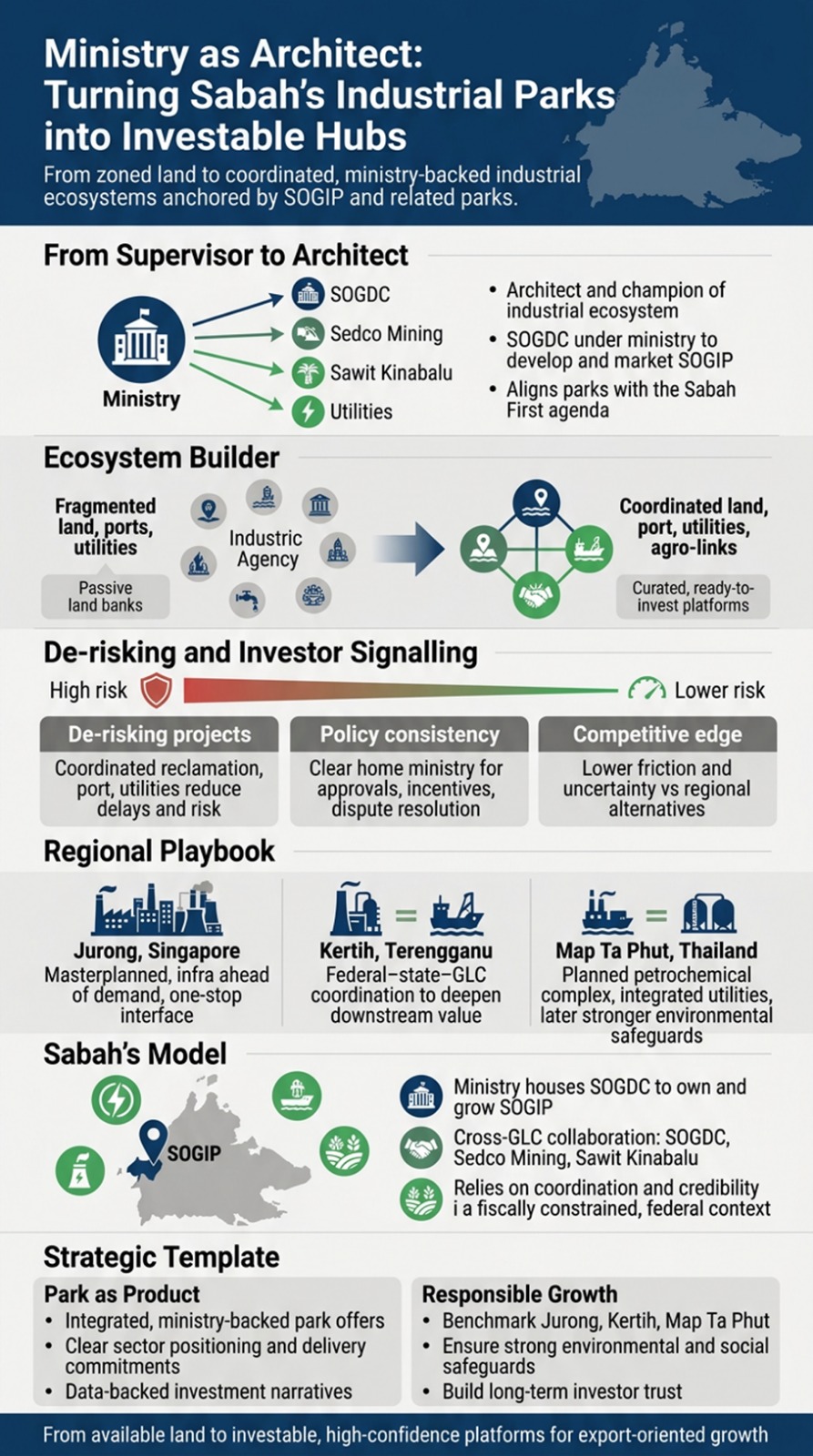
KOTA KINABALU: The Sabah State Ministry of Industry, Entrepreneurship and Transport’s role here is essentially to act as the architect and champion of an investable industrial ecosystem, not just a supervisor of agencies.
Ministry as ecosystem builder
The Ministry (through which SOGDC is placed) sets direction and provides political cover for SOGIP and related parks to become key engines of the “Sabah First” development agenda. In doing so, it:
Mandates coordination among SOGDC, Sedco Mining, and Sawit Kinabalu so that land, reclamation materials, utilities, and port access are planned as a single package rather than in silos.
Uses its convening power to align other technical agencies and utilities around timelines and service standards, echoing national-level calls not to keep investors waiting for basic infrastructure.
This shifts industrial parks from passive land banks to actively curated platforms with credible infrastructure, governance, and support services—critical for capital-intensive oil, gas, and agro-industrial investors.
De-risking and signalling to investors
By publicly backing the SOGDC–Sedco–Sawit Kinabalu collaboration, the Ministry sends a clear signal that these parks are strategic national-level priorities, similar to how other governments elevated their flagship hubs. Its roles include:
De-risking projects: Coordinated reclamation, port development, and utilities planning reduce execution risk and time overruns, improving bankability.
Policy consistency and facilitation: A recognised “home ministry” for SOGIP provides investors with a clear point of contact for approvals, incentives, and dispute resolution.
In effect, the Ministry compresses friction costs and uncertainty into a smaller, more predictable band, which is often the decisive factor when investors compare SOGIP with regional alternatives.
Regional parallels: how others do it
A few instructive comparisons show that Sabah is moving along a well-tested path, though with its own constraints and opportunities.
These cases show that where a ministry (or its agency) clearly “owns” the industrial park agenda, investment flows and complex ecosystems can be built; where ownership is diffuse, parks often stagnate.
The Ministry’s role here is essentially to act as the architect and champion of an investable industrial ecosystem, not just a supervisor of agencies.
Ministry as ecosystem builder
The Ministry (through which SOGDC is placed) sets direction and provides political cover for SOGIP and related parks to become key engines of the “Sabah First” development agenda. In doing so, it:
Mandates coordination among SOGDC, Sedco Mining, and Sawit Kinabalu so that land, reclamation materials, utilities, and port access are planned as a single package rather than in silos.
Uses its convening power to align other technical agencies and utilities around timelines and service standards, echoing national-level calls not to keep investors waiting for basic infrastructure.
This shifts industrial parks from passive land banks to actively curated platforms with credible infrastructure, governance, and support services—critical for capital-intensive oil, gas, and agro-industrial investors.
De-risking and signalling to investors
By publicly backing the SOGDC–Sedco–Sawit Kinabalu collaboration, the Ministry sends a clear signal that these parks are strategic national-level priorities, similar to how other governments elevated their flagship hubs. Its roles include:
De-risking projects: Coordinated reclamation, port development, and utilities planning reduce execution risk and time overruns, improving bankability.
Policy consistency and facilitation: A recognised “home ministry” for SOGIP provides investors with a clear point of contact for approvals, incentives, and dispute resolution.
In effect, the Ministry compresses friction costs and uncertainty into a smaller, more predictable band, which is often the decisive factor when investors compare SOGIP with regional alternatives.
Regional parallels: how others do it
A few instructive comparisons show that Sabah is moving along a well-tested path, though with its own constraints and opportunities.
Several regional experiences underline why a strong ministry-level “champion” is often decisive in turning industrial parks into real investment magnets, rather than just zoned land on a map.
In Singapore, Jurong’s transformation into a world-class industrial hub was driven by a powerful central agency working under a clear ministerial mandate. The government did not simply zone land; it masterplanned the entire area, built heavy infrastructure ahead of demand, packaged incentives, and provided a genuine one-stop interface for investors. This tight linkage between policy authority, land development and investment promotion meant that investors saw Jurong as a coherent, low-risk proposition rather than a patchwork of agencies.
In Terengganu, the evolution of Kertih and its surrounding corridor shows how coordinated leadership can deepen downstream value creation. There, federal and state authorities worked in tandem with major government-linked companies to leverage existing gas and port infrastructure, then layer on new investments in petrochemicals and, more recently, energy transition projects.
The key was that public actors did not work in isolation: they co-invested, co-planned, and sent a unified signal to the market about the region’s long-term strategic direction, giving confidence to capital-intensive investors.
Thailand’s Map Ta Phut industrial estate offers another instructive case. Under the oversight of a dedicated industrial estate authority within the Ministry of Industry, Map Ta Phut was planned as a large petrochemical complex with a deepseaport, integrated utilities and streamlined licensing. This helped attract significant investment and build a dense cluster of related industries.
At the same time, environmental and social controversies later forced stronger governance and safeguards, illustrating that ministerial leadership must balance speed and clarity with robust regulatory oversight to sustain legitimacy and investor trust over the long term.
Seen against these examples, Sabah’s current approach places its Ministry in a similar “architect and champion” role. By housing SOGDC under its wing and visibly backing collaborations with entities such as Sedco Mining and Sawit Kinabalu, the Ministry is moving toward an integrated model in which land, reclamation materials, utilities, port access, and sector positioning are orchestrated as a single package. This is particularly important in a federal and fiscally constrained context, where the State cannot rely on sheer central funding power and must instead rely on coordination, clarity, and credibility as competitive advantages.
In this sense, Sabah is following a proven regional playbook: using strong, coherent ministerial leadership to move industrial parks from being mere geographic locations to being investable, high-confidence platforms for long-term, export-oriented growth.
How Sabah’s approach fits this pattern
Sabah’s Ministry is moving in a similar direction by:
Placing SOGDC directly under its purview and tasking it to own, develop, manage and market SOGIP as a downstream oil and gas platform.
Positioning SOGIP explicitly as a catalyst for energysector-led growth and the broader Sabah First agenda, with ministerial-level messaging to domestic and foreign investors.
Encouraging cross-GLC collaborations (Sedco Mining, Sawit Kinabalu) so that land, industrial platforms, and key materials are coordinated toward common park objectives.
The difference is that Sabah is doing this within a federal system and under fiscal constraints, so it must rely more heavily on GLCs and partnerships than a highly centralised model like Singapore’s. That makes ministerial leadership even more crucial: without a strong “centre of gravity”, each agency would revert to its own priorities, and the industrial park offering would look fragmented.
Strategic implications going forward
From this perspective, the collaboration highlighted is not a one-off MoU, but a template for how the Ministry can systematically:
Turn each major park (SOGIP, SKSIP and others) into an integrated, ministry-backed product with clear sector positioning and delivery commitments.
Benchmark against regional exemplars like Jurong and Map Ta Phut, adopting their strengths (clarity, speed, packaged infrastructure) while avoiding pitfalls (weak environmental safeguards, social pushback).
If the Ministry sustains this role—backed by data, clear investment promotion narratives, and disciplined execution—it can lift Sabah’s industrial parks from “available land” to genuine anchors of highvalue, export-oriented growth in the region.