Pic – AMU TV
BY TENGKU NOOR SHAMSIAH TENGKU ABDULLAH
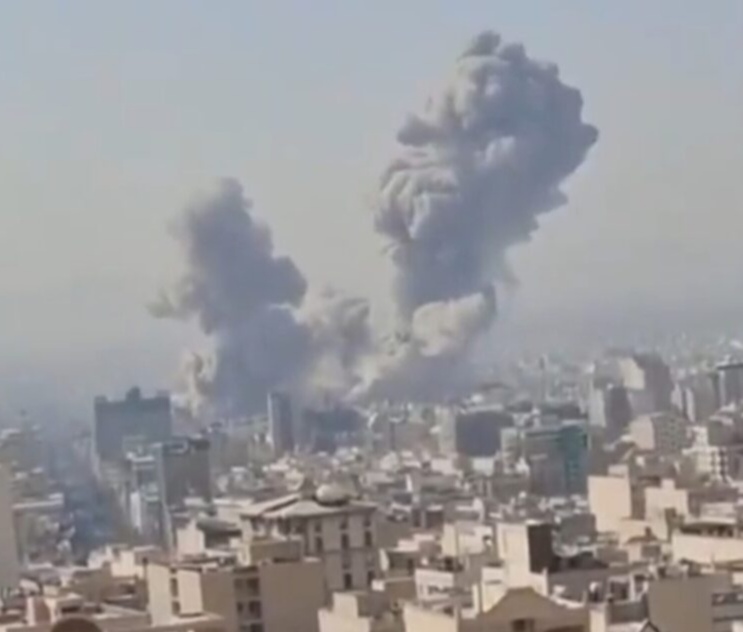
KUALA LUMPUR: In a development that has fundamentally altered the geopolitical landscape of the Middle East, Israel and the United States launched coordinated military strikes against Iran on Saturday morning, with multiple explosions confirmed in the capital, Tehran.
The attacks — described by a US official to Al Jazeera as a joint military operation — represent one of the most consequential acts of state-on-state warfare in the region in living memory, and their reverberations are already being felt far beyond the Gulf.
For Malaysia and the broader Asia-Pacific region, the stakes could scarcely be higher. As a net petroleum exporter and an economy deeply integrated into global trade and shipping networks, Kuala Lumpur finds itself watching this crisis from a position of both opportunity and vulnerability.
THE STRIKES: WHAT WE KNOW
Iran’s Civil Aviation Organization was among the first institutions to respond, shutting down the country’s entire airspace indefinitely. Mobile communications in several parts of Tehran were simultaneously disrupted, raising fears of an impending internet blackout.
Al Jazeera’s correspondent on the ground in western Tehran reported hearing two distinct explosions, while Iran’s Fars news agency identified the Jomhouri area and University Street in the capital as strike locations. Photographs released by international wire services showed thick plumes of smoke rising across the Tehran skyline.
Israel, anticipating a retaliatory response, declared a state of emergency and activated air raid sirens nationwide, ordering citizens to remain near shelter. The Israeli military announced a shift from “full activity” to “essential activity” across the country, entailing the closure of schools, workplaces and public gatherings — spare essential services. The US Embassy in Qatar simultaneously placed all its personnel under shelter-in-place protocols, advising American citizens in the wider region to do the same.
DIPLOMACY THAT CAME TOO LATE
The military strikes follow a near-miraculous sequence of last-minute diplomatic efforts that ultimately collapsed under the weight of mutual distrust and strategic calculation.
Oman’s Foreign Minister, who had been serving as the principal intermediary in indirect negotiations between Washington and Tehran, travelled to the United States as recently as Friday, meeting US Vice President JD Vance in a final attempt to forestall confrontation. Just 48 hours earlier, Muscat had announced that Tehran had agreed in principle to maintain no stockpile of nuclear material — a development that had briefly given analysts reason for cautious optimism.
Those hopes were extinguished within hours. According to Israeli security sources cited by Al Jazeera’s correspondent in West Jerusalem, both Israel and the United States concluded within the past 24 hours that the negotiating track had reached a dead end, with no viable path forward.
Mehran Kamrava, director of the Iranian studies unit at the Arab Centre for Research and Policy Studies and professor at Georgetown University in Qatar, told Al Jazeera that Israel had been working systematically to undermine the US-Iran diplomatic process. In his assessment, Tel Aviv had maneuvered Washington into a position from which it could not withdraw, given the scale of the American military build-up in the region and the sustained political signals given to Israel over the past eighteen months. The result, Kamrava argued, was a situation where US President Donald Trump found himself with no credible off-ramp.
THE STRAIT OF HORMUZ: THE WORLD’S MOST DANGEROUS CHOKEPOINT
Of the many variables now in play, analysts are watching one above all others: the Strait of Hormuz. The narrow waterway separating Iran from the Arabian Peninsula carries approximately one-fifth of the world’s seaborne oil supply — an estimated 20 million barrels per day — along with roughly 20 percent of global liquefied natural gas shipments, according to figures from the Royal United Services Institute and The Washington Institute for Near East Policy.
Iran has periodically threatened to close the strait over several decades but has never acted on those threats, partly because doing so would also sever its own export routes, damage relations with China, its primary oil buyer and violate Omani territorial waters.
However, the calculus may be different this time. With Tehran absorbing a direct and unprecedented military assault on its soil, the political pressure to respond forcefully will be enormous.
The Columbia University Center on Global Energy Policy assessed that in a scenario involving direct kinetic attacks on Iran, Brent crude could jump from the mid-60s to around 80 dollars per barrel in the short term.
If Iranian oil export terminals were targeted or shipping through the Strait were significantly disrupted, prices could surge into the 80-to-100-dollar range or beyond.
Oxford Economics has modelled that a full cessation of Iranian oil exports would reduce global supply by four percent, with Brent likely stabilising near 90 dollars per barrel while a Strait closure could theoretically push prices considerably higher, triggering inflationary shocks across developed and developing economies alike.
A MALAYSIAN ECONOMIST’S ASSESSMENT: MANAGEABLE, FOR NOW
Speaking exclusively to TNS News, Professor Geoffrey Williams, Founder and Director of Williams Business Consultancy Sdn Bhd and one of Malaysia’s most respected independent economists, with decades of experience advising governments, multilateral institutions and corporations across the Asia-Pacific region on macroeconomic policy, trade and business strategy offered a measured and largely reassuring outlook for the Malaysian economy, while flagging key risks that warrant monitoring.
“The attacks in the Middle East will have the same effects as last time,” Prof Williams told TNS News. “They may impact supply chains and shipping routes, but overall there would not be too much impact.”
On the question of bilateral trade exposure, he pointed out that Malaysia’s direct economic ties with Iran are relatively limited.
“Malaysia has total trade with Iran of only RM2.6 billion for 2024 to 2025. This is relatively small,” he said, suggesting that any direct trade disruption would be manageable within the broader context of Malaysia’s diversified external sector.
Prof Williams did, however, identify sanctions as a potential complicating factor. “If the US imposes strict sanctions on Iran, Malaysia may have to follow suit,” he cautioned a scenario that would require careful navigation given Malaysia’s longstanding policy of maintaining balanced international relationships.
On the energy front, he noted that rising oil prices already up more than 12 percent over the past month and approaching 70 dollars per barrel present a net positive for Malaysia as a petroleum-exporting nation. “There may be an impact on oil prices which have risen more than 12% in the last month. This would benefit Malaysia as an oil exporting country. Already oil is heading towards $70 per barrel. It might go higher, which is good for Malaysia as an oil exporting country,” he said.
Markets across Asia are expected to open under significant pressure when trading resumes. Gold and the US dollar will command a safe-haven premium, while regional equity benchmarks — already navigating the headwinds of US tariff policy and global monetary uncertainty — face renewed turbulence.
WHAT COMES NEXT
The immediate question is how Iran responds. Tehran has a range of instruments at its disposal, from direct missile retaliation against Israeli or American assets to asymmetric pressure on Gulf shipping. The pace and nature of its response will determine whether this episode becomes a contained, if devastating, military exchange or the opening chapter of a broader regional confrontation.
What is already clear is that the world entered a fundamentally different strategic environment on the morning of February 28, 2026.
The diplomatic architecture painstakingly constructed to prevent this moment has, for now, been swept aside. The task of rebuilding it and containing the damage now falls to the international community under conditions of maximum uncertainty.
Source – TNS News