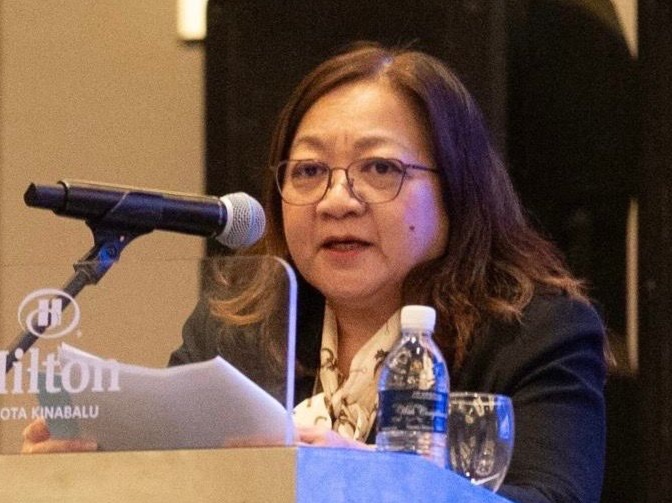
KOTA KINABALU: The Sabah Government today called on Non-Governmental Organizations (NGOs) and voluntary welfare bodies to renew approaches and shift towards strategic, evidence-based programming to ensure the financial sustainability and high impact of social services.
The call was made by Datuk Maria Chong, Permanent Secretary of the Sabah Ministry of Women, Health, and People’s Wellbeing, during her keynote address at the inaugural Social Services Networking Forum 2025 organized by the Sabah Council for Social Services (MPMS) in collaboration with the UMS-UNICEF Communication for Development (C4D) Research Unit at Hilton Kota Kinabalu.
Chong highlighted that the current challenges facing voluntary welfare organizations revolve around financial sustainability and operational management. Many rely on limited traditional funding sources, and their ability to secure larger funding is often hampered by issues of trust and transparency.
“Social service NGOs need to start thinking seriously about evidence-based programming that allows for effective implementation and monitoring of activities. Data that shows impactful programs convinces donors to provide future funding,” she said.
To overcome hurdles, Chong presented several key recommendations, including strategic collaboration and volunteer engagement, in line with the theme of the forum, “Bridging Efforts, Strengthening Communities.”
“NGOs must seek synergy by ending internal competition and engaging in strategic collaborations. Collaborative projects are seen as more effective and are more likely to secure funding confidence from corporate donors.
“To ensure future survival, NGOs must attract and retain young volunteers. A key strategy proposed is establishing mentorship programs that offer young volunteers the chance to lead small projects, fostering a crucial sense of ownership and appreciation,” she said.
Chong outlined active and healthy aging, positive parenting and child protection, and empowerment of persons with disabilities as immediate issues requiring collaborative focus.
She said Sabah was projected to become an aged society by 2029, and concerted efforts are needed to ensure the elderly live actively and with dignity. Meanwhile, strengthening family institutions through continuous support, knowledge, and robust parenting skills is crucial to reduce the risk of neglect and abuse.
Chong said society must shift its mindset from viewing persons with disabilities as aid recipients to individuals with the potential to contribute, focusing on relevant skills training, entrepreneurship, and eliminating physical and social barriers.
Sabah Welfare Services Director Jais Asri, in his welcoming speech, urged participants to forge new collaborative efforts, particularly in volunteer coordination, sharing of best practices, and development of effective community programs.
“I hope this forum enriches us with knowledge and opportunities for collaboration,” Jais said.
Some 120 speakers and participants took part in the forum. Also present were MPMS Executive Secretary Joeanne Lee, UMS-UNICEF C4D Research Unit head Dr. Latif Lai, and UNICEF Programme Specialist Sabah Dr. Elaine Kong.